Companies invest millions in AI – and fail because their data estate, the data architecture, has not grown with it. Algorithms and models are worthless if they are based on incomplete, unstructured or contradictory data. The result: inaccurate forecasts, wrong decisions, compliance risks – and lost investments.
What is a data estate?
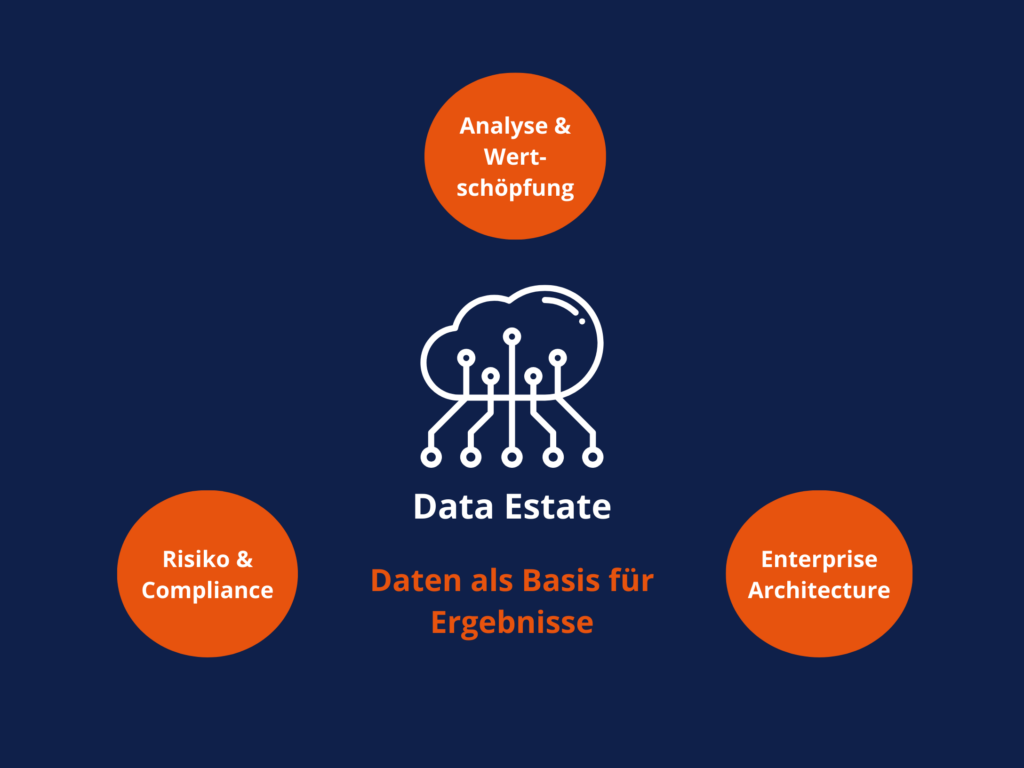
A data estate describes the entirety of all data assets, sources and infrastructures of a company – integrated, managed and scalable. In contrast to individual data silos or a classic data warehouse, a data estate includes all data, whether structured or unstructured, from specialist departments, processes or external sources.
The crucial difference is that while data silos exist in isolation and can only be used selectively, a data estate creates a common, consistent architecture that centralizes and standardizes access to information. As a result, data is not only stored, but also linked, classified and made available in a controlled manner – the prerequisite for modern AI applications to work reliably.
Why your own data estate is indispensable in the AI age
AI only works as well as the data it uses. If you want to survive in the competition, you need a reliable, controlled database.
-
Data Quality & Governance: AI needs reliable, consistent data.
-
Speed: Quick access to relevant data accelerates decisions.
-
Security & Compliance: Especially indispensable in regulated industries.
-
Scalability: From initial use cases to enterprise-wide AI implementations.
If you don’t control your data, you don’t control your AI results.

How Microsoft provides the ideal basis
The Microsoft Cloud offers the building blocks to build a data estate quickly and sustainably – with seamless integration into Modern Work (Microsoft 365) and Business Applications (Dynamics 365):
-
Azure Synapse Analytics – Centralized Data Integration & Analytics
-
Microsoft Fabric – End-to-End Data Platform
-
Azure Data Lake – Scalable data storage
-
Microsoft Purview – Governance & Compliance
-
Power BI – Visualization & Self-Service Analytics
This creates an end-to-end architecture that connects data, processes and users – without media discontinuities, without isolated solutions.
4 steps to your own data estate in the Microsoft Cloud
-
Inventory: Where is data, in what format, in which systems?
-
Consolidation & Architecture: Bring data into scalable, cloud-native structures.
-
Governance & Security: Set access, policies, compliance.
-
Integration & Use: Make data available for AI, analytics and operational processes.
Your competition has been building for a long time – are you helping to build?
AI is not a magic booster – it only reinforces what is already there. If you have chaos, you get faster chaos. If you have a solid data estate, you will get faster success.
Competitors are building their data architecture today in order to make decisions more precisely, faster and more securely tomorrow. Waiting means losing touch.
👉 Let’s work together to create the basis on which your AI not only works, but works – talk to us.