Many companies today no longer want to look at their data only in dashboards. They want to ask questions. What is our pipeline really like? Which projects are running out of budget? Which customers have upsell potential? Which teams are overloaded?
With Microsoft Fabric Data Agents and Copilot, this way of working becomes more realistic. Business users can work with data sources in natural language instead of clicking through reports, tables, and model structures. Microsoft describes Fabric Data Agents as a commonly available capability that enables organizations to build conversational Q&A systems based on data in OneLake, Lakehouses, Warehouses, Power BI Semantic Models, and KQL databases.
That sounds like a big step forward. And it is. But only on one condition: the data must not only be accessible. They must be understood in business terms.
Why dashboards are no longer enough
Dashboards usually answer questions that someone has defined in advance. Data agents change this logic. They are supposed to answer spontaneous questions, explain connections and provide decision-making support.
This is particularly interesting for project-based companies, professional services, healthcare organizations and growing B2B companies. This is exactly where crucial information is often distributed: CRM data, project data, financial data, service histories, time bookings, offers, forecasts, documents and e-mails.
A dashboard can show that a project is red. A data agent is supposed to explain why it is red, which cost items are affected, which resources are missing and which customer communication was relevant to this.
For this, AI needs more than table access. It needs meaning.
The real problem: Each department speaks a different data language
Many companies do not have a pure data volume problem. They have a problem of meaning.
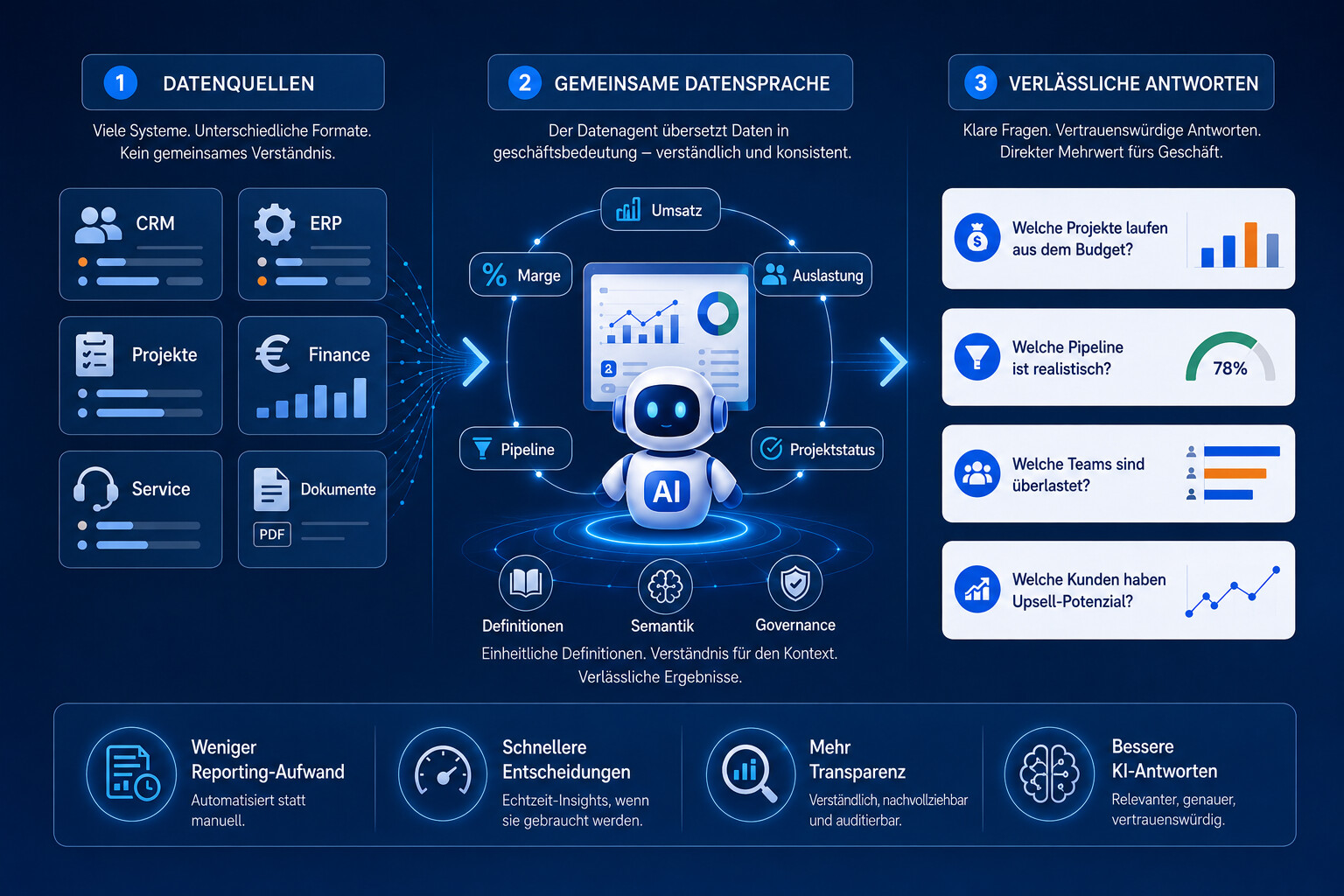
Sales talks about pipeline. Finance talks about Forecast. Operations talks about utilization. Project management talks about residual effort. Management talks about margin. All of them use seemingly familiar terms. But often these terms are not uniformly defined.
When is a project out of budget? Do planned, booked or invoiced hours count? What is a realistic pipeline? By Opportunity Stage, Closing Probability or Commit Forecast? What does customer value mean? Sales, contribution margin, contract duration or strategic potential?
As long as these terms are used differently depending on the department, a data agent can provide an answer. But this answer is not automatically reliable.
| Business Question | What needs to be clarified beforehand |
|---|---|
| Which projects are running out of budget? | Budget logic, posted times, remaining effort, forecast and cost elements |
| Which customers have upsell potential? | CRM data, project status, service history, revenue, and customer segment |
| Which pipeline is realistic? | Sales stage, probability, close date, and forecast category |
| Which teams are overloaded? | Capacity, absences, project assignment, and planned utilization |
| Which processes cause the most costs? | Process data, financial data, time spent and responsibilities |
Without a common data language, there is no real transparency. It only results in faster responses to improper definitions.

Why Semantics Is Now Becoming Strategic
Gartner clearly warns against neglecting semantics in 2026. According to Gartner, a lack of semantics leads to AI agents becoming inaccurate and inefficient, wasting money and creating additional risks for data and AI governance. Gartner also cites semantics as a key trend for data and analytics because AI agents need reliable meaning, context, and rules.
That’s the key point: Data agents don’t just need data access. You need a semantic understanding of what metrics mean, how terms relate and what rules apply.
A semantic model is no longer just a technical issue for BI teams. It becomes the basis for whether AI can provide reliable answers in the company.
What a common data language means in concrete terms
A common data language does not mean that every department loses its perspective. It means that central terms, key figures and relationships are clearly defined.
When sales, finance, and management talk about revenue, it must be clear whether they are referring to posted revenue, invoiced revenue, ARR, order receipt, or forecast. When project teams talk about occupancy, it must be clear whether it is about planned capacity, billable time, actual bookings or availability.
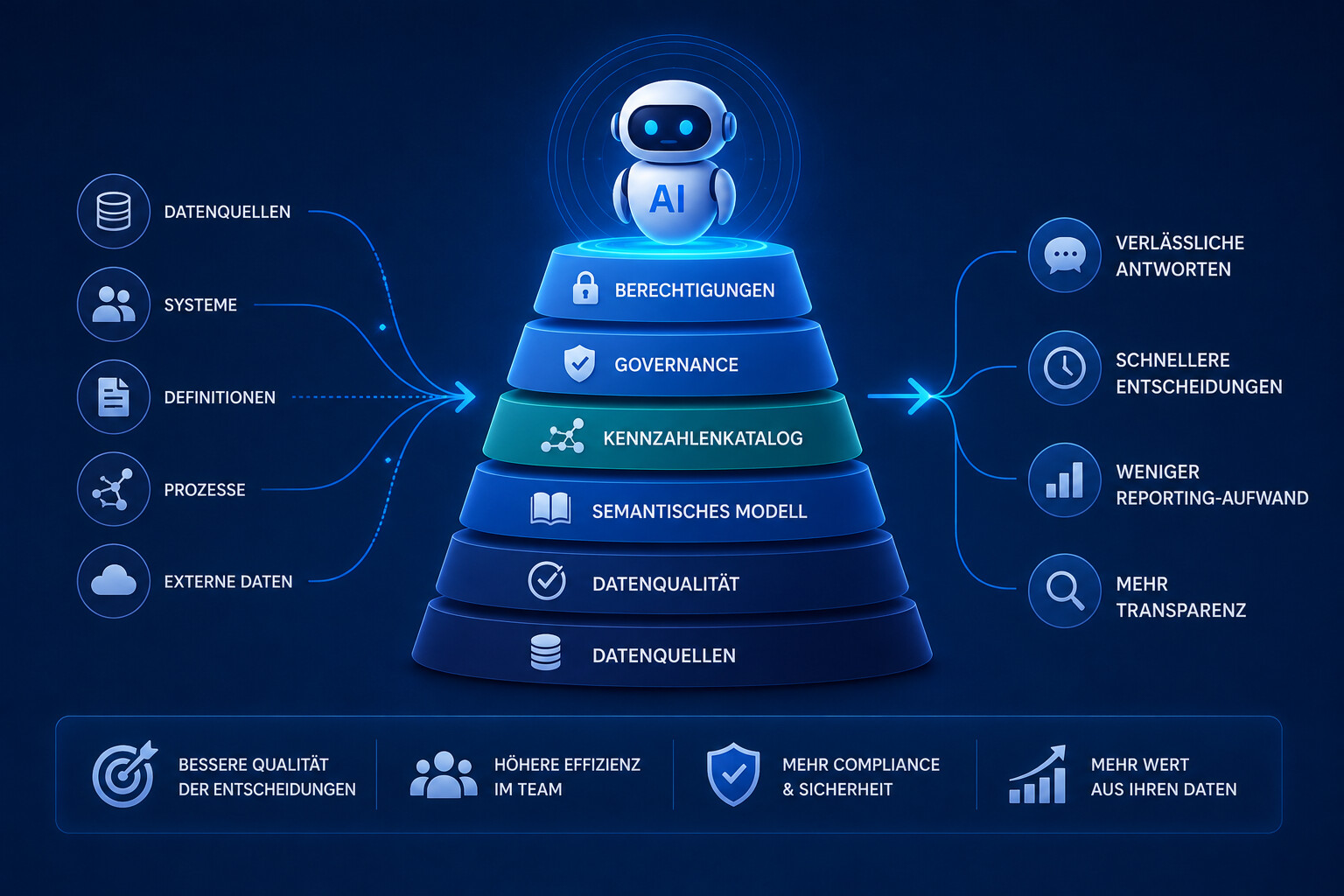
To do this, companies usually need five basics:
of key figures
| Basis | Purpose |
| Catalogue | Central definitions for revenue, margin, pipeline, utilization, or project status |
| Data Responsibility | Clear ownership of data quality, definitions, and changes |
| Semantic Models | Uniform logic for reports, agents and analyses |
| Authorization concept | Secure use based on role, area and data class |
| Governance and Monitoring | Control whether answers remain comprehensible and trustworthy |
These basics sound less exciting than a new co-pilot. But they decide whether Copilot will really be useful in business.
Microsoft Fabric Data Agents as a new gateway to enterprise data
Microsoft Fabric Data Agents make the next step visible. Data should not only be consumed in reports, but should also be accessible via natural language. Microsoft describes Data Agents as a conversational analytics component that can be connected to governed data in OneLake and uses lakehouses, warehouses, semantic models and KQL databases, among other things. Purview governance policies and permissions also continue to apply when data agents are used through Microsoft 365 Copilot.
This is relevant for companies because data work is moving closer to everyday work. A manager doesn’t need to know which report contains the right metric. A project manager doesn’t need to know every data source. A manager can ask questions and get orientation more quickly.
But that’s exactly why responsibility is increasing. As data agents become more widely used, data models, definitions, and permissions need to be cleaner than before. This is because incorrect or inconsistent answers then also scale faster.
Why this is especially important for complex organizations
In simple organizations, data logic is often manageable. In more complex companies, it is not.
Project-based companies need to connect project status, utilization, budgets, forecasts, and margin. Healthcare organizations work with sensitive data, complex processes, and high governance requirements. B2B companies with scaling processes need to bring CRM, marketing, service, finance and operations together.
In such environments, a single dashboard is rarely enough. The real challenge is to make data capable of making decisions across functional boundaries.
A data agent can be of great use here. It can help managers to recognize connections more quickly. It can relieve operational teams by reducing the need for manual evaluations. It can democratize data access without giving every user direct access to every table.
But the data agent is not the beginning. It is the result of a cleanly prepared database.
How companies should start
A good start doesn’t start with the question of which AI function can be activated. It starts with the most important business questions.
Which decisions take too long today? Where do manual reports occur? Which key figures are regularly discussed because no one is sure which number is correct? What data does management really need to better control projects, pipelines, finances or customers?
After that, companies should not immediately connect all data sources. A clear use case with high business value is better.
Business Questiontermsdata sourcesBuildpermissionsyour agent
| Step | Objective |
| Select | for example, project profitability, pipeline quality, or customer segmentation |
| Define | Create common logic for key figures and states |
| Check | Identify relevant systems, data quality, and gaps |
| a semantic model | Harness unified business logic for analytics and agents |
| Clarify | Ensure users only see the right data |
| Try | Validate and improve responses with business units |
| Scale | Gradually add further data areas and questions |
The result is not a technical experiment, but a data-driven entry with clear benefits.

Conclusion: AI needs more than data access
Data agents in the company are an important step. They make data more accessible, more natural and closer to everyday work. But they do not automatically solve the basic problem of many organizations.
If revenue, margin, utilization, project status or customer value are understood differently, even the best agent does not provide a reliable basis for decision-making. It only makes it visible that the common data language is missing.
The next competitive advantage is therefore not only to introduce Copilot or Fabric Data Agents. It lies in preparing data in such a way that AI really understands the business.
If you create a common data language, you get more than better reports. It lays the foundation for reliable data agents, faster decision-making, and productive AI in the enterprise.
FAQ
What are enterprise data agents?
Data agents are AI-powered systems that allow users to ask questions about company data in natural language. You can leverage data sources such as lakehouses, warehouses, semantic models, or analytics models to provide answers and insights.
Why is data access not enough for AI?
Data access only means that a system can read data. To provide reliable answers, AI also needs context, definitions, rules, permissions, and a common understanding of key business terms.
What does common data language mean?
A common data language describes uniform definitions for key figures and terms such as revenue, margin, pipeline, project status, utilization or customer value. It ensures that departments do not work with different meanings of the same terms.
Why is semantics important for AI agents?
Semantics gives data meaning. It helps AI agents understand how metrics, terms, and business logic are related. Gartner warns that a lack of semantics can make AI Agents inaccurate and inefficient.
What is the role of Microsoft Fabric?
Microsoft Fabric can bring together data from different sources and make it conversationally usable with data agents. Fabric Data Agents can work with OneLake, Lakehouses, Warehouses, Power BI Semantic Models, and KQL databases, among others.
How do companies get started with data agents?
The best way to start is with a concrete business question with high benefits. After that, terms, data sources, authorizations and semantic models should be clarified. Only then should a data agent be productively tested and expanded.