


AI agents are considered the next evolutionary stage in automation: they act autonomously, learn from contexts and can be flexibly embedded in business processes. Creating an AI agent sounds abstract at first and it can be difficult to find a good way to get started. Therefore, here we want to break down which platforms are best suited for this and why.
We compared four leading solutions: Azure AI Foundry, Make, n8n , and Relevance AI. This was not just about classic criteria such as user interface or integrations – but about real applicability in the corporate context and the question: Which platform supports you in establishing AI agents as part of your business solutions in the long term?
What is an AI Agent platform anyway?
At its core, it’s about more than simple automation. AI Agents…
-
act purposefully,
-
integrate into complex system landscapes,
-
leverage LLMs, APIs, data sources, and tools simultaneously
-
and can be integrated into larger business processes as reusable building blocks.
The decisive difference to classic automation platforms lies in the ability to plan, adapt and make decisions independently.
Four platforms – four philosophies
| Category | Azure AI Foundry | Make | n8n | Relevance AI |
|---|---|---|---|---|
| Focus | Enterprise agents in the Microsoft ecosystem | No-code workflows for business teams | Open source automation for developers | Insight-driven AI agents |
| Agent Skills | 🟢 Tools, Memory, Multistep Reasoning | ❌ Linear logic | ❌ No real agent model | 🟢 Agent Orchestration & Feedback |
| LLM Integration | 🟢 Azure OpenAI, Cognitive Services | 🟡 HTTP API for GPT | 🟢 OpenAI, HuggingFace, Azure | 🟢 Native LLMs + Vector Databases |
| API/JSON Handling | 🟡 Intended | 🟢 Visual JSON Mapping | 🟢 Powerful API Flows | 🟡 Focus on Prompt & Code |
| Scalability | 🟢 DevOps, Testing, Access Control | 🟡 Scenario Level | 🟢 Modular, Git-compatible | 🟡 SaaS-only, limited embedding |
| Enterprise Fit | 🟢 Governance, Multi-Tenant, Access Zones | ❌ No governance layer | 🟡 Self-hosted possible | 🟡 Good AI, but not a complete platform fit |
Our assessment: What is the best way to create an AI agent?
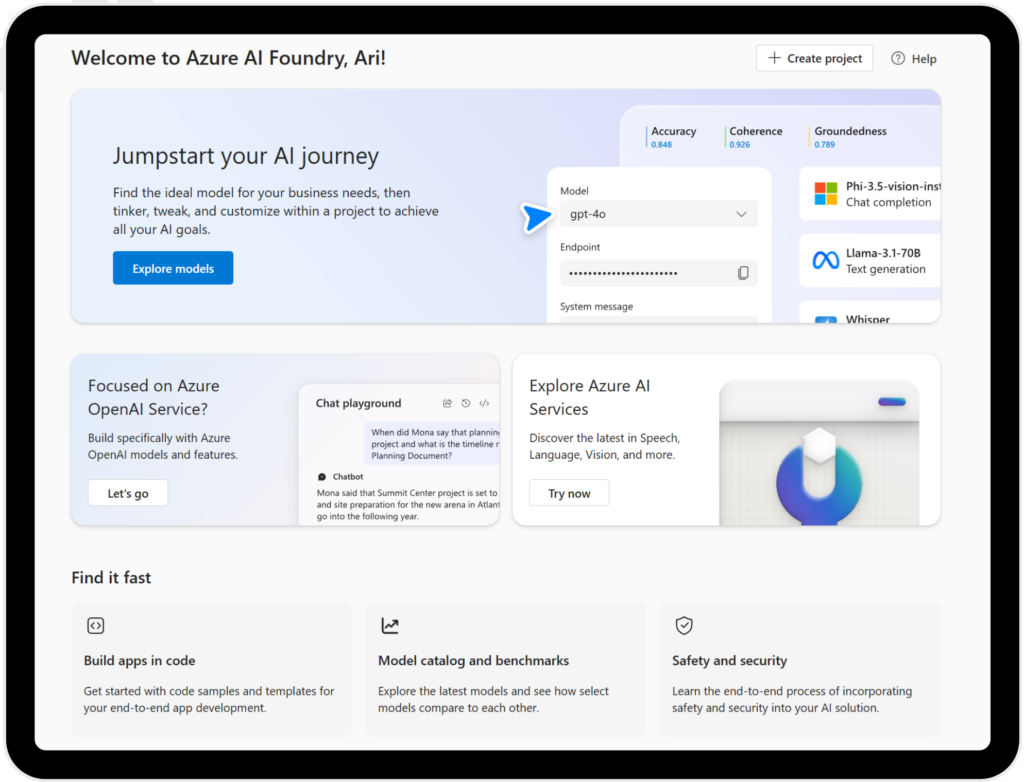
Azure AI Foundry
For organizations looking to strategically embed AI agents into Microsoft technologies, Azure AI Foundry is the strongest candidate. From Copilot Studio to Power Platform to Dynamics 365 – agents can be orchestrated securely and at scale. Governance, lifecycle management and multi-tenant capability included.
Limits: Still in development, technical UX, primarily for developers.

Make
If you want to automate simple processes – e.g. in marketing, HR or support – Make is an excellent no-code solution. JSON handling, API connections and visual mapping are intuitively implemented.
Borders: No agent model, no enterprise architecture, limited reusability.
n8n
Open-source, flexible, developer-friendly – n8n convinces with strong API logic and custom code capabilities. Especially as a sidecar solution for specific agent processes, n8n can be meaningfully integrated.
Borders: No native agent focus, lack of governance features.
Relevance AI
Ideal for insight-driven agents, e.g. in customer service or product feedback. Relevance AI combines LLMs, vector data and agent control in a lean interface – but with a focus on special cases.
Borders: Not designed for broader business architectures or deep integration with business suites.
Conclusion: Being able to create an AI agent will be critical for survival for companies – but not every platform is made for it
If you are seriously thinking about scalable, testable and controllable agents in a corporate context, you should not be blinded by a simple interface or short-term use case. The decisive question is:
Can I maintain, update, test, and evolve this agent later as part of my solution—just like any other enterprise module?
If the answer is yes, Azure AI Foundry is currently the most promising candidate – especially for companies in the Microsoft environment. If you want to get started faster with smaller use cases, you will find interesting alternatives in Make, n8n or Relevance AI. But real business maturity only emerges with structure, governance and platform strategy.
You don’t just want to try out AI agents, you want to use them strategically?
As a Microsoft partner for Data & AI, we support you in getting started – from tool selection to architecture consulting and implementation. Contact us for an individual assessment.


