Many HR departments are currently under pressure, without it always being openly expressed. Budgets are examined more closely. Attitudes are questioned. At the same time, the expectations of HR to deliver well-founded decisions are increasing. In this situation, a topic that has long been considered more of a reporting discipline is coming more into focus: HR analytics. But more data alone won’t solve the problem. Many organizations today have extensive people data. What is often lacking is the ability to derive reliable decisions from this. This article shows why HR analytics is gaining in importance right now, where typical weaknesses lie and what HR needs to clarify in concrete terms so that data actually becomes relevant for action.
Why HR Analytics Is Crucial Right Now
In economically tense phases, the demands on HR change noticeably. Decisions are questioned more critically, measures must be justified and at the same time the room for manoeuvre remains limited. As a result, HR is taking on more responsibility than before to set priorities.
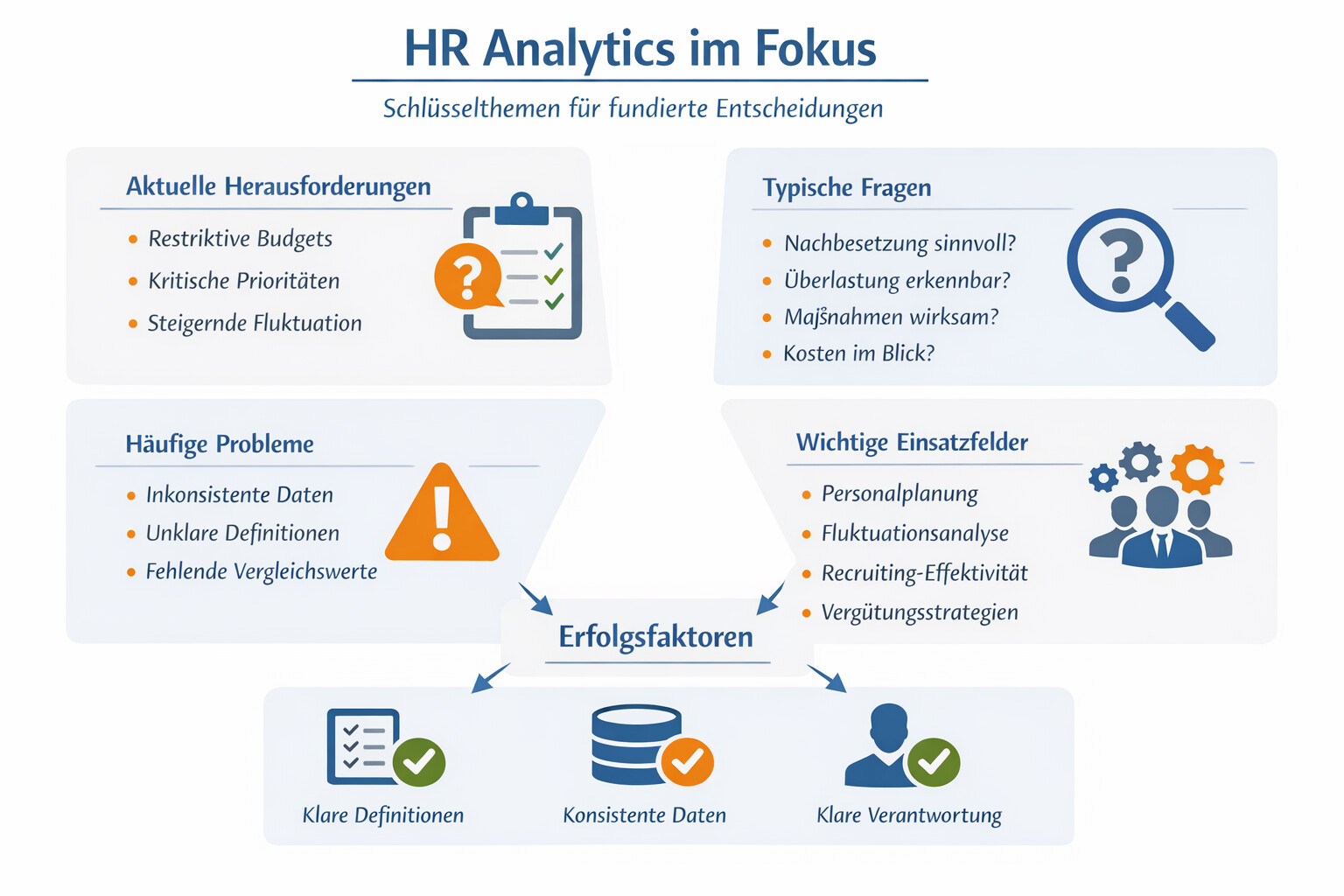
Typical questions that are currently gaining in importance are, for example:
- Should a position really be filled or can it be absorbed internally
- Which areas are structurally overloaded and where are hidden capacity reserves?
- Which measures for employee retention are actually effective
- How do cost structures develop in relation to performance?
Questions like these can no longer be answered qualitatively alone. They require a reliable data basis and, above all, a clear classification.

Where HR analytics often fails in practice
Many companies already have dashboards, reports and key figures. Nevertheless, uncertainty arises as soon as concrete decisions have to be made. This is rarely because data is missing, but because it is not used consistently.
A typical pattern is that key figures are interpreted differently. What exactly is meant by fluctuation is often not clearly defined. Different areas work with their own logics, data sources are not properly integrated and comparisons lose their significance as a result.
Another problem is the lack of classification of numbers. An eight percent turnover rate can be stable or critical, depending on the context. Without comparative values, target values or historical development, each key figure remains isolated and difficult to interpret.
In these cases, HR analytics fails not because of the amount of data, but because of a lack of structure.
What HR Analytics Needs to Do
HR analytics only fulfills its purpose when it supports decisions. This means that data is not only collected and visualized, but also answers concrete questions.
Typical decisions that should be supported by HR analytics are:
- Prioritization of hires and replacements
- Identification of areas with increased risk of fluctuation
- Evaluation of the effectiveness of HR measures
- Control of capacities and utilization
Answering these questions requires more than a reporting setup. Clear definitions, consistent data and a common decision-making logic are crucial.
Strengths and limitations of HR analytics in practice
| Dimension | Strengths | Boundaries |
|---|---|---|
| Basis for | Supports traceable and data-driven decisions | Dependent on data quality and definitions |
| Transparency | Makes developments and patterns visible | Can lead to misinterpretations without context |
| Comparability | Enables benchmarks and internal comparisons | Comparative values are often not standardized |
| Control | Supports prioritization of actions | Only works if decisions are actually based on it |
| Acceptance | confidence in HR decisions | Decreases when numbers are not comprehensible |
Typical fields of application of HR analytics
HR analytics is not an isolated discipline, but is closely linked to operational decisions. In practice, this is particularly evident in the following areas:
- Personnel Requirements Planning and Capacity Management
- Fluctuation and retention analysis
- Evaluation of recruiting processes
- Development of remuneration structures
- Derivation of further training needs
These areas of application make it clear that HR analytics not only describes what happened, but also helps to decide what should happen next.
The real challenge: definition and responsibility
The biggest challenge is rarely in the technology. It lies in the question of how key figures are defined and accounted for. Without clear definitions, different interpretations emerge that relativize any analysis.
Central questions that often remain unanswered are:
- What exactly is measured and what is not
- Which data source is considered authoritative
- Who is responsible for the quality of the data
- What definition applies company-wide
If these questions are not answered unambiguously, parallel truths arise. As a result, HR analytics exists, but is not accepted as a basis for decisions.
What HR should clarify now in concrete terms
To make HR analytics decision-making, organizations need to clarify a few basic points. These are less technical than organizational and decide whether data actually has an effect.
Key aspects are:
- Which decisions should be supported by HR data
- Which key figures are relevant for this and how they are defined
- What data sources are used and how consistent they are
- Who is responsible for data quality and definitions
These questions seem simple at first glance, but in practice they are often not clearly clarified. This is exactly where it is decided whether HR analytics ends up as reporting or acts as a control instrument.
Conclusion
HR analytics doesn’t become more important because more data is available. It is becoming more important because decisions have to be made under pressure and should be more justified. Organizations that clearly define their key figures, structure data consistently and define responsibility create a basis for reliable decisions. It is no more data that makes the difference, but the ability to classify it in a meaningful way. HR analytics is therefore less a tool topic and more a question of clarity.