HR automation is currently being intensively discussed in many organizations. The use of artificial intelligence in HR in particular raises high expectations. However, not every HR process can be meaningfully automated. While some tasks benefit greatly from digital systems, others continue to be shaped by human assessment. The crucial question is therefore: Where does HR automation create real added value – and where not?
Why HR automation is currently being discussed
The discussion about HR automation is not a short-term trend. It arises from several structural developments in organizations. A key driver is the increasing complexity of HR processes. Recruiting, training, performance management and compliance generate a large number of administrative tasks. Many HR departments spend a significant amount of their time on operational activities. At the same time, management and departments expect more data-based decisions. HR should not only manage processes, but also actively contribute to the management of organizations.
Several factors increase this pressure:
- Increasing requirements for reporting and transparency
- Increasing shortage of skilled workers
- Increasing regulatory requirements
- Growing expectations for data-based HR management
This creates an area of tension. On the one hand, the need for strategic HR work is increasing. On the other hand, administrative processes continue to tie up large resources. This is where the idea of HR automation comes in. If recurring tasks can be automated, there is room for analytical and strategic activities. Technologically, however, a lot has changed in recent years. Modern HR systems integrate workflow automation, self-service capabilities, and analytics tools. At the same time, the use of artificial intelligence HR is increasingly being discussed. These technologies enable new forms of process support. However, they do not automatically solve the structural challenges of HR.
What is actually meant by HR automation
In order to make sensible decisions, a clear definition is first required. HR automation basically refers to the automated execution of HR processes or process steps by digital systems. Several levels can be distinguished. A first form is classic process automation. Here, clearly defined processes are digitally controlled. Typical examples are approval processes, contract documents or onboarding workflows.
A second level concerns self-service functions. Employees or managers can perform certain tasks themselves.
Typical examples are:
- Master Data Changes
- Leave requests
- Access to HR reports
- Document retrieval
This reduces administrative work in the HR team. A third level is created by data-based analyses. HR Analytics makes it possible to systematically evaluate HR data and identify patterns. Artificial intelligence HR only comes into play at the next level. Here, algorithms support decisions or automate certain evaluations. The levels can be distinguished in simplified terms as follows:
| Level | Description |
|---|---|
| Process automation | Digital workflows for clearly defined HR processes |
| Self-service | Employees perform simple HR tasks themselves |
| HR Analytics | Analysis of personnel data |
| Artificial Intelligence HR | Algorithmic support for analysis and forecasting |
Many projects are described as AI initiatives, although they actually represent classic process automation. For organizations, this differentiation is crucial. It helps to understand which problems can actually be solved by automation.
Where automation in HR actually makes sense
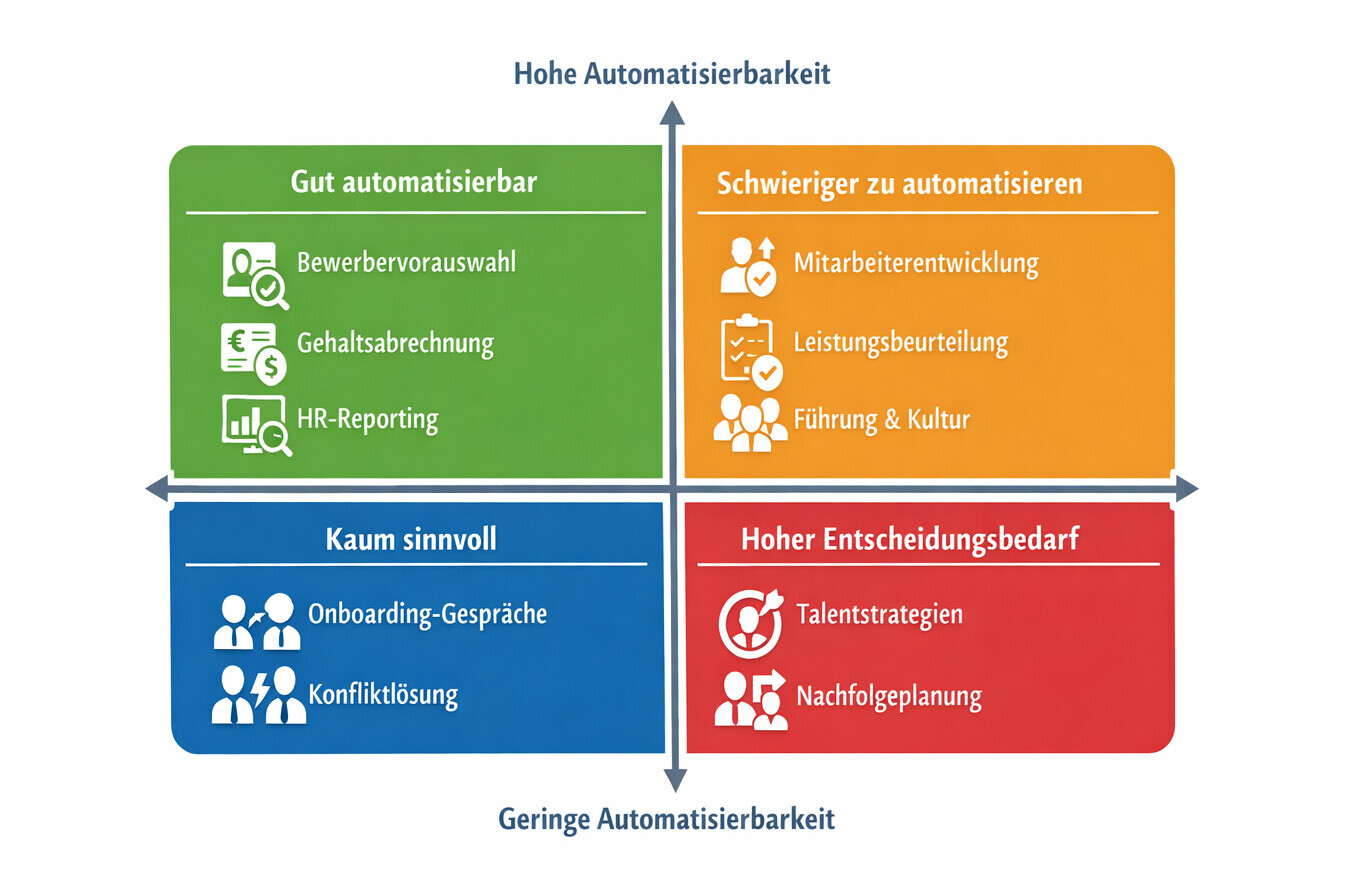
HR automation unfolds its greatest benefit where processes are clearly structured, repeatable and rule-based. A typical example is administrative support in recruiting. Making appointments, communicating with candidates or collecting application documents often follow clearly defined processes. Here, digital systems can take over a significant part of the work. Document creation is also one of the areas with high automation potential. Employment contracts, amendment agreements or certificates are usually based on standardised templates.
Typical HR processes with high automation potential are:
- Scheduling in recruiting
- Applicant communication
- Contract documents
- Onboarding workflows
- HR Reporting
Another field is reporting. Many organizations regularly create HR key figures on fluctuation, recruiting duration or absences. If data is available in a structured way, these reports can be generated automatically. In addition, artificial intelligence can help HR analyze large amounts of data. Algorithms can, for example, recognize patterns in application processes or provide indications of structural developments. It is important that such systems have a supportive effect. They provide information or structure processes, but do not automatically make strategic decisions. Especially in large organizations, these forms of HR automation can bring significant efficiency gains. They reduce operational burden and at the same time improve the database for HR management.
Where artificial intelligence in HR reaches its limits
Despite this potential, HR automation is reaching clear limits in many areas. A central reason lies in the nature of many HR decisions. HR issues are rarely purely data-based. They always include context, experience, and organization-specific assessments. One example is employee development. Decisions about career paths, coaching or further training depend heavily on individual factors.
Algorithms can analyze data, but they don’t automatically understand:
- Cultural dynamics in teams
- Individual motivations
- informal organisational structures
- Leadership context
The same applies to performance evaluations. Many organizations are trying to make performance management more data-based. Nevertheless, evaluations always remain associated with subjective assessments. Questions of leadership culture cannot be automated either. Topics such as motivation, conflict resolution or team dynamics arise from social interactions. Another risk is the apparent objectivity of data. If organizations delegate decisions too much to algorithmic recommendations, existing biases can even be amplified. Artificial intelligence HR should therefore be understood primarily as an analysis tool. It can make patterns visible, but it does not replace the responsibility of managers and HR.

Typical misconceptions about HR automation
Many discussions about HR automation are characterized by simplified expectations. These misunderstandings often lead to disappointed projects. A common assumption is that automation basically replaces HR work. In practice, however, it mainly changes the structure of tasks.
Typical changes are:
- Fewer administrative activities
- Greater focus on analysis
- more advice for executives
- Greater importance of HR data
A second misconception concerns the role of data. Many organizations assume that their HR data is automatically suitable for analytics.
In fact, projects often present three problems:
- Incomplete data
- Different data models
- Lack of data standards
The idea that tools solve organizational problems is also widespread. New systems can support processes, but they cannot replace clearly defined responsibilities or governance structures. After all, the use of artificial intelligence HR is often overestimated. Algorithms are only as good as the data and models on which they are based. Organizations that ignore these limitations often invest in technology without achieving the expected benefits.
How companies make sensible decisions about which HR processes should be automated
The decisive challenge is to use automation in a targeted manner. A useful starting point is to analyze existing HR processes. Organizations should check which processes are highly standardized and which are highly dependent on individual decisions.
Simple decision-making logic can help:
| Process Feature | Automation makes sense? |
| High degree of | often yes |
| Clear rules | often yes |
| High proportion | Mostly no |
| Highly contextual decisions | Mostly no |
Processes with clear rules and a high degree of repetition are usually well suited for automation. Here, digital systems can reliably take over tasks. However, the more processes are based on interpretation, experience, or organizational context, the more limited the benefits of automation become. Another important factor is the database. Automation and Artificial Intelligence HR only work reliably if data is complete, consistent and structured. Many organizations underestimate this point. In practice, it often becomes apparent that data models and data collection must first be improved. Governance also plays a central role. When responsibilities for data, analyses and decisions are unclear, a diffuse system of tools and reports quickly emerges.
Successful organizations therefore do not view HR automation as an isolated technology project. They connect:
- Process Design
- Data Strategy
- System Architecture
- Organizational roles
Conclusion
HR automation can make an important contribution to modernizing HR processes. Particularly in administrative and highly structured areas, there are significant efficiency gains. At the same time, central HR tasks continue to be characterized by human assessment. Leadership, development, and strategic workforce decisions cannot be fully automated. Organizations therefore benefit most from a differentiated approach. Automation supports well-defined processes and provides better data for decision-making. However, the responsibility for personnel decisions remains with humans.