Managers today are under increasing pressure. Teams are getting bigger, projects are becoming more complex, and at the same time, expectations for productivity, communication, and employee development are increasing. Many managers spend a large part of their day on coordination, emails, meetings, and administrative tasks.
At the same time, employees need more orientation than they did just a few years ago. Economic uncertainty, new technologies and the increasing use of AI are changing ways of working and role models. This is exactly where the question arises for many companies as to how managers can be relieved without reducing the quality of leadership.
Why leadership has become more difficult today
The demands on leadership have changed significantly in recent years. Whereas in the past the focus was primarily on operational management, today managers must simultaneously accompany changes, develop employees, increase productivity and integrate new technologies into everyday work.
In addition, there is the current economic situation. Many companies are under cost pressure, scrutinize investments more critically, and expect greater efficiency from existing teams. At the same time, projects are becoming more complex and change cycles shorter.
Research by Deloitte shows that organizations increasingly need leaders who can coordinate people, processes, and technology at the same time. This makes leadership more demanding and time-consuming than it was just a few years ago.
Why employees need more leadership right now
Many companies are in a phase of permanent change. New technologies, economic uncertainties and increasing requirements are continuously changing ways of working. At the same time, the increasing use of AI is causing many employees to wonder which tasks will be automated in the future and which skills will be in demand in the long term.
In such situations, orientation becomes particularly important. Employees want to understand what goals are being pursued, what their priorities are, and how they can develop themselves. Regular feedback, transparent communication and clear decisions are becoming increasingly important.
This is exactly where an area of tension is currently emerging. While employees need more support and guidance, many managers are spending more and more time on administrative tasks. Status reports, votes, meetings and documentation take up a significant part of the working day.
The real challenge for many companies is therefore not whether leadership is important. The challenge is how managers can regain more time for real leadership work.
The hidden burden in everyday management
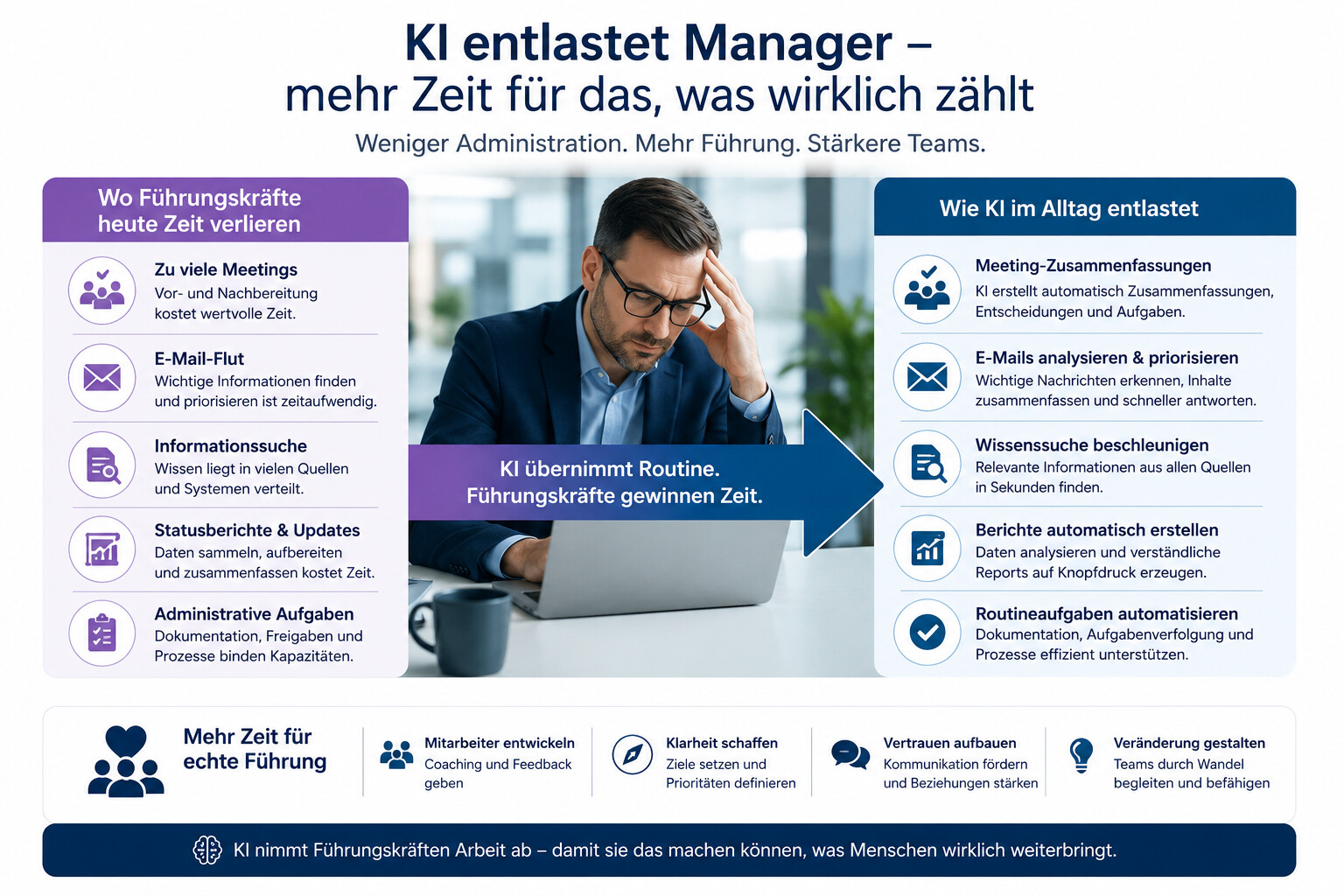
Many managers today spend surprisingly little time on the tasks that they themselves would consider value-adding. Instead of developing employees or driving strategic topics, the coordination of day-to-day business often dominates.
Meetings have to be prepared and followed up. Information is distributed in e-mails, Teams chats, documents and various specialist applications. Decisions need to be documented and tasks tracked. At the same time, employees expect quick responses and continuous support.
The problem is not a lack of competence or motivation. Rather, the amount of information and coordination is continuously increasing, making managers increasingly coordinators instead of actual leaders.
This is exactly where AI can make a noticeable difference.

Why HR can’t ignore the topic
The relief of executives is often seen as a purely management issue. In fact, however, it is increasingly affecting HR.
HR departments are now more measured than in the past by how they support productivity, employee development and organizational performance. At the same time, recent studies by Mercer and Deloitte show that managers play a central role in employee retention, engagement and the ability to change.
When leaders are permanently overworked, it often has a direct impact on teams. Employees receive less feedback, development meetings are postponed and change processes are slower.
That’s why supporting executives is increasingly becoming a strategic task for HR. This is not only about training or management programs, but also about the question of how modern technologies can be used sensibly.
How AI can relieve managers in concrete terms
The greatest added value of AI currently does not lie in replacing decisions. Rather, it helps to regain time for the tasks that make up real leadership work.
A typical example is meetings. Many managers spend several hours a week on meetings and their follow-up. Modern AI solutions can summarize conversations, document decisions, and automatically derive tasks. This significantly reduces the administrative effort.
The situation is similar with the search for information. Managers regularly need information from different sources. Instead of manually searching through documents, emails, or policies, modern AI systems can provide relevant information in a matter of seconds.
There is also great potential for status reports. Many managers regularly invest time in merging project information, team updates or management reports. AI can analyze, condense and prepare this information in an understandable way.
The real advantage is not the automation itself. It is crucial that managers gain more time for employee appraisals, coaching and strategic topics.
What role Microsoft Copilot plays in this
Microsoft is now deeply integrating AI into the everyday work of many companies. Microsoft Copilot in particular is increasingly becoming a tool for executives.
Within Teams, Copilot can summarize meetings and identify open tasks. In Outlook, the solution supports the analysis and prioritization of emails. In Word and PowerPoint, it helps with the creation of documents, reports and presentations.
This becomes particularly interesting in combination with Dynamics 365 and other enterprise applications. Information from different sources can be brought together and provided contextually. This creates much more efficient access to knowledge and company data.
For managers, this means one thing above all: less time for administrative tasks and more time for people.
Why AI does not replace leadership
Despite all the technological advances, leadership remains a deeply human task. AI can analyze information, summarize content, and support processes. However, she can’t build relationships, build trust, or have difficult conversations.
Employees expect orientation, empathy and decision-making skills from their managers. Especially in times of change and uncertainty, these skills continue to gain in importance.
Therefore, AI should not be seen as a substitute for leadership. Rather, it is a tool that allows managers to focus more on the tasks that actually require human strengths.
How companies get started
Many organizations are currently starting their first AI pilot projects. It is usually not the largest or most complex projects that are successful, but concrete use cases with direct benefits for everyday work.
It makes particular sense to start where managers regularly lose time. Meeting documentation, information search, status reports or routine administrative tasks often offer quick and measurable success.
HR can play an important role in this. In addition to training and change management, the main focus is on identifying useful areas of application and accompanying managers in the use of new technologies.
Conclusion
Leadership will not get any easier in the coming years. Economic uncertainty, technological changes and rising expectations are continuously increasing the demands on managers.
At the same time, employees need more orientation, communication and support right now. This is precisely why it is becoming increasingly important to relieve managers of administrative tasks and to give them more time for real leadership work.
AI can make an important contribution to this. Not by replacing leadership, but by reducing routine tasks and making room for the tasks that companies need most today: orientation, development and human leadership.
FAQ
How can AI support leaders?
AI can summarize meetings, provide information faster, generate reports, and reduce administrative tasks.
Why are managers currently under particular pressure?
Economic uncertainty, larger teams, technological changes and increasing productivity requirements increase the complexity of leadership.
What role does HR play in the introduction of AI?
HR supports training, change management, governance and the identification of meaningful use cases.
Can AI prepare appraisal interviews?
Yes. Modern AI solutions can bring together information from different sources and provide relevant basis for conversation.
Is AI replacing leaders?
No. AI can support administrative tasks, but it cannot replace human leadership, empathy or decision-making skills.
What are the benefits of Microsoft Copilot for executives?
Copilot supports meetings, e-mails, documents, knowledge search and the preparation of information, among other things.
Why do employees need more leadership today?
Changes due to economic uncertainty, digitalization and AI create an additional need for orientation and increase the importance of good leadership.