Artificial intelligence is currently becoming an important tool for finance departments. At the same time, many companies are finding that the success of AI depends less on the models used than on the quality of the underlying data.
This is exactly where the importance of modern ERP systems becomes apparent. After all, AI in finance can only provide reliable analyses, forecasts and recommendations if financial data is consistent, up-to-date and centrally available. Microsoft Dynamics 365 Business Central creates the necessary foundation for this and is thus becoming an important building block of many companies’ future finance strategy.
Why AI in Finance is currently receiving so much attention
The demands on finance departments have changed significantly in recent years. CFOs and finance teams should react faster to changes, update forecasts on an ongoing basis and make informed decisions. At the same time, the pressure to control costs, identify risks at an early stage and make processes more efficient is growing.
This is precisely why AI in finance is increasingly coming into focus. Modern systems can analyze large amounts of data, recognize patterns and prepare information much faster than would be possible manually. For many companies, this creates the opportunity to accelerate financial processes and make better decisions.
However, it is often overlooked that AI is not a silver bullet. The quality of the results depends directly on the quality of the data that is available.
Why AI is only as good as the database
Many companies start their AI initiatives by asking what technology they want to use. However, the more important question is often: Is our data even ready for AI?
Today, financial data is created in numerous systems. Information is stored in ERP, CRM, project management, purchasing or Excel files. Data is often maintained multiple times or merged manually. This results in inconsistencies, media breaks and different data statuses.
AI cannot solve such problems automatically. On the contrary. If incomplete or incorrect data is analyzed, incomplete or erroneous results are also produced.
This can have a significant impact, especially in the finance sector. Forecasts, cash flow analyses or management reports lose their significance if the underlying information is not consistent. That’s exactly why AI in finance doesn’t start with individual tools, but with the question of whether data is consistent, up-to-date, and centrally available.
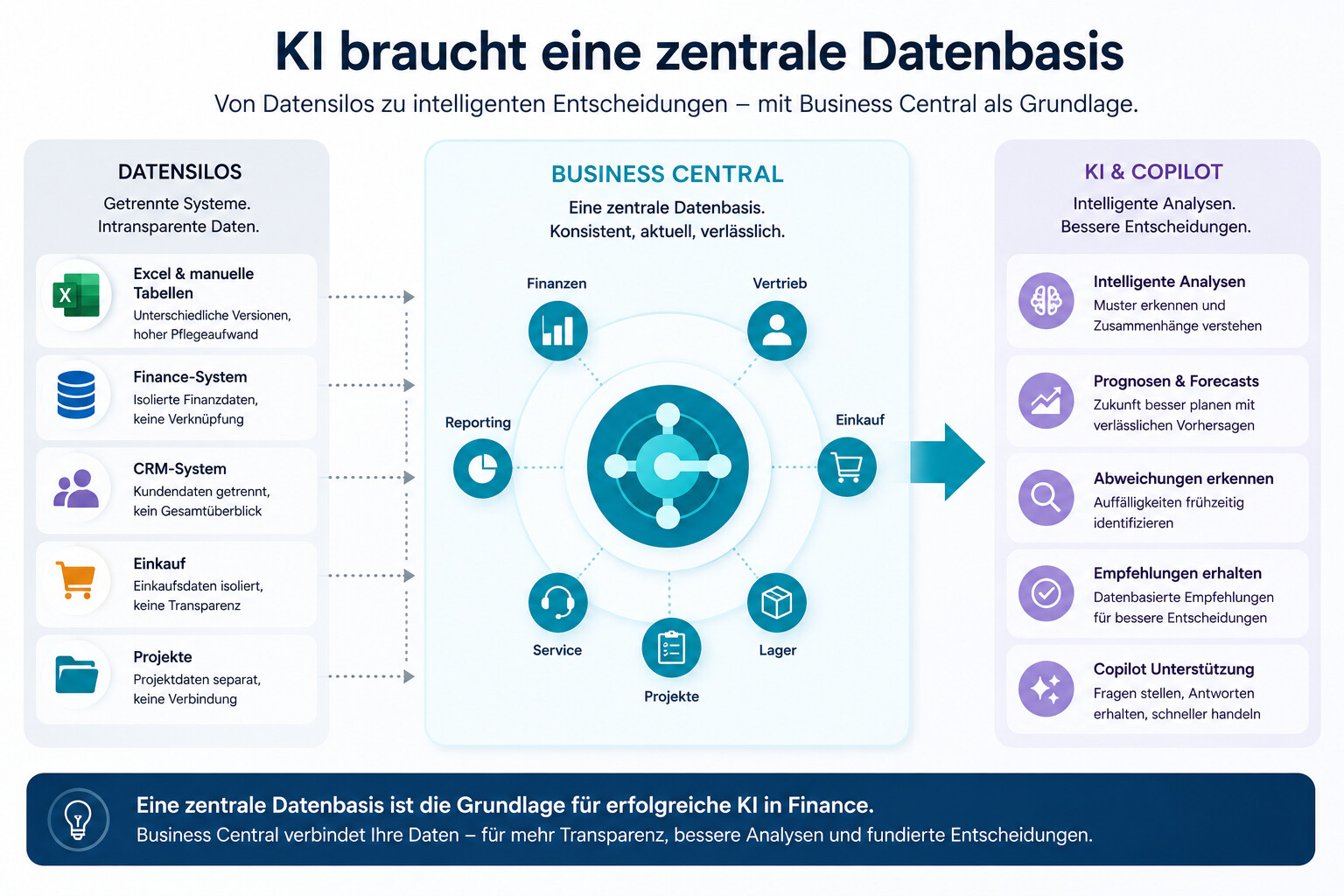

The Problem of Siloed Financial Data
In many companies, data has grown historically. Sales works in their own systems, Finance in separate applications, and project teams maintain additional information in other platforms.
These silos not only make reporting and transparency more difficult. They also limit the utility of AI.
If financial data can’t be connected to project information, customer information, or operational metrics, the necessary context for intelligent analytics is missing. AI can then only evaluate individual data points, but cannot recognize complete relationships.
This is precisely why the question of a central platform is becoming increasingly important. Organizations need an environment where information converges and is consistently available.
Why Business Central is laying the foundation for AI in finance
Business Central provides just that foundation. Financial data, operational information and business processes are brought together in a common platform.
This creates several advantages. Data becomes more consistent, processes more standardized, and information available more quickly. At the same time, the effort for manual data maintenance and coordination between different systems is reduced.
For AI applications, this means a much better starting position. Instead of isolated information, up-to-date and reliable company data is available.
It is particularly important that Business Central not only stores data, but also maps processes in a structured way. This creates a context that modern AI systems can use for analysis, forecasting, and recommendations.
Companies that want to successfully use AI in finance need precisely this combination of data quality, process standardization and central availability of information.
Microsoft Copilot and Business Central
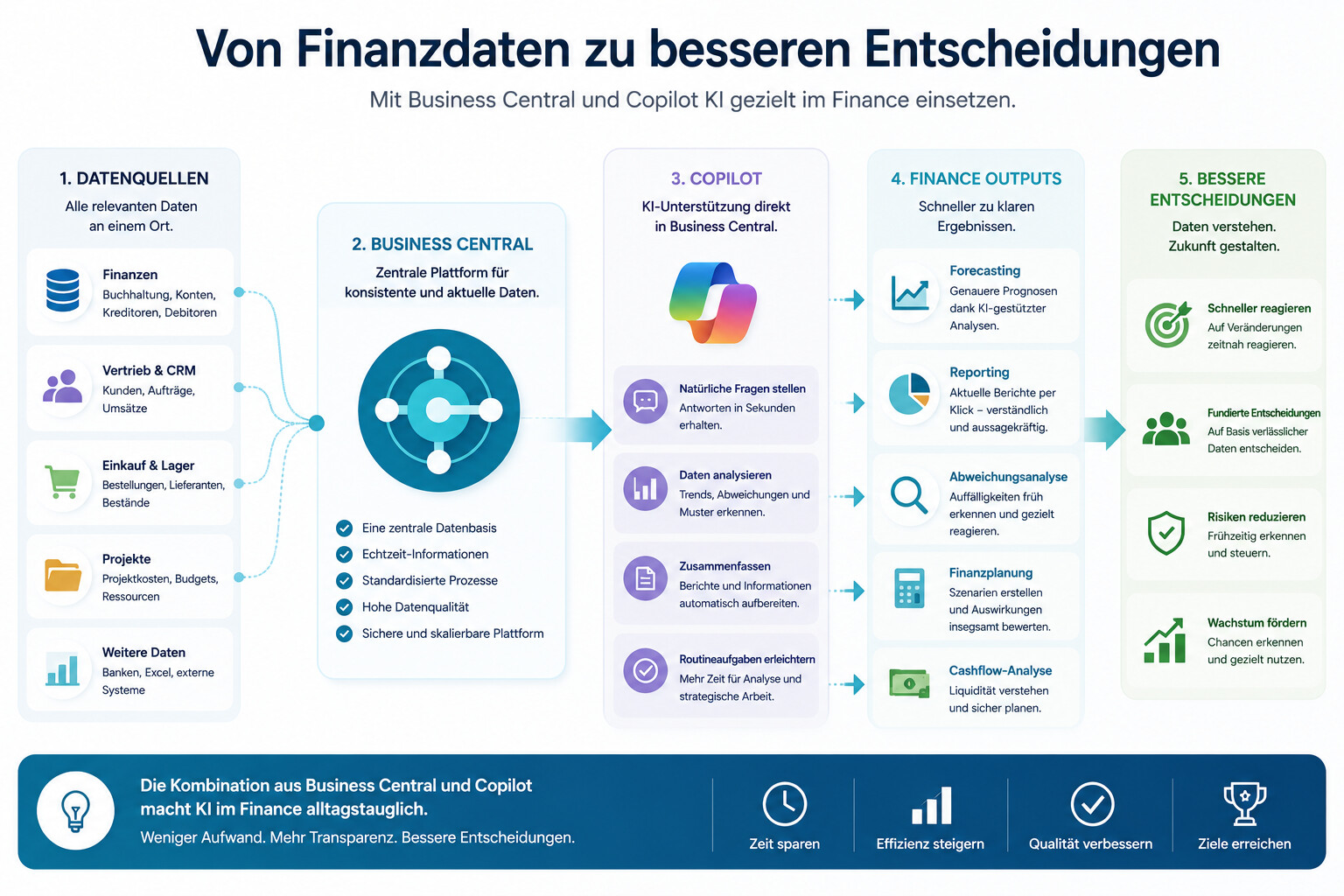
With Microsoft Copilot, AI is increasingly finding its way into the everyday work of finance teams. This is not about replacing financial experts. Rather, Copilot helps to find information faster, carry out analyses and simplify routine tasks.
Users can ask questions in natural language and get answers directly based on the available data. Reports can be created faster, correlations can be identified more easily and information can be prepared more efficiently.
This becomes particularly interesting when analyzing larger amounts of data. Instead of manually searching for deviations or trends, finance teams can identify relevant developments much faster.
This shifts the focus from data collection to interpretation and control.
How AI can support finance teams in concrete terms
Many companies initially associate AI with automation. In fact, however, great added value lies in the support of analysis and decision-making processes.
For example, when it comes to forecasting, AI can take into account historical developments, current business figures, and trends to create forecasts faster. In reporting, anomalies or deviations can be automatically identified. Cash flow analyses or budget planning also create new opportunities to make correlations visible more quickly.
At the same time, finance teams benefit from the automatic preparation of information. Instead of manually merging reports, data can be analyzed and summarized in an understandable way.
This frees up finance departments to focus on their core tasks: analysis, control, and strategic decisions.
Why modern ERP systems are becoming a prerequisite
Many companies today want to use AI without changing their existing system landscape. In the long term, however, this approach often reaches its limits.
AI needs up-to-date, structured and reliable information. The more data is distributed across different systems, the more difficult it becomes to use intelligent functions.
Modern ERP platforms therefore create the basis for future AI scenarios. They connect processes, data and applications with each other and thus enable significantly better data use.
Business Central thus becomes not only a finance platform, but also a central building block for data-driven decisions.

Why companies should lay the foundations now
The use of AI will continue to increase in the coming years. At the same time, it is already evident that companies with a modern data and ERP strategy can benefit from new technologies much faster.
The most important preparation is therefore not to introduce as many AI tools as possible. Much more important is the development of a clean and consistent database.
If you want to use AI in finance sensibly, you must first modernize ERP, data quality and processes. Companies that modernize their ERP landscape and standardize processes today are setting the stage for future AI applications. This allows new functions to be used more quickly and the benefits of AI to be exploited much better.
Conclusion
AI will permanently change the work of finance teams in the coming years. However, the real success factor lies not in the technology itself, but in the quality of the underlying data.
Business Central creates the necessary foundation for this. A central database, standardized processes and integration into the Microsoft ecosystem create a platform on which modern AI applications can be used sensibly.
For CFOs and finance teams, this means one thing above all: better data, faster analytics, and more informed decisions.
FAQ
What does AI in finance need to function meaningfully?
AI in finance requires consistent financial data, clear processes and a central database. Without this foundation, analyses, forecasts and recommendations remain unreliable.
What role does Business Central play in AI initiatives?
Business Central provides financial and enterprise data centrally, creating the foundation for analytics and AI applications.
How does Microsoft Copilot Finance support teams?
Copilot helps with analytics, reporting, information search, and natural language data processing.
Can AI improve forecasts in finance?
Yes. AI can analyze historical data, current developments, and patterns to make forecasts faster and more informed.
Why are isolated data sources not enough for AI?
Because important connections between finance, projects, customers and operational processes are lost.
Is AI possible without a modern ERP system?
In principle, yes. However, the benefits are often limited if data is not centrally available and consistently structured.