


For a long time, the classic sales funnel was the measure of all things in marketing and sales. Prospective customer comes in at the top, customer comes out at the bottom – ideally. But the reality is different today. Customers move through their decision-making processes more dynamically, informed, and unpredictably. Time for a rethink: The Flywheel model offers a new, contemporary approach.
What has changed? – The new reality in buying behavior
Today, customers are more independent than ever. They do their own research, compare products and providers independently and often only come into direct contact with a company very late. They use a wide variety of channels: website, social media, review platforms, e-mail, etc. The customer journey is no longer linear, but is a constant change between touchpoints and decisions.
The weaknesses of the classic funnel
The sales funnel is linear and one-dimensional. It ends with the purchase and ignores what happens afterwards. Customer loyalty, recommendation and repeat purchases? Nothing. In addition, all interested parties are treated equally, regardless of their prior knowledge or behavior. The result: untapped potential and inefficiency.
Flywheel instead of funnel – The new model
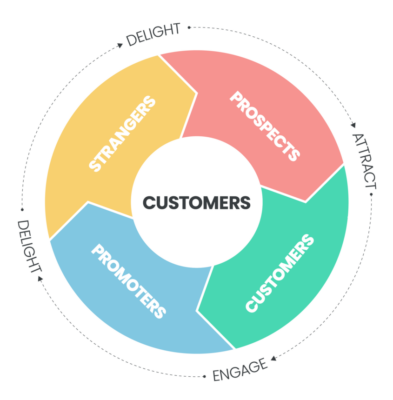
The Flywheel focuses on the customer and relies on continuous movement. Positive experiences generate energy that keeps the wheel spinning: Existing customers promote new contacts through their satisfaction, and the company constantly invests in this positive dynamic. Acquisition, service and marketing intertwine seamlessly and form a cycle.
Always-On & Personalization as Key
In the Flywheel world, communication is not a project, but a permanent state. “Always-on” means providing relevant content at all times. And personalized: Not all customers need the same information at the same time. With the help of data, e.g. from a Customer Data Platform (CDP), the approach can be individualized, relevant and at the right time.
The role of RevOps in the new world
Revenue Operations (RevOps) combines marketing, sales, and customer success into a unified strategy. The goal is to break down silos, harmonize processes and make data-based decisions for the entire customer journey. RevOps creates the structural foundation to successfully implement the flywheel model.
Practical tip: Implementation in 3 steps
- Analyze the existing customer journey: Where is it not running smoothly? Where do interested parties jump off?
- Testing and expanding the tech stack: Is a CDP in use? Automation available? Data can be used in good quality?
- Develop a RevOps strategy: Unify processes, define KPIs, foster cross-departmental collaboration.
Conclusion on the Flywheel model
The sales funnel is not wrong per se, but it is no longer sufficient in today’s complexity. The Flywheel offers a modern view of customer relationships: long-term, dynamic, personalized. Companies that work in a data-driven manner, intelligently link processes and focus on customer experiences not only win customers – but fans.
What is your strategy? Are you still in funnel mode or is your flywheel already spinning? Contact us for an exchange about the next steps towards RevOps & data-driven customer engagement.


