Project management is on the verge of a fundamental change in 2026. Projects are becoming more complex, dependencies are becoming denser and framework conditions are becoming more volatile. At the same time, new opportunities are emerging through AI, data-based planning and more flexible delivery models. Classic project management has its limits, as do purely agile approaches. The 2026 project management trends clearly show that organizations need to find new balance points between flexibility and controllability, operational excellence and strategic control.
Why Project Management 2026 Needs to Be Reassessed
In many organizations, project management is historically anchored as an operational discipline. The focus is on schedules, budgets and deliverables. This logic falls short in 2026. Economic uncertainties, resource scarcity and parallel transformation initiatives are increasing the pressure on project organizations. Projects are no longer isolated projects, but part of larger change programs. Project management is thus more strongly measured by whether it creates orientation, transparency and decision-making security.
Trend 1: AI-powered planning and forecasting
Artificial intelligence will find its way into project planning and management across the board in 2026. Not as a substitute for project managers, but as a supporting infrastructure. AI-powered systems analyze historical project data, recognize patterns, and provide forecasts on effort, risk, and dependencies. This makes planning more dynamic and less dependent on individual experience.
What this trend means for project organizations
AI relieves operational burdens, especially when it comes to scheduling and resource planning. At the same time, the competence profile in project management is shifting. The ability to classify forecasts, question assumptions and derive consequences is becoming more important than manually creating plans. Project managers must learn to work with uncertainty and probabilities instead of sticking to seemingly stable plans.
Trend 2: Hybrid delivery is becoming the norm
The juxtaposition of agile and classic will continue to lose importance in 2026. In practice, hybrid delivery models that combine different approaches are gaining ground. Agile methods are used where uncertainty is high and learning is in the foreground. Classic control mechanisms remain relevant when dependencies, regulation or investment volumes require clear control.
What Hybrid Delivery Means for Control and Implementation
Hybrid delivery requires clarity about roles, decision-making processes and expectations. Without a common understanding, friction is created between teams, methods and management levels. Successful organizations consciously define where flexibility is necessary and where reliability is a priority. Hybridity thus does not become a compromise, but a designed delivery model.
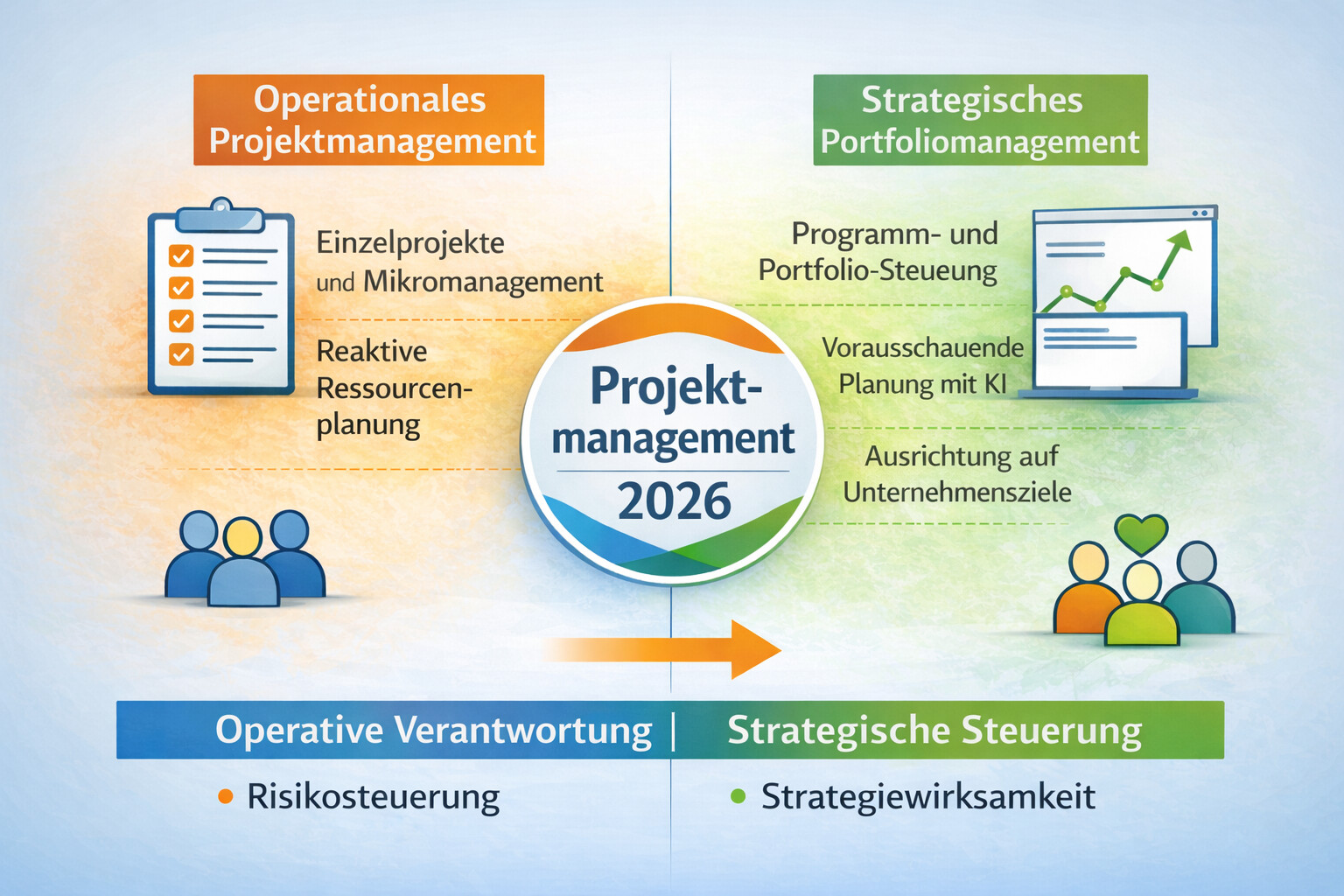

Trend 3: Portfolio and program management as a central discipline
As the number of projects increases, so does the importance of portfolio and program management. In 2026, it will hardly be possible to manage individual projects in isolation in a meaningful way. Dependencies, resource conflicts, and strategic priorities require an overarching view. Portfolio management is becoming the central control authority between strategy and implementation.
Why strategic management is becoming more important than individual project optimization
The success of individual projects says little about the overall success of the organization. The decisive factor is whether the right initiatives are prioritized, synchronized and, if necessary, stopped. Portfolio management creates transparency about target contributions, risks and resource utilization. Project management is thus more strategically embedded and perceived less as a purely operational function.
Trend 4: Soft skills and leadership are gaining in importance
With increasing automation, the requirements for project managers are also changing. Technical methodological competence remains important, but it is no longer sufficient. Communication, decision-making skills and temporary leadership are becoming key success factors. Project managers often move in areas of tension between departments, management and external partners.
What is shifting in the understanding of the role of project managers
In 2026, project managers will act more as moderators, translators and decision-making facilitators. They create clarity in uncertain situations, address conflicts at an early stage and hold different interests together. Leadership in a project context means less instruction and more orientation. These capabilities cannot be automated, but they are becoming more important through the use of AI.
Typical misconceptions in today’s project organizations
Many organizations are responding to the trends described above with selective measures. New tools are introduced, methods are adapted or roles are renamed. Without structural embedding, however, these changes remain ineffective. Project management is still understood as a service function, not as an integral part of strategic management. This misconception leads to overload, lack of transparency and inconsistent decisions.
How project organizations should align their delivery models
Project Management 2026 requires a conscious alignment of structures, roles and control logics. Key questions relate to the integration of AI in planning and reporting, the clear definition of hybrid delivery models and the strengthening of portfolio management. Equally important is the targeted development of leadership and communication skills in the project context. Organizations that think these layers together create both agile flexibility and strategic control.
Conclusion: Project management is becoming more strategic and human
The project management trends for 2026 show a clear direction. Operational excellence remains important, but it is no longer enough. Project management is developing into the connecting discipline between strategy and implementation. AI helps to master complexity, but does not replace leadership. The real lever lies in the ability to navigate uncertainty, prioritize, and guide people through change.