Without data governance, your AI will be inaccurate, insecure—and expensive
Many companies rely on AI – but neglect the foundation: controlled, high-quality and secure data. This is a strategic mistake. This is because a lack of data governance leads to contradictory reports, legal risks and AI results that no one trusts.
If you don’t build a data governance strategy now, you risk not only slower decisions, but also compliance violations and the loss of strategic ability to act. While others are already optimizing their database for AI-supported processes, you are stuck in reaction mode.
What is data governance?
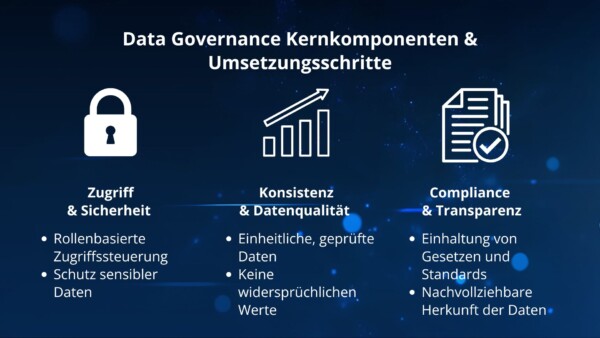
Data governance is the structured framework of policies, processes, roles, and technologies that ensures that data is accurate, secure, consistent, and usable. It goes far beyond data protection or IT security. Governance includes:
-
Quality: Complete, error-free data
-
Access: The right data for the right people
-
Compliance: Compliance with all regulatory and legal requirements
-
Transparency: Origin and use traceable at all times
These principles are not just theoretical requirements – in the age of AI, they determine the reliability of results, the speed of decisions and the scalability of new projects.
Why Data Governance Is Essential in the AI Age
AI models are only as good as the data they are trained with.
Without governance, garbage in = garbage out.
The challenges are clear:
-
Trusted data for AI models: No reliable analyses without quality
-
Increasing regulatory requirements: Data Protection, ESG and Industry-Specific Regulations
-
Exploding data volumes: Without governance, there is a risk of loss of control
-
Speed as a competitive advantage: Clean processes reduce coordination loops and data conflicts
AI without governance accelerates mistakes, not progress. The risk: quick decisions based on wrong foundations.

Data governance as the foundation of modern data estate
A modern data estate without governance is like a high-rise building without a foundation – it stands, but every expansion costs a disproportionate amount of time and money.
Without governance means: inconsistent data, insecure access, high integration costs for every new project.
By governance means:
-
Enterprise-wide, trusted database
-
Secure and scalable AI deployments
-
Faster, more informed decisions
-
Efficient collaboration between all departments
Implementation in the Microsoft Cloud
The Microsoft Cloud offers a complete set of tools to efficiently implement data governance:
-
Microsoft Purview – Single Tool for Data Catalog, Classification, and Compliance
-
Azure Active Directory role-based access control
-
Microsoft Fabric – central integration and analysis
-
Power BI – Governance for dashboards, reports, and shares
The key is to see governance not as a one-off project, but as an ongoing process – from defining responsibilities to automating policies.
4 Steps to a Data Governance Strategy
-
Define goals: What data, what risks, what regulatory requirements?
-
Set roles: Data Owner, Data Stewards, Governance Board
-
Integrate technology: Purview, AAD, Automation Solutions
-
Continuously optimize: Governance is a permanent process that grows with you
Conclusion: Governance decides who leads – and who follows suit
Without governance, your data is a cost and risk. With governance, they become a competitive advantage. Your competitors are creating the structures today to work precisely, quickly and compliantly with AI tomorrow. If you wait, you react – instead of leading.
Let’s build your data governance strategy now, before a lack of data control slows down your growth.