The topic of pay transparency has arrived in many HR teams. Not as an acute crisis, but as permanent background noise. 2026 still seems a bit away and at the same time close enough to feel: This will be relevant. Many head-of-HR are familiar with this situation. There are initial questions from management, isolated inquiries from employees, tips from legal or finance. Nothing has escalated yet. But one thing is clear: Waiting doesn’t feel right anymore.
This article classifies what companies can expect with EU pay transparency . And above all: what concrete steps HR should take now to be prepared. Without actionism and without being overwhelmed.
Why pay transparency is now a priority for HR
The EU Pay Transparency Directive not only changes the legal situation. Expectations are also changing. Employees compare more closely. Managers are involved in salary issues at an earlier stage. And HR is moving more into the role of the explanatory, moderating authority. Pay transparency is therefore no longer a classic compliance issue. It touches on culture, trust, and the credibility of HR decisions. Many HR managers feel exactly that. Not because they have read the directive in detail. But because conversations are becoming more demanding and can no longer be answered with standard sentences.
What companies can expect in concrete terms with EU pay transparency
The aim of EU pay transparency is to make gender-related pay differences visible and explainable. The focus is not on individual disclosure of individual salaries. But on structural fairness. Key points of the Directive include:
- Transparency about remuneration structures
- Comparability of work and roles
- objective, gender-neutral criteria for remuneration decisions
For HR, this means that not every difference is problematic. It becomes problematic where differences cannot be justified. This is exactly where the work shifts. From pure calculation to explainability.
Schedule and classification: When does it become relevant?
Even if details are implemented differently nationally, the direction is clear. Companies should not first deal with the final national legislation. Because preparation takes time.
Milestonepreparedexplainable and documentedresilient in the long termEmployeepossibleto justify differences
| Period | Importance for HR | Possible consequences of non-compliance | |
|---|---|---|---|
| EU directive adopted | 2023 | Frame is set | No direct consequences yet |
| National implementation | by 2026 | Requirements become concrete, HR must be | Increasing pressure to adapt, little lead time |
| Initial reporting obligations | from 2026 (staggered according to company size) | Remuneration structures must be | Complaints by authorities, request for improvement |
| Ongoing transparency obligations | thereafter regularly | Processes and data must remain | Sanctions, fines or supervisory measures (regulated nationally) |
| complaints or complaints | at any time | HR must be able | Burden of proof lies with the employer, loss of reputation and trust |
For HR, this does not mean acting immediately. But: now begin to understand structures.
Where HR teams stumble in practice
In conversations, a similar picture emerges again and again. The biggest challenges rarely lie in a lack of will. But in grown structures. Roles have been created over the years. Titles have been adjusted, tasks have been postponed, responsibility has been expanded. Salaries often follow individual decisions. This works well in everyday life.
Until someone asks why two comparable roles are paid differently. At the latest then it becomes clear: The data is there. But the story behind it is missing. HR is then caught between two stools. Between managers who are supposed to explain decisions. And employees who expect comprehensible answers.
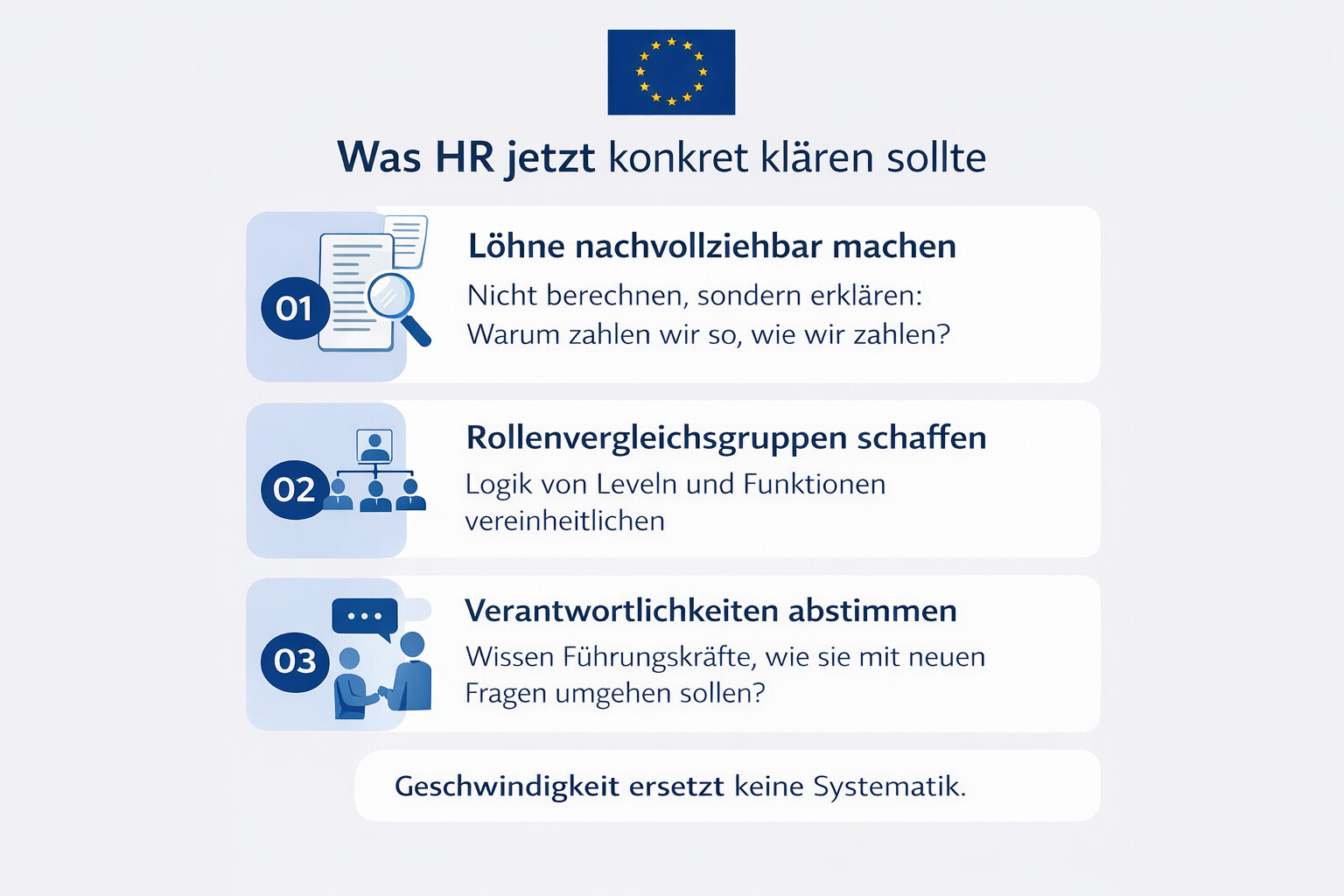

What HR should do now in concrete terms
1. Make wages comprehensible
At its core, it’s not about whether salaries are different, but why. HR should therefore clarify:
-
What objective criteria do salary differences actually apply today?
-
What role do you play:
-
Responsibility and Breadth of Tasks
-
Market and scarcity factors
-
individual development or performance
-
-
Which decisions have grown historically and have never been properly documented?
-
Where are there differences that can be explained and where where even HR comes to a standstill?
It is important to note that not every blur is a problem. A problem only arises when differences cannot be justified.
2. Create role comparison groups without building everything from scratch
Pay transparency requires comparability. This is exactly where it gets difficult for many organizations. HR should ask itself:
-
What roles do employees implicitly compare with each other today?
-
Where to get:
-
same titles with very different responsibilities?
-
different titles with factually similar work?
-
-
Which roles can be sensibly bundled into comparison groups?
-
Where are clear criteria missing to define “work of equal value”?
The goal is not a perfect job architecture. But a logic that makes comparisons comprehensible. And that also for outsiders.
3. Prepare data in a way that makes conversations possible
Pay transparency not only increases reporting obligations. Above all, the inquiries are increasing. HR should therefore check:
-
Is salary data consistent across areas, countries, and systems?
-
Can differences be contextualized, not just displayed?
-
Is understandable:
-
who made which decision and when?
-
on what basis?
-
-
Are there clear leeway and are they consciously defined?
Because in practice it turns out that the technical report is rarely the problem. The subsequent discussion almost always.
4. Prepare managers and clarify responsibility
Pay transparency is not “rolled out” by HR in everyday life. It is lived in conversations. HR should therefore clarify at an early stage:
-
What questions will managers hear more often in the future?
-
Which answers are consistent – and which are not?
-
Where do we need clear guidelines to avoid individual interpretations?
-
Who bears what responsibility:
-
for data?
-
for communication?
-
for escalations?
-
The better prepared managers are, the less pay transparency ends up as a conflict issue in HR.
What HR deliberately does not have to do now
An important point at the end: Pay transparency does not mean immediate disclosure of all salaries. HR doesn’t have to solve everything at once. And also not create a perfect structure. It is crucial to start now. With clarity. With structure. And with realistic expectations.
Conclusion
The EU pay transparency makes visible what already exists in many organizations. Differences, decisions, historical developments. This is a challenge for HR. But also an opportunity. Anyone who now deals with roles, criteria and data in a structured way creates orientation. Not only for upcoming reporting obligations. But for fairer, explainable HR work in everyday life.