Many project-based companies realize too late that a project is tipping over economically. The customer is satisfied, the team is working intensively, the invoices are running. Nevertheless, the margin is shrinking. Not suddenly, but gradually.
A few hours more here. An unplanned change there. A senior profile that stays tied longer. A budget that still fits formally, but has long been under operational pressure.
The problem is rarely the individual project. The problem is the lack of early warning. Project margin is not lost at the end of the month. It is lost every day when effort, resources, scope and forecast are not brought together cleanly.
Why classic project controlling comes too late
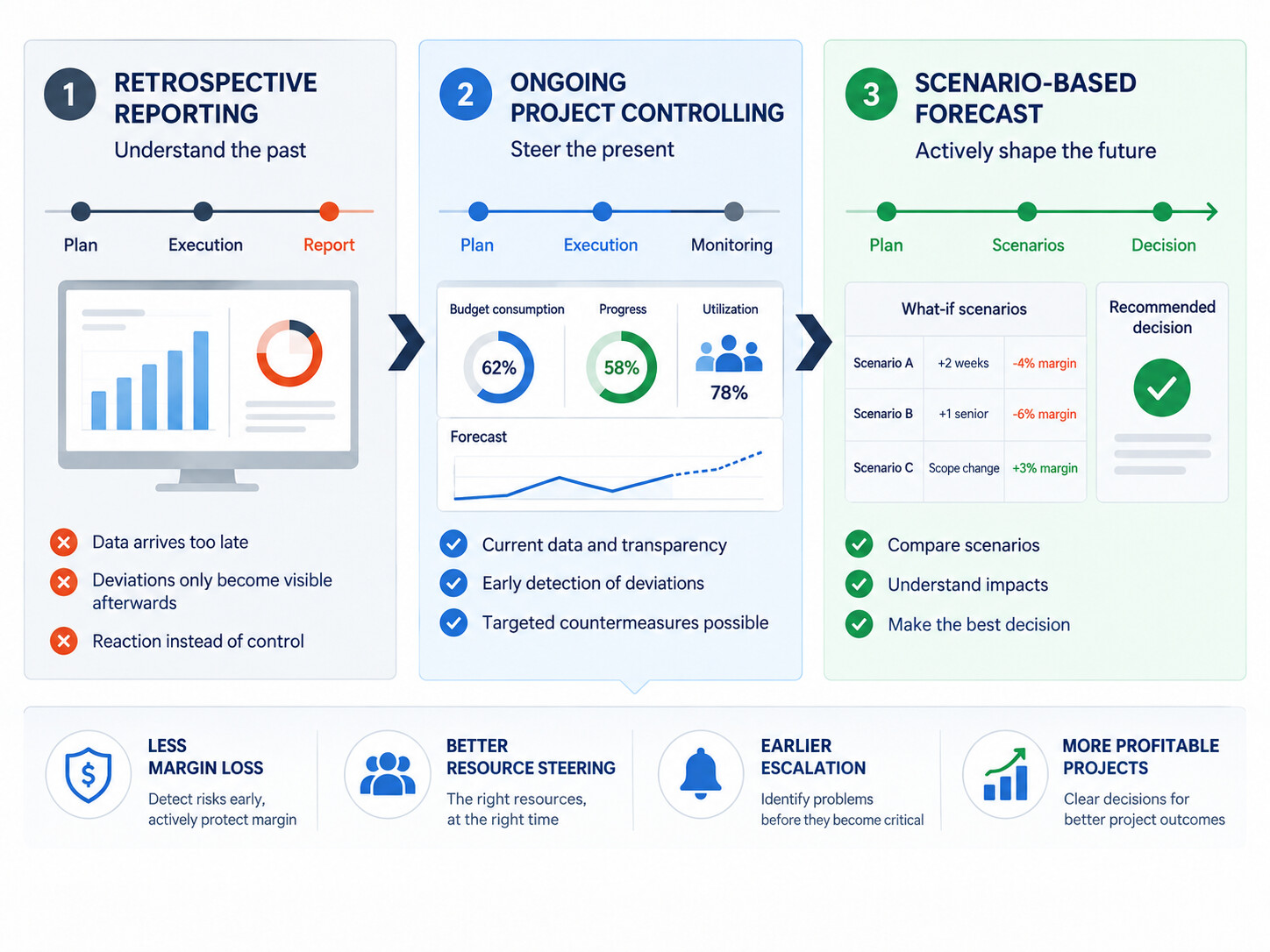
In many companies, project transparency is created backwards. Times are booked, costs are collected, invoices are created and at some point it is reported whether the project is still profitable. This is too late for control. If you only see that a project is out of line after the monthly statement, there is hardly any way to counteract it. Then all that remains is to explain why the margin is lower than planned.
Professional services, IT service providers, consultancies and project-based B2B companies in particular need a different logic. Project controlling must start earlier: with resource planning, budget consumption, remaining expenses, change requests, forecasts and billing.
Dynamics 365 Project Operations is an application that combines sales, resource planning, project management, and finance in one solution to give project-centric organizations better visibility, collaboration, and agility across the entire project lifecycle.
The margin suffers from handovers
Project margin is often lost where teams hand over.
Sales sells a project with assumptions. Project management plans with resources. Consultants book times. Finance evaluates costs and revenue. Management expects forecasts. Each function works on a part of the truth. If this information is not connected, typical problems arise:
informally
| Break in the process | Effect on margin |
|---|---|
| Sales sells too optimistically | Budget and effort do not fit together from the beginning |
| Resource planning is inaccurate | expensive profiles are tied up for too long |
| Times come too late | Forecasts are not up-to-date |
| Scope changes are resolved | Additional expenditure is not invoiced properly |
| Finance sees costs only downstream | Control becomes a hindsight |
| Project status is subjective | Risks are escalated too late |
This is not a reporting problem. It’s a control problem.
Why forecasts are becoming more important than status reports
A status report describes where a project stands. A forecast shows where things are heading.
It is precisely this perspective that becomes crucial for project-based companies. Project managers not only need to know how many hours have been booked. They must be able to estimate how much effort is still to come, which resources will be scarce, which budget items are at risk and whether a change order will be necessary.
Microsoft mentions several features for Dynamics 365 Project Operations in Release Wave 1 2026 that go exactly in this direction: change order management, what-if analyses on estimates, multiple budget drafts for what-if analyses, multiple baselines, timeline views for staffing as well as improvements in project planning, budgeting, contract management and resource availability.
This clearly shows the direction: project management will not only be more precise, but more scenario-based.

What-if instead of gut feeling
Many project decisions today are made from experience. This is not wrong, but risky. Experience helps to recognize patterns. However, it does not replace a reliable scenario analysis.
What happens to the margin if a senior consultant is tied down for two weeks longer? What happens if a feature is also delivered? What happens if the go-live is postponed? What happens if a resource fails?
Such questions must be answered more quickly. Not only when Finance confirms the deviation. But while the project is still controllable.
What-if analyses are therefore more than a planning function. They help to evaluate operational decisions economically before they become margin deviations.
Change orders must get out of the gray area
In many projects, changes occur informally. A customer asks for an adjustment. The team delivers. The effort is swallowed because the relationship is important or because the change seems too small.
A single change is rarely the problem. The sum is it.
If changes are not properly evaluated, documented, and commercially classified, the company loses margin without seeing it immediately. That’s why change order management is not an additional administrative process for project-based companies. It is margin protection.
The decisive question is not: Can we still go along with this? The key question is: What does this change mean for budget, schedule, resources, and earnings?
Resource planning is financial management
Resource planning is often understood as an operational discipline. Who is available? Who is a good fit professionally? Who can start when?
For project-based companies, however, resource planning is always also financial management. The choice of resource affects cost, speed, quality, and margin. If available capacities, skill levels, hourly rates and project priorities are not considered together, economic risks arise. Microsoft cites improvements in resource planning, global views of resource assignments, and granular availability views for Project Operations 2026, among other things.
This is particularly relevant for companies with several parallel projects. This is because overload, incorrect staffing or short-term rescheduling have a direct impact on profitability and delivery capability.
What companies need to prepare for this
Dynamics 365 Project Operations can provide the technical and procedural foundation. However, business value only arises when companies clearly define their project management.
The following basics are particularly important:
Uniform
| Basis | Why it’s important |
| project costing | so that sales, delivery and finance work with the same assumptions |
| Clear budget logic | so that budget consumption and residual expenditure are comparable |
| Current time and cost bookings | so that forecasts are not based on outdated data |
| Defined change process | so that additional effort does not disappear into the margin |
| Resource and skill visibility | so that occupation becomes economically controllable |
| Forecast routines | so that risks become visible earlier |
Without these foundations, any system will remain a better repository. With them, Project Operations becomes the basis for control.
Where AI can provide meaningful support
AI can help in project controlling, especially where many signals come together. It can detect anomalies in time bookings, summarize project status, derive risks from project communication, explain forecasts or support project managers in next measures.
But here, too, AI does not replace clean data. If budgets, times, resources, change requests, and project statuses are not maintained in a structured way, AI will remain superficial.
The real benefit arises when Project Operations provides the operational database and AI uses it to generate earlier clues, better summaries, and concrete recommendations for action.

Conclusion: Project margin needs early warning, not hindsight
Project-based companies rarely lose margin due to a single major event. They lose it due to many small deviations that become visible too late.
This is precisely why classic reporting is no longer sufficient. Companies need an integrated view of sales, resources, project planning, effort, budget, change orders and finance.
Dynamics 365 Project Operations then becomes more than just a project management system. It becomes the basis for economic project management.
Those who see project margins earlier can act earlier. Those who act earlier protect not only individual projects, but the profitability of the entire business.
FAQ
What does project controlling mean with Dynamics 365 Project Operations?
Project controlling with Dynamics 365 Project Operations means combining project planning, resources, effort, budget, billing, and finance in one integrated solution. The aim is to make project status and profitability visible earlier and more reliably.
Why do companies often recognize project margins too late?
Many companies only look at costs, times and budget downstream. If project times, remaining effort, change requests and resource planning are not continuously connected, margin loss only becomes visible when it is hardly possible to take countermeasures.
What role does resource planning play in the project margin?
Resource planning has a direct influence on costs, delivery capability and profitability. The wrong resource or one that has been tied up for too long can put an economic strain on a project, even if operational progress looks good at first.
Why are what-if analyses important in project controlling?
What-if analyses help to assess the economic impact of changes, delays or resource bottlenecks at an early stage. This allows project managers to make decisions before variances are firmly written into the budget and margin.
What is the benefit of change order management?
Change order management ensures that additional requirements do not disappear informally in the project margin. Changes are evaluated, documented and commercially classified.
What are the latest developments in Dynamics 365 Project Operations?
Microsoft cites change order management, what-if analyses, multiple budget drafts, multiple baselines, and improvements in project planning, budgeting, contract management, and resource availability for Release Wave 1 2026, among other things. Source: Microsoft Learn.