Marketing will be at a turning point in 2026. Many mechanisms that have worked reliably for years are losing their effectiveness. Automation, AI-generated content and data-based control have long been part of everyday operations. At the same time, a growing demand to the contrary is growing on the customer side. Communication should be understandable, relevant and credible. Not more perfect, but more fitting. Not louder, but more helpful. The Marketing Trends 2026 can therefore not be understood as a continuation of existing tactics. They mark a structural paradigm shift that fundamentally affects marketing organizations.
Why marketing needs to be reclassified in 2026
Marketing is under growing pressure of expectations. Budgets are becoming more restrictive, impact must be proven more clearly, and at the same time the complexity of channels, technologies and target groups is increasing. In many organizations, marketing has historically been channel- or campaign-oriented. This logic will increasingly reach its limits in 2026. Relevance no longer arises from presence on as many channels as possible, but from consistent classification along real customer needs. Marketing is being measured more strongly by the contribution it makes to long-term customer value. This shifts the focus from activity to strategic impact.
Trend 1: AI-First Marketing
Artificial intelligence is still considered a complementary tool in the marketing of many companies. Another tool in the stack, an efficiency lever for content production or analysis. In 2026, however, it is clear that this view falls short. AI-first marketing describes the transition from selective AI applications to structural anchoring. AI is becoming the infrastructural basis, comparable to CRM systems or marketing automation in earlier years.
What this trend means for marketing organizations
AI-first doesn’t mean maximum automation. The decisive factor is the deliberate separation between machine support, as in Dynamics 365 Customer Insights, and human evaluation. AI prepares decisions, prioritizes information, and recognizes patterns. The responsibility for classification, tonality and strategic relevance remains with humans. Organizations that don’t clearly define these roles risk either blind automation or inefficient duplication. AI-first is therefore less a question of technology than an organizational question.
Trend 2: Zero-Click Marketing
A defining feature of the marketing trends 2026 is the further decline in classic click paths. Search engines, platforms and AI interfaces are increasingly answering questions directly. Information is summarized, classified and displayed without users necessarily visiting a website. Visibility is often created without direct interaction.
What this trend means for visibility and content
Success can no longer be measured solely by traffic. Content must be designed in such a way that it also works outside of one’s own channels. Comprehensibility, clarity and citability are gaining in importance. Relevance arises where orientation is offered. Not through reach, but through presence at the decisive points. For marketing organizations, this means understanding content more as a strategic asset and less as a campaign tool.
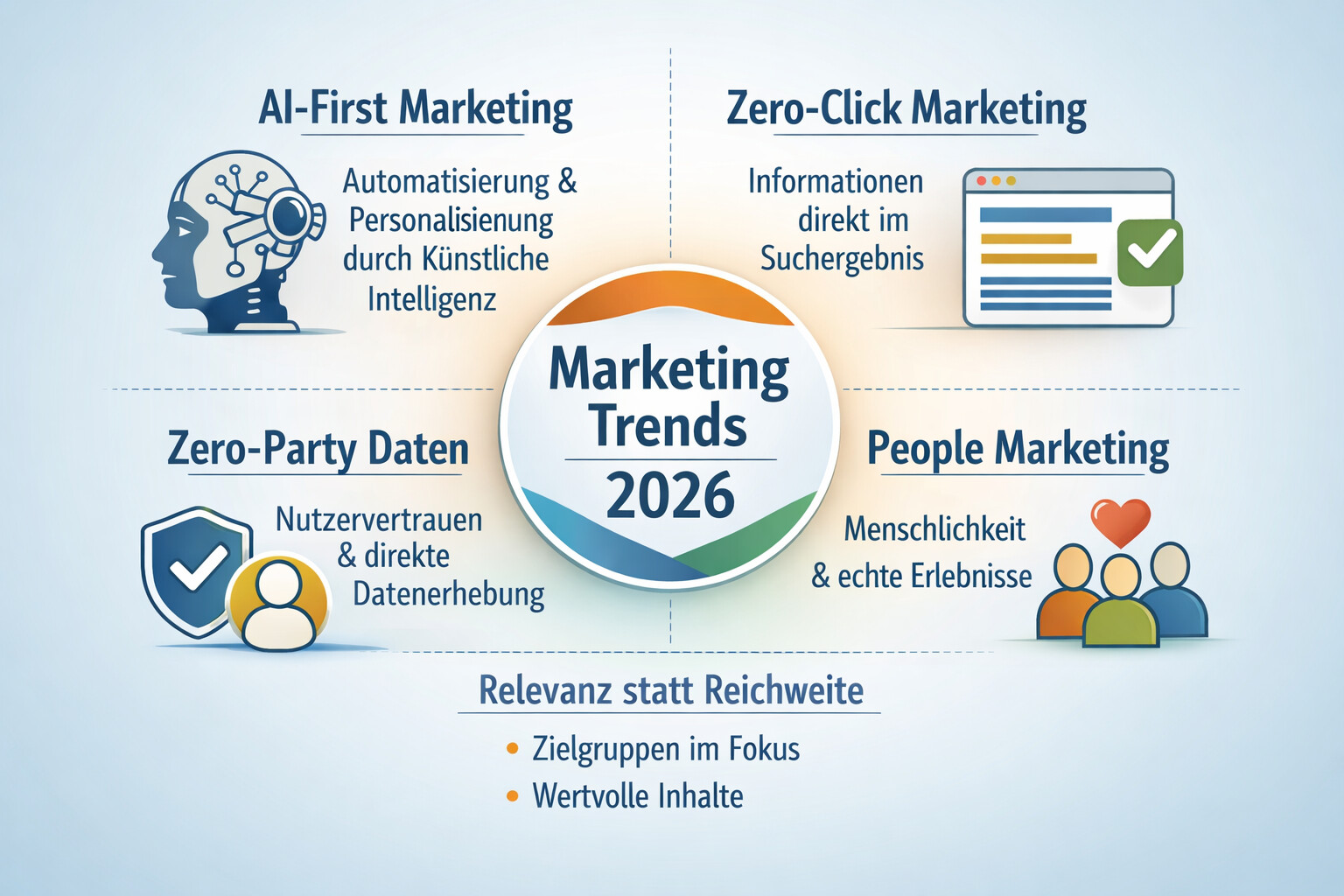

Trend 3: Zero-Party Data and Trust
Parallel to the loss of importance of third-party data, zero-party data is gaining relevance. This refers to information that users consciously and voluntarily share. This development is not a technical subtlety, but an expression of a fundamental change in confidence. Data protection regulation, increasing sensitivity and declining acceptance of tracking are changing the rules of the game permanently.
What this trend means for data strategies
Marketing can no longer simply collect data. It must provide reasons why people are willing to disclose information. Trust is becoming a central resource. Content, services and interactions must offer clear added value before data flows. This brings marketing closer to customer experience, service and communication. Data strategy becomes relationship work.
Trend 4: People Marketing
The marketing trends for 2026 are also clearly evident in the context of employer attractiveness. Classic employer branding often works with generic promises and idealized images. These patterns are increasingly losing their effect. Candidates and employees expect classification instead of staging.
What this trend means for organizations
People marketing focuses on real roles, actual expectations and concrete development opportunities. Not as a campaign, but as continuous communication. Here, marketing takes on a connecting role between internal reality and external perception. Credibility is created where communication is consistent with the experienced organization.
Trend 5: Relevance instead of reach
One of the central marketing trends in 2026 is the move away from pure reach thinking. Attention is fragmented, budgets are under pressure and impact becomes more difficult to measure. Reach alone is increasingly being decoupled from actual benefit.
What this trend means for management and KPIs
Successful marketing organizations prioritize relevance. They no longer ask how many people are reached, but which ones. This perspective changes goal definitions, KPI models and internal coordination. Marketing is moving closer to business goals and is more strongly understood as a strategic function that makes value contributions visible.
Typical misconceptions in marketing organizations
Many organizations are reacting to these developments with actionism. More tools, more content, more campaigns. However, the real problems often lie deeper. Marketing is still organizationally structured in silos. These structures make it difficult to integrate AI-first approaches, zero-click logic, and relevance thinking in a meaningful way. Without clear priorities and decision-making paths, operational overload instead of strategic impact arises.
What marketing organizations need to do now
Marketing 2026 does not require a radical reinvention, but a clear reorientation. Central fields of action lie in the conscious clarification of the role of AI, the adaptation of success criteria beyond clicks, the development of trust-based data relationships, the stronger dovetailing of marketing with HR, sales and service, and the consistent focus on relevant target groups and topics. These steps are organizational in nature and require leadership and guidance.
Conclusion: Marketing is becoming quieter, but more effective
The marketing trends 2026 do not show an easy path, but a clear direction. Marketing is becoming more technological and more human at the same time. Organizations that take this balancing act seriously gain clarity. Not through volume, but through relevance. Marketing is thus evolving from a campaign function to continuous value creation for customers, employees and the company as a whole.