Especially in professional services , project transparency is a declared goal for many companies. In practice, however, reporting in project management often means one thing above all: regular status reports. Traffic light colors, percentages and summaries are intended to provide orientation. This may be helpful for operational teams. For management, however, this information is rarely a reliable basis for decision-making.
The problem is not a lack of reporting, but a lack of project transparency in the true sense of the word.
What Project Visibility Really Means
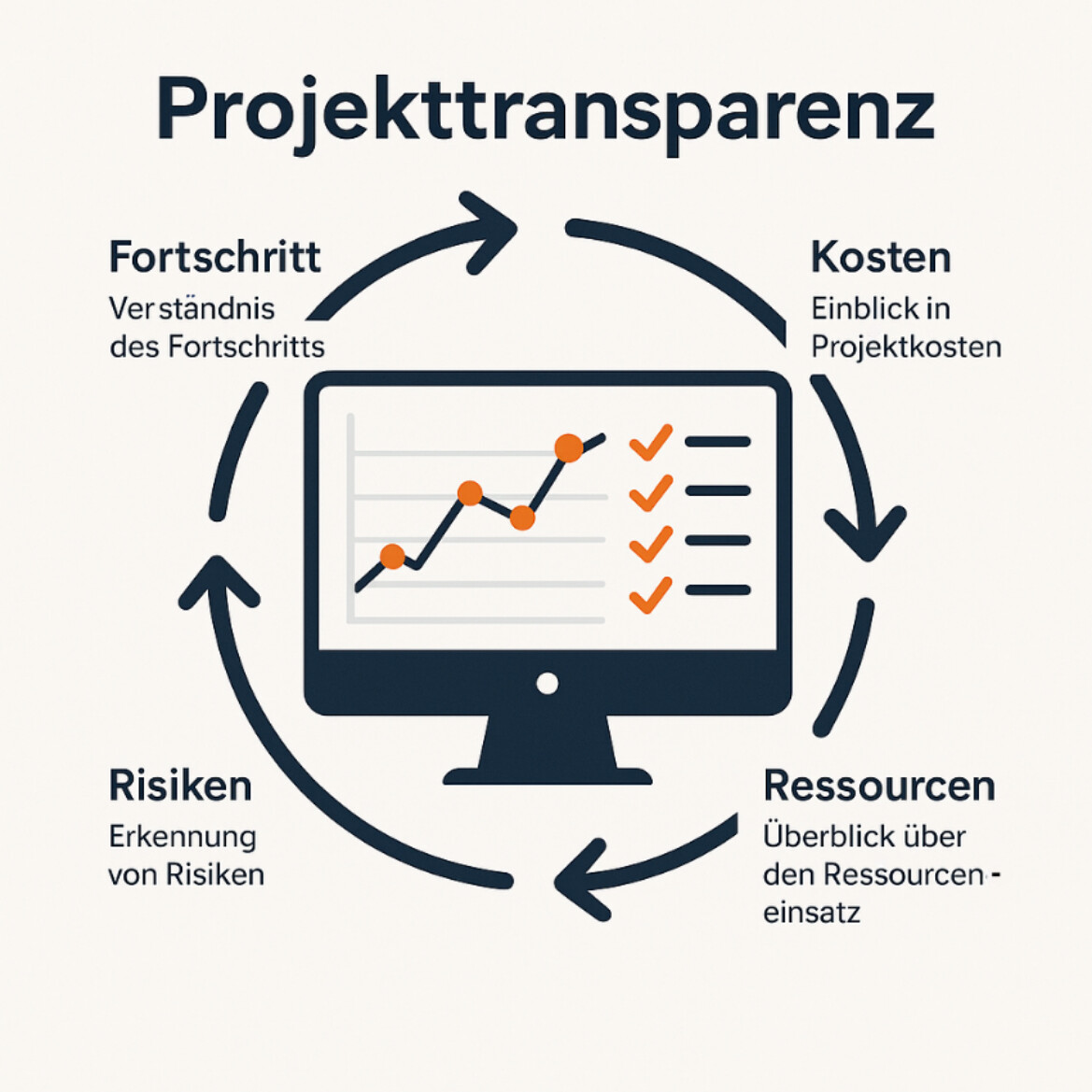
Project transparency describes the ability to understand the actual state of a project, in real time and in context. This includes not only timelines or milestones, but above all relationships between progress, costs, resources and risks.
Many organizations confuse transparency with information. They generate data, reports and presentations without gaining control-relevant insights from them. However, transparency only arises when information enables decisions.
Why Status Reports Reach Their Limits
Classic status reports are retrospective. They depict a state that is often already outdated at the time of creation. Decisions are thus based on past values – not on current developments.
In addition, there is the subjective component. Assessments of project progress are often dependent on interpretation. Risks are formulated in a weaker way, deviations are put into perspective. As a result, problems only become visible when they can hardly be corrected.
For management, this does not create a clear picture, but a condensed representation without depth of field.
Typical causes of a lack of project transparency
In practice, similar patterns emerge again and again:
-
Project data is spread across multiple tools and files
-
Costs, resources and schedules are considered separately
-
Excel-based reports require a lot of manual effort
-
Project knowledge lies in people’s minds instead of systems
The result is a fragmented picture. Correlations remain invisible, dependencies are detected too late, control is reactive.

What decision-makers need instead
From a management point of view, it’s not about depth of detail, but about reliability. Decision-makers need answers to key questions:
-
Where are deviations currently occurring?
-
Which projects are developing critically
-
What is the impact of delays on costs and resources?
-
Where is there a need for short-term action
Project transparency must answer exactly these questions – clearly, consistently, and without additional interpretation loops.
Project transparency as a control instrument
True project transparency is created when project data is structurally linked to each other. Progress, costs and resources must not be considered in isolation, but must be placed in a common context.
Only then can early warning signals be detected and informed decisions made. This makes project management easier to plan, risks become visible earlier and management decisions gain in quality.
How companies implement this approach depends heavily on their project landscape, their processes and their level of maturity. However, an integrated view of project data is always key, as a basis for control and decision-making.
At this point, further insights into digital project management in the company or integrated project and controlling approaches can be meaningfully deepened.
Conclusion
Project transparency is not a reporting issue. It is a prerequisite for effective project management. Companies that rely on status reports react too late. Companies that systematically build transparency create the basis for better decisions, at the project and management level.
Want to know how other companies are using project visibility at the management level? A 15-minute conversation is enough to get started.