AI has long since arrived in service – at least on paper. Tools are being introduced, pilot projects are being launched, and expectations are high. But in everyday life, it quickly becomes clear that an intelligent tool does not make an intelligent service.
In this article, we show what really matters if customer service is to be future-proof: How companies can meaningfully embed AI in their platform strategy, what modern service structures have to do – and why Dynamics 365 is more than a toolset.
Why AI often fails – and what it lacks
The reality in many service departments: different systems, decentralized information, no complete view of the customer. AI can provide support here – but only if it is embedded in an environment that understands processes and merges data. Only when channels, concerns and histories converge does a foundation emerge on which AI can deliver real added value: automatic prioritization, personalized suggestions, contextual answers.
Where service is faltering today – and how it can be done better
In many companies, service processes look like this: Customers write an e-mail because the chatbot did not have an answer. The responsible agent has to click through several tools, gather information from CRM, e-mail inbox and Excel – often without knowing whether someone has already dealt with the problem. Instead of quick solutions, there are queries, duplicate work, media breaks.
Many things could be automated and simplified:
- Automatically sort and prioritize requests
- Provide appropriate answer suggestions – based on similar cases
- Suggest relevant content from the knowledge base
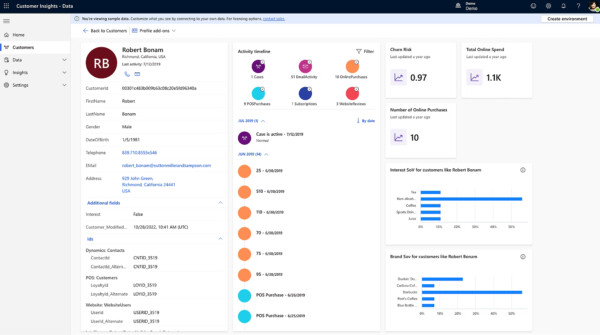
- Create an overview: Who last spoke to the customer?
Modern platforms such as Microsoft Dynamics 365 with Copilot make exactly that possible: They combine case management, customer history, channels and AI in one system – not as an end in itself, but as a real relief in everyday life. This leaves more time for what really matters: solutions instead of searching, proximity instead of follow-up.
Where do you stand today – and where do you want to go?
If you want to use AI in customer service in a meaningful way, you don’t just need tools – you need a realistic picture of your own starting position.
Self-check: How mature is your customer service for AI?
Find out how prepared your service processes are for intelligent automation today. Tick your boxes – and count your points at the end.
1. Do your service employees have access to all relevant customer information at all times – across all channels?
-
☐ Yes, all in one place (3 points)
-
☐ Partially, across multiple systems (2 points)
-
☐ No, a lot of manual research required (1 point)
2. How often do your agents access a structured, well-maintained knowledge base?
-
☐ Daily – it is a central part of work (3 points)
-
☐ Rare – not all information is available (2 points)
-
☐ Not at all – knowledge is usually in heads or e-mails (1 point)
3. How much time does it take on average for a customer to receive a qualified response?
-
☐ Within an hour (3 points)
-
☐ Within a day (2 points)
-
☐ More than one day or unclear (1 point)
4. Is your team already using AI-powered features in service today – e.g., suggested answers, text classification, or copilot?
-
☐ Yes, regular and structured (3 points)
-
☐ Partially – in pilot or as a supplement (2 points)
-
☐ Not yet – but is being considered (1 point)
5. How clearly and scalable are your service processes defined – e.g. when forwarding inquiries, escalations or reporting?
-
☐ Processes are clearly documented and automated (3 points)
-
☐ There are standards, but with many exceptions (2 points)
-
☐ Mostly solved individually, depending on the employee (1 point)

📊 Evaluation
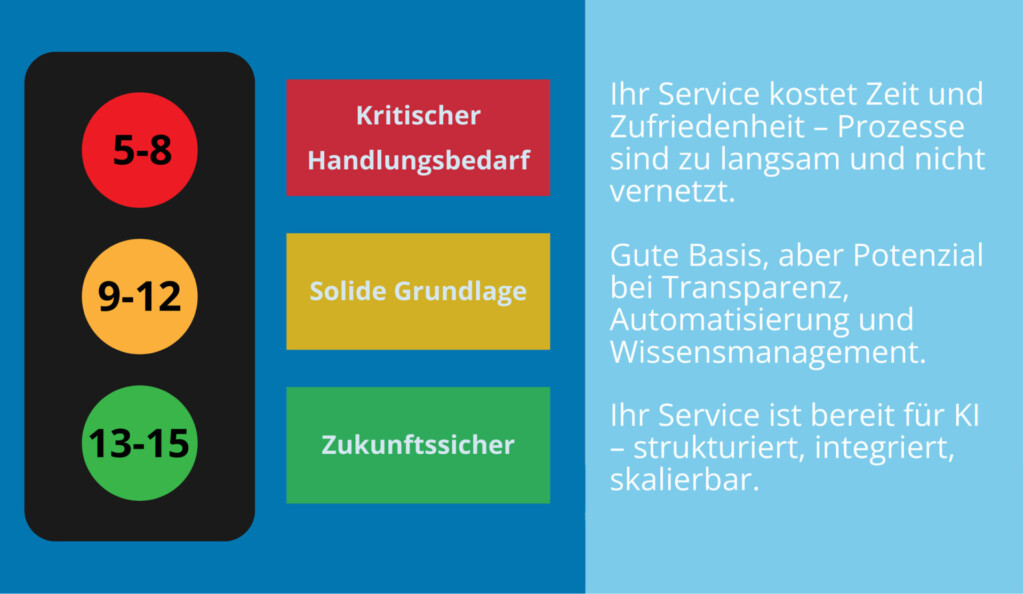
13–15 points:
🚀 Service as a strategic lever
Your customer service is structured – now you can use AI in a targeted manner to further scale efficiency and customer experience.
9–12 points:
🔧 Solid basis – with room for improvement
Your team has already laid good foundations. The next step is to better network data, automate processes, and make concrete use of AI potential.
5–8 points:
⏳ Time for the next leap in development
Many basics are still missing – but this is exactly where your opportunity lies. With clear pilot projects and a structured platform approach, progress can be made quickly.
Conclusion: Service can do more – if the basis is right
Today’s customers don’t just expect quick answers, they expect real solutions. If you want to achieve this, you need more than tools – you need clarity, structure and a system that turns information into real intelligence. AI can be a powerful accelerator in this regard – if it is properly embedded.
The first companies are showing how it can be done: They start with clearly defined use cases, rely on solutions with a platform character and quickly achieve noticeable success – in the team, with the customer, in the KPIs.
We would be happy to share insights from current projects – and show you which levers could be particularly worthwhile in your situation.