In 2026, companies will operate in a market environment that fluctuates faster than any classic planning can capture. Demand shifts at short notice, prices change dynamically, supply chains react sensitively and even minor operational disruptions often have a noticeable impact on margins and capacities. Strategic planning is thus becoming less a question of long-term plans – and more and more a question of the ability to run through scenarios precisely and quickly.
This is exactly where a new strategic advantage arises: companies that understand scenario planning not only as an annual exercise, but as a continuous process, make better decisions, react earlier and are more resilient in volatile markets. And they are increasingly using AI to map these scenarios in a data-based, dynamic and realistic way.
Why classic planning is no longer enough in 2026
In many organizations, planning continues to be based on fixed assumptions: stable demand, predictable costs, linear developments. But these assumptions no longer fit reality.
According to the PwC Global CEO Survey, 56% of CEOs feel like they are making “too blind” decisions because they lack realistic future scenarios. This is exactly where the pressure arises to think of planning no longer as an annual exercise, but as continuous scenario control.
Typical challenges:
-
Plan values change faster than they can be updated.
-
Dependencies between areas remain invisible – Sales plans differently than Operations, Finance differently than Delivery.
-
Risks become visible late because leading indicators are missing or not connected.
-
Budget and revenue forecasts are based more on gut feeling than data.
This form of planning works until the market changes, i.e. constantly.
Companies do not rely on poor planning, but on unregulated planning.
The risk: Make decisions too late or based on outdated information.
Scenario planning: not theory, but operational necessity
Scenario planning means not only having “the plan”, but understanding several possible realities at the same time:
-
What happens if demand increases by 20%?
-
What happens if it drops by 10%?
-
What happens if an important project is delayed by four weeks?
-
What are the effects of a price change or a change in customer behavior?
-
Which capacities are missing – and which remain unused?
-
How do costs, margins and cash flow shift?
These questions are not new.
What is new is that companies have to provide them on an ongoing basis, not just once a year.
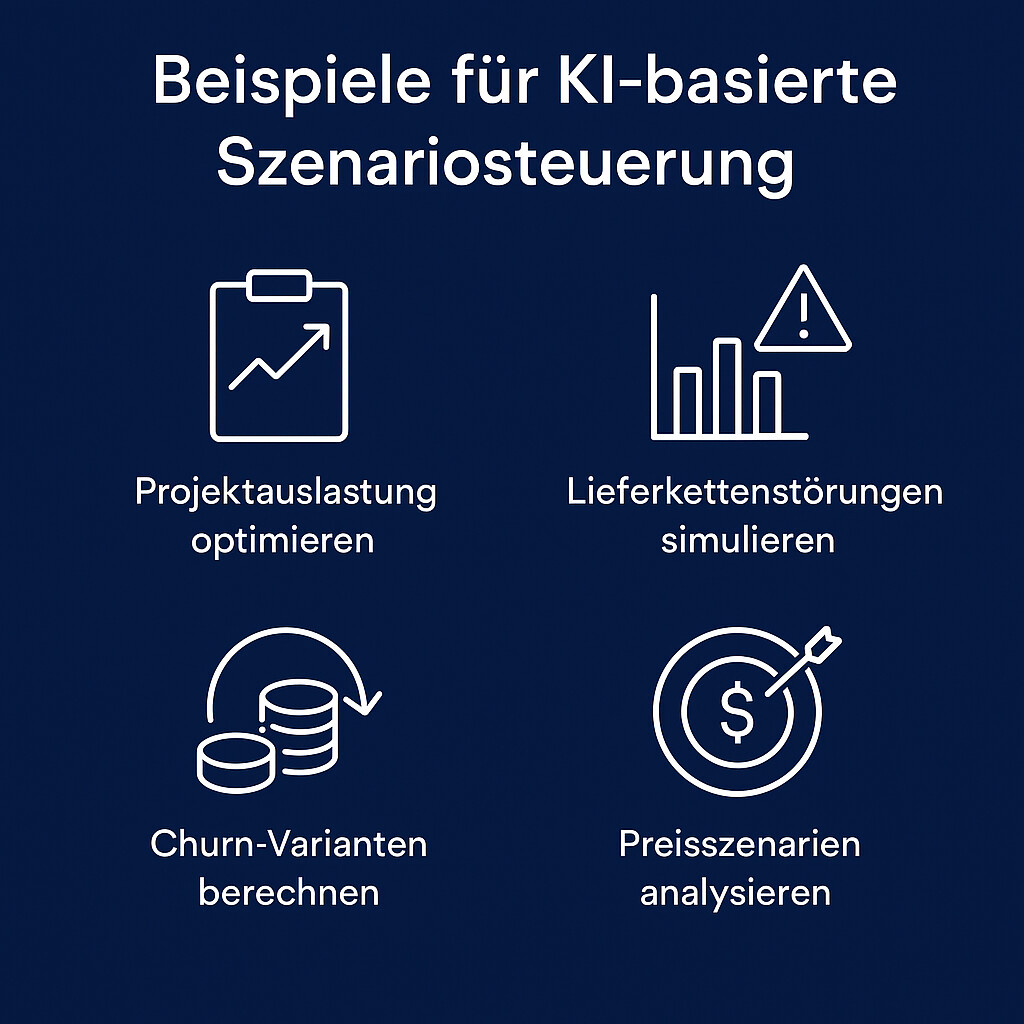

Why AI is the biggest lever here
AI is fundamentally changing scenario planning because it:
Recognizes patterns that humans don’t see
AI identifies correlations between demand, capacity, costs, seasonalities and external factors that are never visible in manual analyses.
Scenarios calculated in seconds
What used to take days to coordinate, Excel models or meetings can now be simulated within minutes.
probabilities instead of speculation
Instead of “perceived” assessments, AI provides reliable probabilities and effects.
Makes scenario planning continuous
Forecasts can be automatically adjusted every time demand, costs, or resources change—no manual cycle, no waiting for monthly reports.
Makes risks visible at an early stage
AI detects deviations before they become noticeable – and shows possible courses of action.
This makes scenario planning proactive instead of reactive.
What this means for companies in 2026
Companies that use AI-powered scenario planning win:
-
Higher quality of decision-making
-
More agility in volatile markets
-
Early warning indicators instead of surprises
-
Realistic sales and cost forecasts
-
Better resource and capacity planning
-
Greater transparency for finance, operations and management
And above all:
They react earlier – and make better decisions faster.
How modern platforms support
Modern data and AI platforms such as Microsoft Fabric, Azure AI , and Power BI make it possible to automatically create, compare, and continuously update scenarios.
Technology is not the focus here – but it is the enabler that makes modern scenario planning possible in the first place.
Conclusion
Scenario planning will become a key competitive factor in 2026.
Companies that not only plan, but also understand and manage possible futures, are better prepared, make more precise decisions and ensure long-term stability in a dynamic market environment.
15-minute impulse discussion
Want to know how your organization can strategically leverage AI-powered scenario planning?
In 15 minutes, you will receive a clear assessment of your potential – concrete, compact and tailored to your business model.