Othercompanies are already building AI agents that qualify leads, prepare project tasks, summarize service cases, or analyze financial data. Many others are still in the same place as they were two years ago: they chat with an AI tool and hope that productivity will emerge from it.
ChatGPT, Microsoft Copilot, and other AI assistants are valuable starters. But they are not the goal. The next step is to connect AI to data, processes, and concrete tasks. That’s where the difference between occasional support and productive automation begins.
Why chatting alone is not enough
A chatbot answers questions. An AI agent completes tasks within a defined framework. This difference sounds small, but it changes the way companies use AI.
If you work with ChatGPT, you get texts, ideas, summaries or analyses. This can relieve the burden on individual employees. But the benefits often remain individual. One employee saves time, another hardly uses the tool, and a third copies data manually between systems. This does not automatically make the company itself faster, more transparent or more scalable.
AI agents go further. They can be connected to systems, data sources, and tools. They read information, check submissions, create proposals, initiate workflows or prepare decisions. Microsoft describes exactly this development on the Microsoft Copilot Studio page: from simple prompt-and-response agents to agents that can execute complete workflows from start to finish.
This makes AI more relevant for companies. Not because the chat disappears, but because the chat becomes the entry point for real processes.
The market is moving towards agents
Microsoft names 2025 in the Work Trend Index as the year in which the “Frontier Firm” is created. This refers to organizations in which humans and AI agents work more closely together. According to Microsoft, 28 percent of managers are already thinking about hiring AI Workforce Managers. 32 percent are planning AI Agent Specialists to develop and optimize agents.
Gartner also sees rapid development. In a forecast for Agentic AI in Enterprise Applications , Gartner expects that by the end of 2026, up to 40 percent of enterprise applications could contain task-specific AI agents. At the same time, Gartner warns against “agent washing”, i.e. renaming classic assistants, chatbots or automations to agents without real agent capabilities.
This is important for companies. The market creates pressure, but not every agent project creates value. If you only test the next tool, you run the risk of generating effort without effect. On the other hand, those who select specific processes, prepare data and define clear responsibilities can make AI agents productive in a targeted manner.
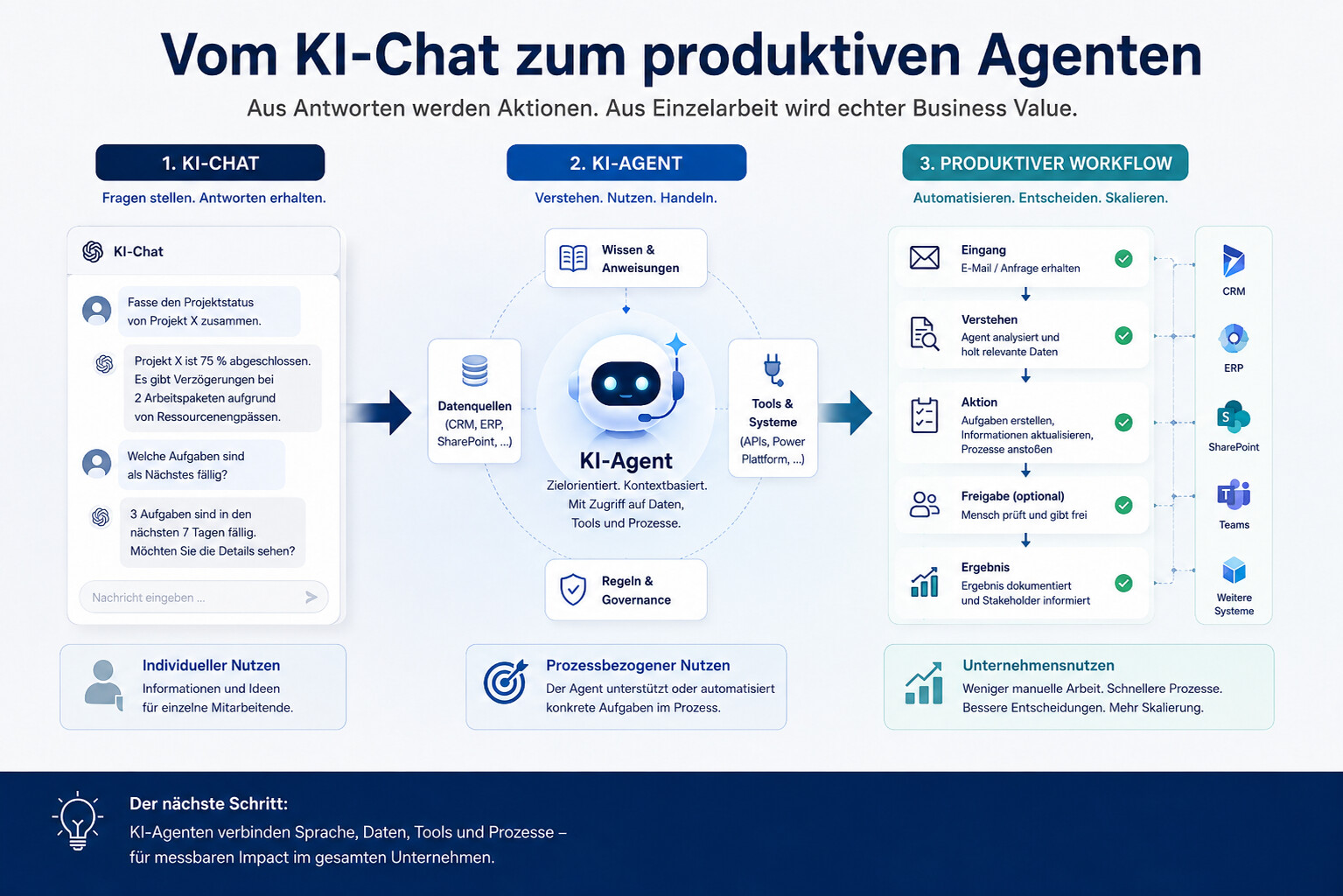

What distinguishes AI agents from classic AI assistants
AI assistants usually help reactively. They wait for input and provide an answer. AI agents are more focused on goals, tasks, and actions. You can use information from different sources, execute tool calls, plan intermediate steps and process results in a process.
The difference is particularly evident in everyday business life.
| Classic AI Chat | AI agent in the enterprise |
|---|---|
| answers individual questions | Supports or automates recurring workflows |
| often works without system context | Uses data from CRM, ERP, SharePoint, e-mail or specialist systems |
| generates text or analysis | can prepare tasks, update data, or initiate actions |
| Benefits often remain individual | Benefits arise in the process and become measurable |
| requires manual transfer | can be integrated via tools and interfaces |
An example from sales: A chat can help formulate an email to a lead. An agent can review incoming information, prepare a lead in the CRM, query for missing mandatory fields, create a summary, and get approval from an agent. Only then does AI become part of the sales process.
Why data and processes are becoming more important
The more an agent is supposed to do, the more important the foundation becomes. An AI agent needs access to the right information, clear rules, and clear boundaries. If data is incomplete, contradictory, or spread across different systems, the agent won’t automatically get better. It makes the weaknesses of the organization visible more quickly.
McKinsey describes in Building the foundations for agentic AI at scale that agents need consistent, interoperable data. Individual agents can make inconsistent decisions on fragmented data. Multi-agent systems can lose coordination or pass on errors if the database is not correct.
This is the crucial point for Data & AI. AI agents are not just an automation issue. They are a data and process maturity issue. Companies must clarify which data sources may be used, which systems are leading, which authorizations apply and when a human must intervene.
Good use cases are more concrete than “We need an agent”
Many companies start too broadly. They want “an agent for sales,” “an agent for HR,” or “an agent for projects.” That sounds ambitious, but it’s rarely a good starting point. A productive agent needs a clearly defined use case.
It is better to ask a specific question: Which recurring task takes a lot of time? Where do employees often have to gather information from several systems? Where do errors occur due to manual entries? Where is a proposal needed, but still a human release?
For project-based companies, such use cases can be particularly relevant. A project management agent can read project information, prepare tasks, or summarize status changes. A Lead & Opportunity agent can structure sales data and prepare new leads. A Secretary Agent can connect emails, calendars, and documents. An account intelligence agent can analyze customer data and provide indications of potential.
It is precisely this logic that fits the “from use case to productive AI agents” approach: It is not the agent that is at the beginning, but a clear business process that becomes faster, more transparent or better controllable through AI.
Microsoft Copilot Studio as an entry point into productive agents
For companies in the Microsoft ecosystem, Copilot Studio is particularly relevant because it can connect agents to Microsoft 365, Power Platform, Dynamics 365, Dataverse, SharePoint, and other data sources. Microsoft describes Copilot Studio as a platform to create agents, add knowledge and instructions, connect tools, build workflows, and operate agents securely.
The development towards autonomous agents is particularly interesting. Microsoft announced the general availability of autonomous agents on the What’s new blog in Copilot Studio: March 2025 . These can react to events via triggers and execute defined actions. According to Microsoft, actions remain visible via the Activity tab so that transparency and control are maintained.
This shows the direction: agents should not only answer, but work. At the same time, governance remains crucial. Companies must determine which actions an agent is allowed to perform themselves, when approval is necessary and how errors are detected.
Why not every process needs an agent
The hype around agents quickly leads to the wrong question: Where can we deploy agents? The better question is: Where does an agent add more value than a classic workflow, dashboard, or simple copilot?
Gartner warns in Gartner Predicts Over 40% of Agentic AI Projects Will Be Canceled by End of 2027 that many Agentic AI projects could fail due to lack of value, unclear costs, or inadequate risk management. Gartner recommends using Agentic AI where there is clear value or ROI.
This is not an argument against agents. It is an argument for better selection. An agent is especially worthwhile when a task involves multiple steps, requires different data sources, prepares decisions, and recurs regularly. For simple, linear processes, a classic Power Automate Flow may make more sense. For pure information queries, a co-pilot or a better knowledge search is often sufficient.

From Reading to Building: AI Agent in a Day Workshop
Many companies now know that AI agents are becoming relevant. The next question is more difficult: Which use case is really suitable for getting started and how does it create a first functioning agent?
This is exactly why INKUBIT offers the AI Agent in a Day Workshop . The workshop is not a lecture or a tool demo. They work on a prioritized use case, build an initial agent prototype with Microsoft Copilot Studio, and directly test how AI, data, and processes interact in their own day-to-day work.
The focus is on specific agent scenarios, for example for project management, lead and opportunity qualification, administrative tasks in Microsoft 365 or account intelligence. This turns an abstract AI discussion into a practical introduction to productive agents.
| Workshop step | Result |
|---|---|
| Select | Clarity on which process is suitable for a first agent |
| Build | First working prototype with Microsoft Copilot Studio |
| Test and Customize | Better understanding of data, tools, instructions, and limitations |
| Defining | Concrete path for further development and scaling |
The most important effect: Teams not only experience what AI agents can theoretically do. You can see which prerequisites are already in place in your own company and where data, processes or governance still need to be prepared.
To the AI Agent in a Day Workshop
Why AI agents are a business topic
AI agents are often discussed technically. But its real value lies in the business result. You can reduce manual work, make knowledge more usable, shorten lead times and prepare decisions. However, this can only succeed if they are linked to real processes.
This creates a new task for management. It is no longer enough to provide employees with ChatGPT or Copilot. Companies have to decide which processes should be changed by AI. You need to define how people and agents work together. And they need to ensure that data, governance, and accountability grow with them.
The competitive advantage does not come from a company chatting more with AI. It is created by AI measurably improving operational processes.
Conclusion: The chat was the beginning, not the goal
ChatGPT has shown many companies how accessible AI can be. But the next step is bigger. AI agents connect voice, data, tools, and processes. You can prepare tasks, support decisions, and automate workflows.
This is exactly why companies should not stop at chat use now. You should check which recurring tasks are suitable for productive agents, what database is necessary for them and which governance needs to be built in from the beginning.
Anyone who only chats today gains experience. Anyone who builds agents today creates structures for measurable business value.
FAQ
What are AI agents in the company?
AI agents are systems that can not only answer questions, but also perform or prepare tasks within a defined framework. They use data sources, tools, and instructions to support business processes.
What is the difference between ChatGPT and an AI agent?
ChatGPT is often used for individual questions, texts or analyses. An AI agent is more involved in processes. It can use information from systems, execute work steps, prepare results and obtain human approval if necessary.
When is an AI agent worthwhile?
An AI agent is particularly worthwhile for recurring tasks with multiple steps, multiple data sources, and clear business value. Examples include lead qualification, project status, service cases, meeting preparation, or data analysis.
Do companies need clean data for AI agents?
Yes. The more an agent is supposed to act, the more important clean, available and linked data becomes. Without a clear database, errors, inconsistencies and manual rework increase.
What is the role of Microsoft Copilot Studio?
Microsoft Copilot Studio can be used to build agents, connect knowledge, connect tools, and design workflows. It is particularly relevant for companies that already use Microsoft 365, Dynamics 365, Power Platform or Dataverse.
Do AI agents have to work completely autonomously?
No. In many business processes, a human-in-the-loop makes sense. The agent prepares information or actions, a human checks and releases. This creates productivity without losing control.