


Project management rethought: Why digitization makes the difference!
In today’s fast-paced business world, companies are continuously challenged to optimize their processes in order to remain competitive. Project management plays a crucial role in the successful implementation of strategic initiatives and the achievement of business goals. In this context, the digitization of project management is becoming increasingly important. Managing projects manually can be time-consuming, error-prone, and inefficient. The integration of digital tools and technologies into project management can offer companies decisive advantages. In this article, we’ll dive into exactly why companies should seriously consider digitizing their project management processes to succeed in today’s dynamic business world.
89%
of companies see project management digitally in the future.
“Digitally, the project is more result-oriented than ever before.”
– Project management study

The challenges for successful project management
Time management
Meeting schedules and deadlines is crucial, but it can be complicated by delays and unforeseen events.
Quality Management
Ensuring high quality standards in all project phases requires close monitoring and control.
Budget control
Meeting the project budget requires accurate accounting and management of costs and expenses.
Communication
Effective communication is crucial, both internally within the team and externally with stakeholders and customers.
Resource management
Efficiently allocating staff, budget, and other resources can be challenging, especially in larger organizations.
Project management and its hurdles
Project management is undoubtedly crucial to the success of companies in today’s business world. The definition underlines the importance of efficient planning, implementation and monitoring of projects to ensure that the agreed objectives are achieved within the established technical, schedule, personnel and financial frameworks. However, despite this clear definition, project managers and teams often face numerous challenges that can jeopardize the smooth running of the project.
One of the first stumbling blocks in project management is faulty communication. At a time when teams are increasingly working remotely, regular, face-to-face communication is becoming increasingly difficult. This is where digital solutions come into play that facilitate team communication. Video chats, recording capabilities, and chat integration are valuable tools to maintain collaboration.
Another common challenge is unrealistic cost estimation. Budgets are often tight, and accurately estimating costs is crucial. Digital tools can help to create realistic cost estimates, stay within budget frameworks and process invoices efficiently.
During project planning, it is of great importance to work out the project plan in detail. Failure to invest sufficient time in goal definition, resource planning and milestone setting can lead to problems later on. This is where digital planning tools and dashboards can help document and adapt all relevant information.
Another common problem is unclean reporting. Status reports can be time-consuming, but digital solutions can reduce the effort and make important data more accessible. Interactive real-time dashboards provide informed metrics and visualizations that support decision-making processes.
Poor collaboration, especially when collaborating across locations, can lead to longer response times and inefficient work processes. Digital collaboration tools such as SharePoint or Confluence can increase productivity by providing remote-enabled online and offline capabilities.
Finally, the lack of effective project controlling is another risk. Non-transparent project results and the increased risk of not achieving project goals are possible consequences. Online controlling boards enable the monitoring of key project metrics and facilitate the review and analysis of deviations.
Overcoming these challenges requires not only adapting processes, but also implementing digital solutions that increase efficiency and transparency in project management. The right tools and the ability to use them effectively can make all the difference to project success and ensure that projects are completed smoothly and successfully.
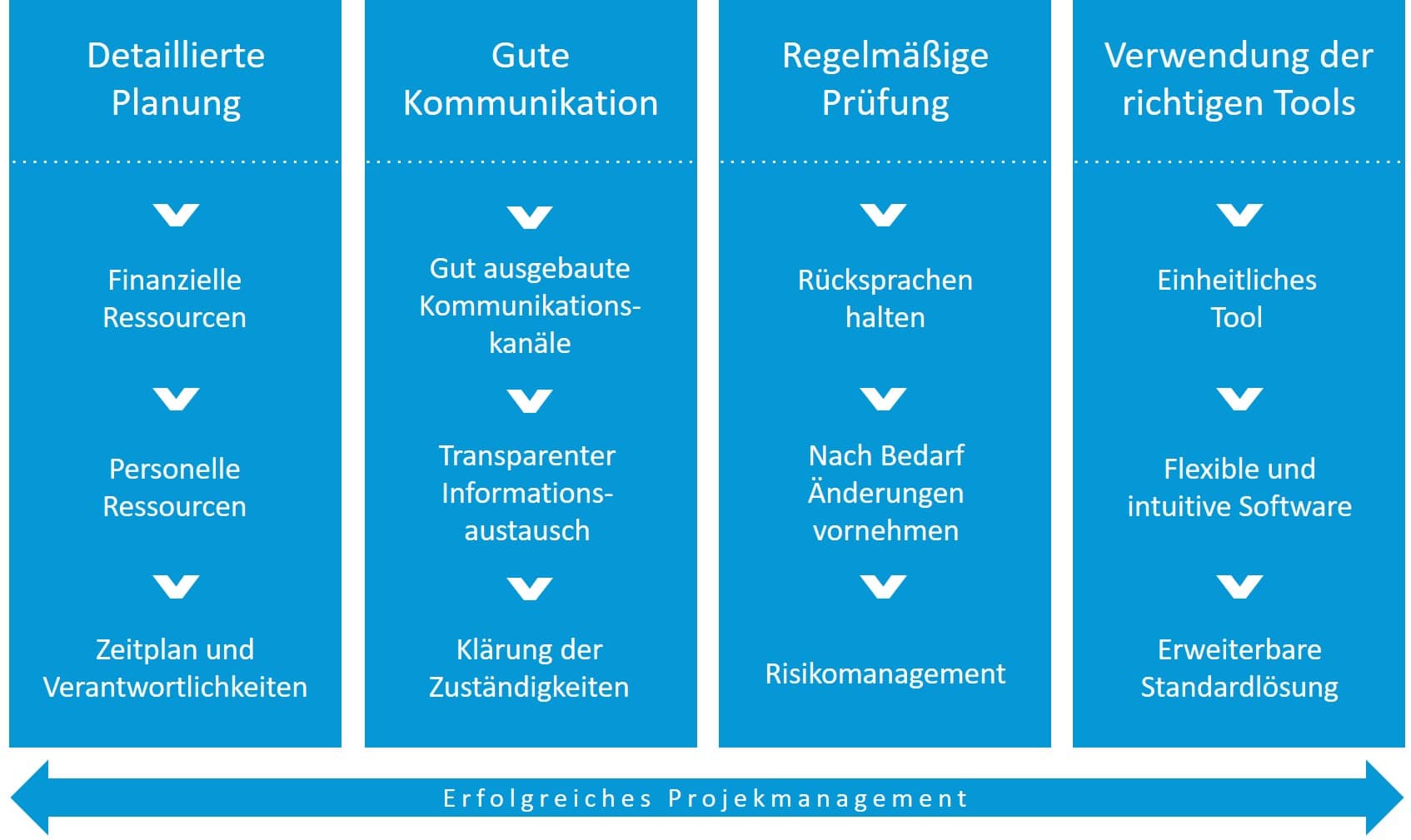
Why choose project management software?
The use of digital solutions in project management offers companies an effective tool for the successful implementation of their goals. These technologies enable more precise planning and control of projects, which means that project goals can be achieved on time, with high quality and within budget . Companies that continue to operate without suitable software run the risk of putting more effort into it and making less profit. This results from the increased time spent on organizational tasks and the susceptibility to human error, which can be avoided by leveraging IT solutions.
In terms of future trends in project management, digitalization is crucial to keep up with the competition. An important challenge is to optimize the utilization of existing employees and to react flexibly to new requirements and areas of knowledge. This requires better support for the variable planning of scenarios. Here, IT solutions such as predictive analytics can help to make the unplannable plannable.
Pros
Features of the Microsoft Dynamics 365 Project Operations solution
Efficient resource management and project planning
- With features such as resource planning and Microsoft Project Integration, Microsoft Dynamics 365 Project Operations enables streamlined assignment of project collaborators based on competencies and availability.
- The application supports the management of project budgets and costs, whether they are time & material or fixed-price projects.
Project Management KPIs and Visualization
- The application provides dashboards and reports to monitor project management metrics (KPIs). This allows for greater control over project profitability in the bidding process and monitoring of project budgets down to the project task level.
- Visualization of project resources, costs, and efforts against revenue makes it easier to monitor and control projects.
Seamless integration and use
- Microsoft Dynamics 365 Project Operations leverages the same platform, Dynamics 365, as other Microsoft business applications, which makes integration easier and reduces the risk of data silos.
- Integration with Microsoft 365 seamlessly integrates communication and collaboration tools such as Teams, SharePoint, and Outlook.