


Clarity, Not Chaos: How Intelligent Data Integration Drives Your Business Forward
Welcome to the era of data-driven companies, where the efficient handling of information is the key to success. In a world permeated by a constant flow of data, the need for enterprise data integration is becoming increasingly important. Organizations are challenged to unify their diverse data sources to gain clear insights and optimize operations. In this landscape of digital transformation, the ability to seamlessly integrate and harmonize data is a key competitive advantage.
But unifying business data is not only a necessity, but also a strategic initiative for your company’s success. In this introduction, we’ll explore the basics of data integration, understand why it’s essential for businesses, and take a look at powerful solutions that enable this transformation.

In a nutshell
EDI reduces data silos, duplicates, and errors, improving the quality and accuracy of data. A single source of truth minimizes the risk of inconsistencies and enables a unified view of data brought together from different sources.
The challenge of integrating your data
Diversity of data sources
Companies often work with different types of data sources and formats. Integrating this diverse data can be complex, especially if the systems are not standardized.
Lack of IT expertise
The lack of specialized professionals can make it difficult to implement and maintain integration solutions.
Scalability
Data integration requirements can change quickly for businesses, especially as the business grows. The ability to scale integration solutions accordingly can be challenging.
Complex compliance requirements
Ensuring compliance can add an additional burden to data integration.
Data security
Ensuring data security when integrating different systems can be challenging.
Limited resources
Small and medium-sized enterprises (SMEs) in particular often have limited financial and human resources. However, implementing enterprise data integration often requires investment in technology and skilled workers.
Resistance to change
There can be resistance to change, especially if employees are already used to existing processes. The introduction of new integration methods may require an adjustment of the way of working.
Unraveling the data jungle
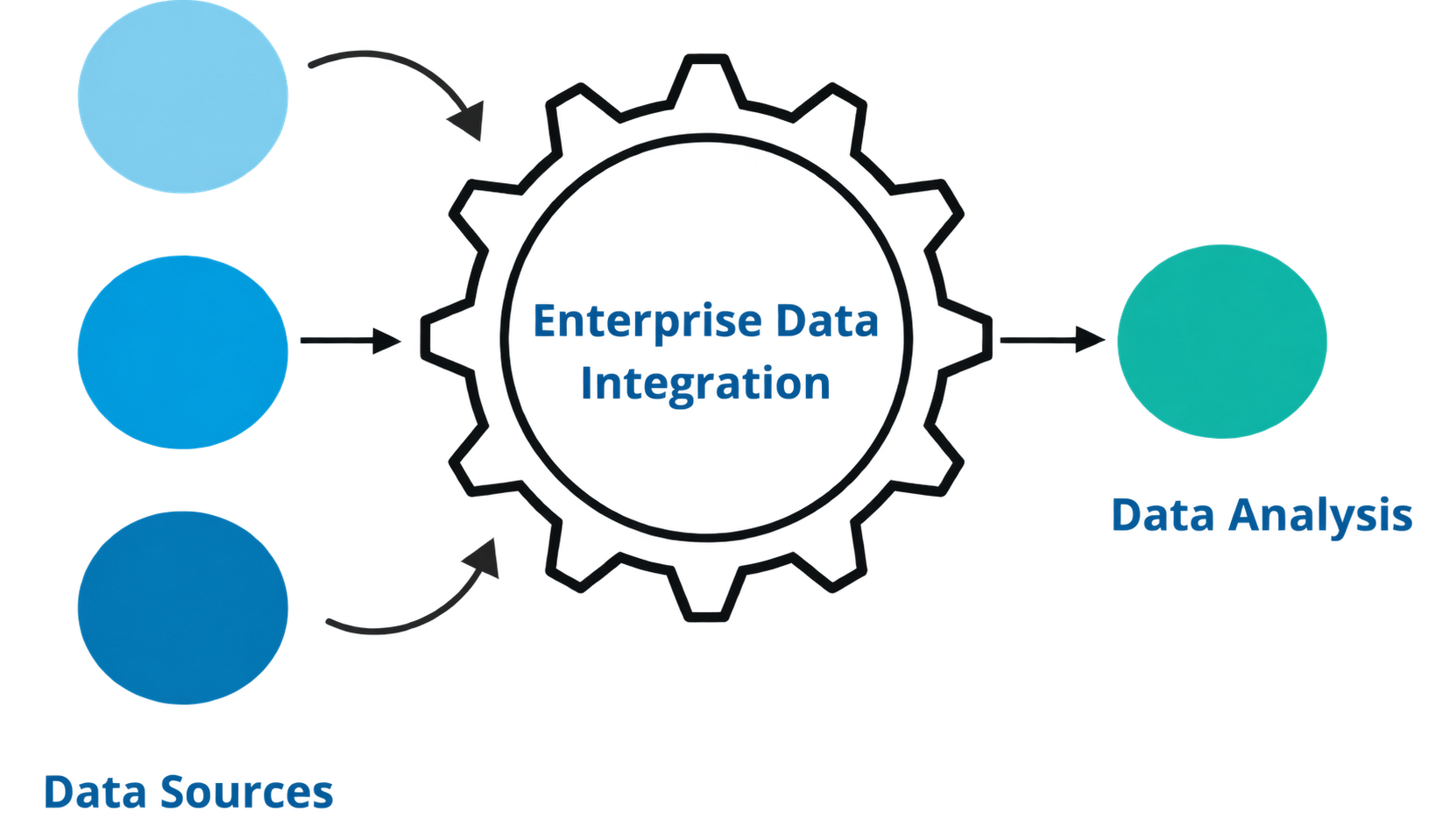
The challenge of integrating data from multiple sources is a key concern for businesses in today’s digital era. With an increasing variety of data sources, ranging from internal systems such as CRM and ERP to external sources such as social media, the need to unify these heterogeneous data streams is at the forefront. The challenges range from different data formats and structures to divergent quality standards and real-time requirements. Effective data integration means not only overcoming these hurdles, but also ensuring that the integrated data is coherent, consistent, and accurate. The key is to implement advanced technologies and strategies to ensure a seamless flow of data that enables organizations to gain meaningful insights and make informed business decisions. Because: The evaluation is only as correct as the underlying data.
Digital solutions and data integration
Digital solutions for enterprise data integration are revolutionizing the way organizations manage, analyze, and use their data. By using advanced technologies such as artificial intelligence (AI), machine learning (ML), and cloud computing, businesses can seamlessly integrate data from multiple sources. Automated processes not only enable faster data integration, but also continuous adaptation to changing requirements. Cloud-based solutions offer scalability and flexibility, while big data technologies make it possible to process large amounts of data in real time. Visualization tools provide a clear view of integrated data, and advanced analytics enable informed decisions. By implementing digital solutions for enterprise data integration , companies can not only increase their operational efficiency, but also gain a competitive advantage through improved data quality, transparency, and agility.
Next Level: EDI and AI
The integration of Enterprise Data Integration (EDI) and Artificial Intelligence (AI) marks a significant advance in data processing and decision-making for businesses. The use of AI technologies in EDI systems takes the automation of data integration and analysis to a new level. AI enables the intelligent processing of large amounts of data, the recognition of patterns and the prediction of future developments. In the EDI context, AI can help efficiently integrate complex data from different sources, detect errors, and continuously improve data quality.
Machine learning allows the system to learn from past experiences and adapt to new circumstances. This leads to more agile, data-driven decision-making and helps organizations gain valuable insights from their data that go beyond traditional integration methods. The synergy of EDI and AI creates a powerful platform for a data-driven future for businesses.
Features of our Microsoft solutions
Azure Integration Services provides a comprehensive and flexible enterprise data integration (EDI) solution. Through a range of services, it enables the seamless integration of different data sources and formats. The Azure Data Factory, as an integral part, enables the visual design and execution of data pipelines, allowing organizations to integrate data from over 90 built-in connectors at no additional cost. The scalable capabilities of Azure Integration Services enable organizations to adapt their data integration strategy to meet changing needs. The integration of on-premises data centers into cloud systems ensures greater efficiency and flexibility in data processing.
Azure AI and machine learning extend the possibilities of enterprise data integration through intelligent analysis and prediction. With advanced analytics tools, such as Azure Data Factory, companies can use AI algorithms to identify patterns in their data. Azure Machine Learning Studio provides an easy-to-use environment for developing, training, and deploying machine learning models. This enables predictive data integration, where the system responds to changing patterns to continuously optimize integration. Combining Azure AI and machine learning with EDI gives organizations the ability to make not only reactive, but also proactive decisions based on their data.
Power BI, as part of the Microsoft Power Platform, is a powerful data visualization solution that integrates seamlessly with Enterprise Data Integration (EDI). It allows users to aggregate, transform, and visualize data from various sources to gain meaningful insights. By integrating Power BI, organizations can not only monitor their integrated data in real-time, but also create custom dashboards to track key performance metrics. The integration of Power BI with Azure Services enables a holistic data strategy where organizations can not only integrate their data, but also maximize its value through engaging visualizations.