Companies today have more data than ever before. At the same time, many finance teams struggle to quickly derive the right insights from it. Information is scattered across different systems, reports are compiled manually, and key metrics are often available only after a delay.
However, transparency is becoming increasingly important, especially for CFOs and finance executives. Decisions must be made more quickly, forecasts must be adjusted more frequently, and senior management and business units expect up-to-date figures at all times. This is precisely why many traditional reporting approaches are increasingly reaching their limits.
Why Reporting Has Become More Complex for Finance Teams
The demands placed on finance departments have changed significantly in recent years. Whereas monthly and quarterly financial statements used to be the main focus, companies now expect information to be available in near real time.
In addition to traditional financial data, project figures, sales data, budgets, forecasts, and operational metrics often need to be taken into account as well. At the same time, requirements for compliance, documentation, and traceability are increasing.
Many finance teams respond to this by creating additional reports, new Excel files, or custom analyses. This often results in increasingly complex reporting environments that are time-consuming yet still fail to provide complete transparency.
The problem: Too much data, not enough clarity
In many companies, information is stored in different applications. Financial data is in the ERP system, sales figures are in the CRM, project information is in separate solutions, and additional reports are maintained in Excel.
This creates several challenges. Numbers must be reconciled manually, different versions of reports lead to discussions, and data quality suffers as a result of duplicate data entry.
This poses a significant risk for CFOs. Decisions are not always based on the same information, and important developments are sometimes not recognized until valuable time has already been lost.
The real problem for many companies, therefore, is not a lack of reporting. What is missing is a central and reliable basis for decision-making.
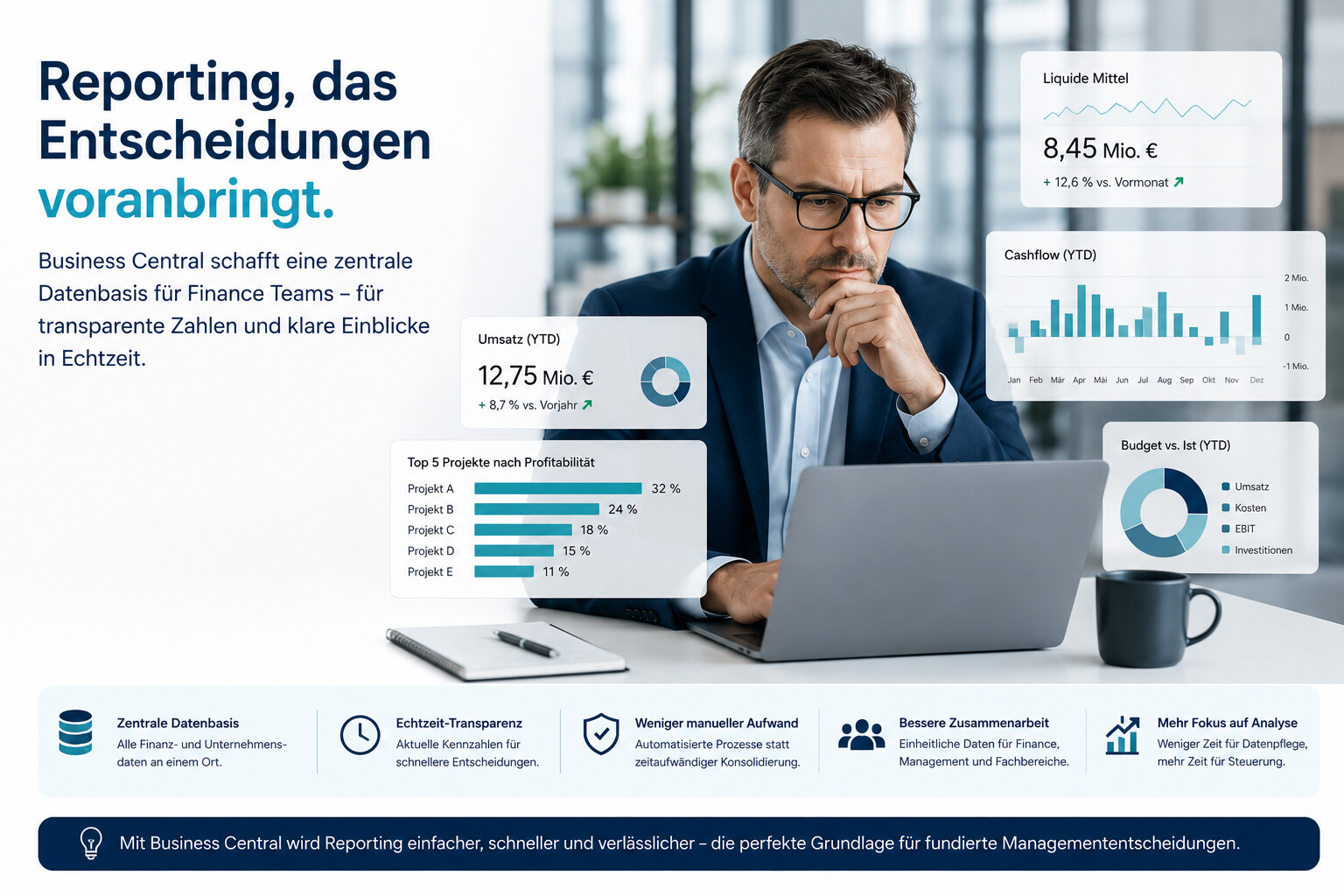

Why Traditional Excel Reports Are Often No Longer Sufficient
Excel remains an important tool for many finance teams. At the same time, as data volumes grow and complexity increases, the application is increasingly reaching its limits.
Manual consolidations, different file versions, and time-consuming reconciliation processes result in a significant amount of work. The more people involved in creating reports, the more difficult it becomes to ensure a consistent data set.
This becomes particularly critical when it comes to forecasts and management reports. When figures from different sources have to be manually consolidated, delays and potential sources of error arise.
That doesn't mean Excel is going away. Rather, the finance department needs a platform that serves as a central database and provides consistent information.
How Microsoft Dynamics 365 Business Central Simplifies Reporting
Microsoft Dynamics 365 Business Central takes exactly this approach. Instead of spreading data across different applications, financial and business data are consolidated in one place.
This provides a consistent view of the company. Finance teams work with up-to-date information and spend significantly less time consolidating data.
This is particularly relevant in the following cases:
| Challenge | Traditional Approach | Business Central |
|---|---|---|
| Data Sources | Multiple systems | Central Database |
| Reporting | Manual Consolidation | Automated Analyses |
| Transparency | Different versions | Standardized Key Performance Indicators |
| Forecasts | High manual effort | Real-time data |
| Management Reports | Delayed Deployment | A Faster Basis for Decision-Making |
This shifts the focus from data collection to analysis and control.
Why Real-Time Data Is Becoming Increasingly Important for CFOs
The pace of decision-making is constantly increasing. Companies can less and less afford to wait several weeks for meaningful data.
When it comes to liquidity, profitability, project development, or budget variances, up-to-date information is increasingly becoming a competitive advantage. Modern ERP systems make it possible to identify trends early on and respond more quickly.
Business Central supports this approach with up-to-date data and integrated reporting capabilities. This provides finance teams with a significantly better foundation for forecasts and management decisions.
The Role of Power BI and Modern Analytics
Another advantage is the integration with Microsoft Power BI. Data from Business Central can be used directly for dashboards and management reports.
This results in interactive analyses rather than static reports. Executives can examine key metrics in greater detail, track trends, and identify deviations more quickly.
For CFOs in particular, this provides greater transparency regarding:
- Financial Ratios
- Cash flow
- Budget Trends
- Project Profitability
- Revenue Trends
At the same time, the effort required to create and update reports is significantly reduced.
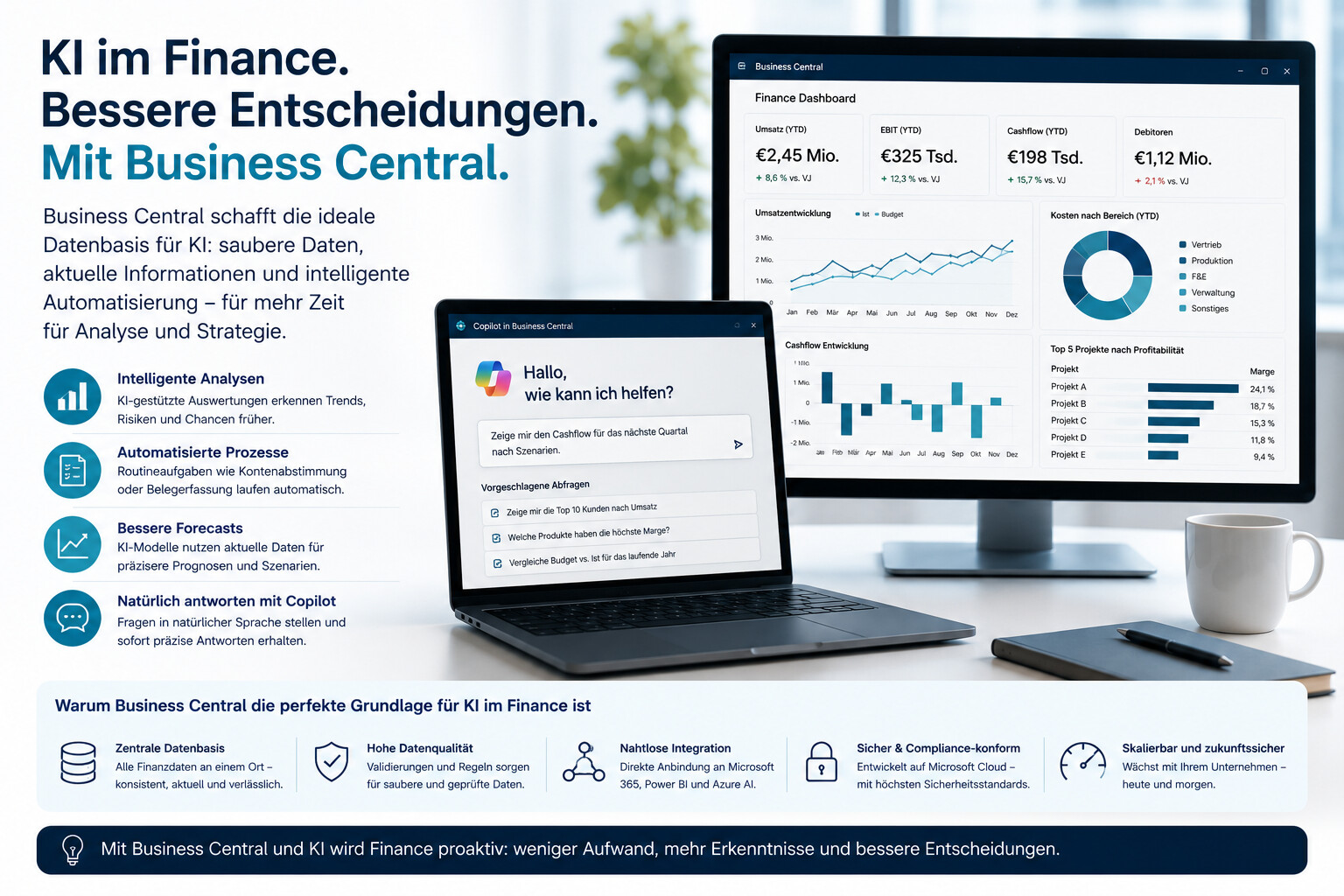

Why Reporting Today Goes Beyond Finance
Modern financial management no longer ends with accounting. Executive management, sales, project management, and other departments also need reliable information.
As a result, reporting is increasingly becoming a company-wide responsibility. The quality of decisions depends directly on the quality and availability of the underlying data.
Business Central supports this approach through a shared database that connects different areas. This reduces data silos and improves collaboration between business units.
What Business Value Does Greater Transparency Create?
Many companies initially view reporting as a necessary administrative task. In fact, however, transparency has a direct impact on business results.
When up-to-date information is available more quickly, risks can be identified earlier and opportunities can be seized more quickly. Forecasts become more reliable, decisions are better informed, and operational processes are easier to manage.
For CFOs, this means one thing above all else: less time spent on data collection and more time devoted to analysis, management, and strategic decision-making.
Conclusion
The biggest challenge facing modern finance teams is not obtaining more data. The challenge is having the right information available at the right time.
Business Central provides a central foundation for this. Through a unified database, modern reporting capabilities, and integration with the Microsoft ecosystem, companies gain greater transparency and a faster basis for decision-making.
It is particularly clear to finance teams with demanding reporting requirements that modern ERP systems are no longer just accounting software. They are becoming the central platform for corporate management and financial transparency.
FAQ
Why are reporting requirements higher today than they used to be?
Companies must respond more quickly to market changes and, to do so, need up-to-date and reliable information.
What benefits does Business Central offer finance teams?
Business Central creates a centralized database, reduces manual processes, and improves transparency and reporting.
Is Excel Still Sufficient for Modern Financial Reporting?
Excel remains important, but it often reaches its limits when dealing with complex data environments and increasing reporting requirements.
How does Business Central support management reports?
With up-to-date data, automated analyses, and integration with Power BI, reports can be created and analyzed more quickly.
Why is real-time data important for CFOs?
They enable faster decision-making and help identify risks and opportunities early on.
What role does Power BI play in reporting?
Power BI enhances Business Central with modern dashboards, analytics, and interactive reports.