


Companies differ in their processes just like their employees themselves.
Due to the current situation, many companies are forced to take the first step into digitalization. And rightly so: In the future, Human Resource Management (HRM) will no longer be driven by routine manual activities, but by automated processes. This allows HR staff to spend less time on administrative and more on strategic HR tasks. Through digital HR processes, HRM can make data-driven decisions and thus contribute added value to the company’s success.
On the basis of the HR strategy, which takes into account the influences of digitalization, HR processes and HR structures must be optimized or redesigned appropriately and the right HR IT must be used.

48%
of employees feel burnt out, according to Microsoft’s Work Trend Index .
This underlines the need for precisely aligned strategies in your HR & employee management.
Guiding principles for your digital HR strategy
Applicant and employee orientation
Start and end processes with the applicant or employee for a conscious “Candidate Experience Design” or “Employee Experience Design”.
Customization
Align processes with the specific applicant or employee using algorithms and artificial intelligence (AI).
Simplicity
Design processes in such a way that they are perceived as easy to use, e.g. through an intuitive user interface.
Agility
Adapt HRM to constantly changing environmental influences quickly and in a targeted manner.
Evidence-based
Use of HR analytics tools or artificial intelligence to simplify personnel decisions with information-based ones.
Efficiency orientation
Have recurring routine tasks carried out by algorithms and thus increase efficiency, e.g. through digital personnel files and workflow systems.
Scalability
Expand processes that can be digitized at near-zero marginal cost.
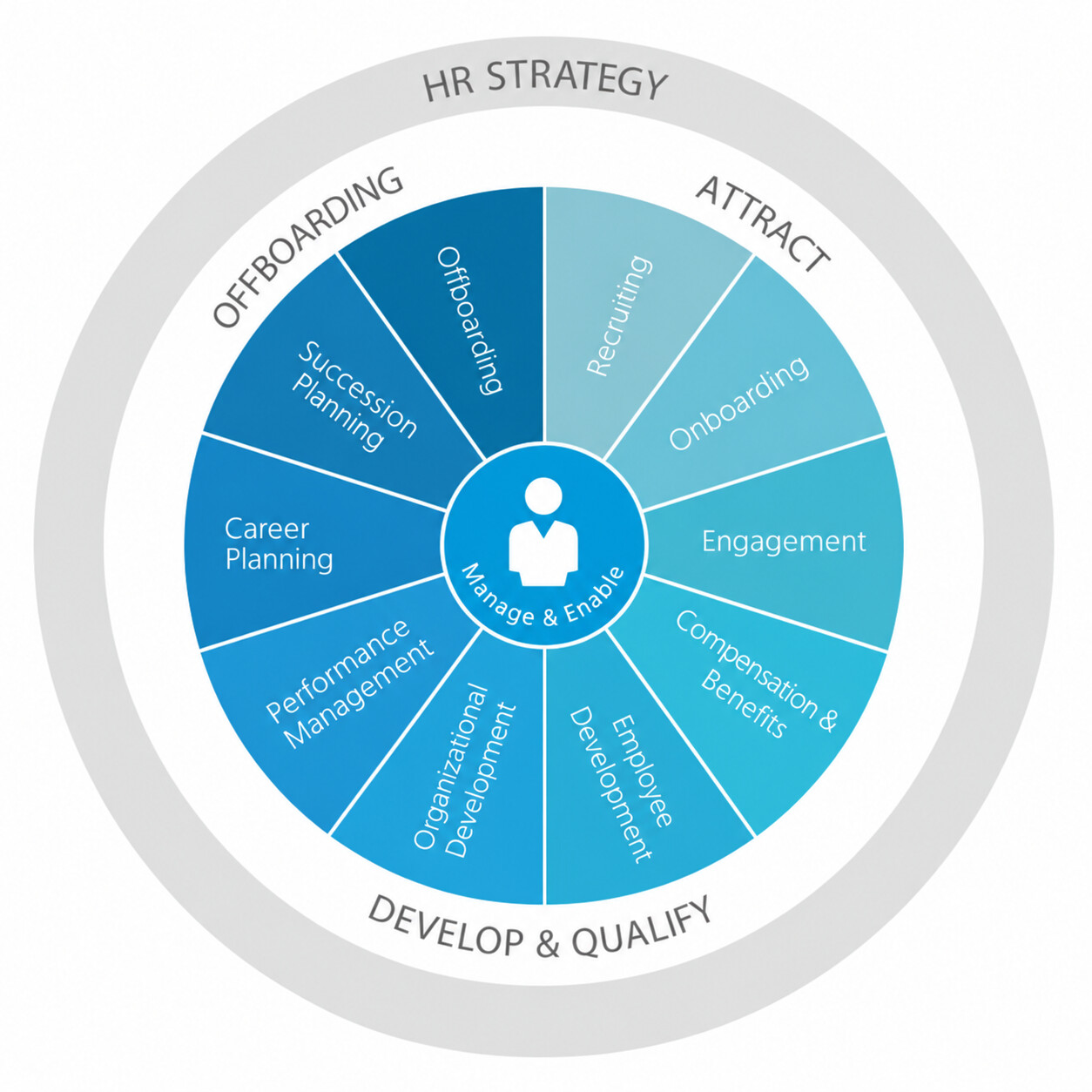
The employee lifecycle
The goal is to create the best possible employee experience. Employee experience encompasses the impressions and feelings that employees gather during their employment with a company. It ranges from the hiring process to the experiences in everyday office life to leaving the company.
So intervene where your employee is currently and support him as an HRM in every phase of the employee life cycle: A goal-oriented strategy combined with efficient HR processes increases the commitment of your employees and at the same time promotes the sustainable development of your company.
In order to withstand the diverse challenges and changes in the HR sector, such as demographic change, a shortage of skilled workers and digitalisation, a holistic approach is required.
HRM is therefore responsible for preparing companies and their employees for future challenges. This gives HRM a completely new understanding of its role. The HR employee turns from a pure administrator into a creative innovator, a source of inspiration for value development and a business partner of the company and thus finds himself between the employees and the management.
With the ability to automate processes and repetitive tasks, HR staff can focus on both creative and strategic issues. The use of HR information systems also leads to an increase in efficiency for companies and HR managers themselves.
Digital Agenda
of HR & Employee Management
HR managers must decide whether HRM can take advantage of the new digital possibilities, e.g. in an HR management system, such as Hubdrive, in order to increase one’s own strategic contribution to the company’s success. This is called the digital agenda of HRM . The digital agenda of HRM pursues the goal of providing HR managers of a company with a tool to actively shape their own position in the context of the digitization of the company. This allows HRM to act entrepreneurially on the one hand and to focus on individual customer requirements on the other.
Fields of action of the digital agenda of the HRM are consumer orientation, workforce analysis and reorganization of work. The goals of HRM’s digital agenda are a more effective HR function, better employee decisions and an agile company.
| Konsumentenorientierung | Arbeitskräfte-Analytik | Neuorganisation von Arbeit |
|---|---|---|
| Komplexitätsreduktion | Deskriptive Analytik | Netzwerke und Zusammenarbeit |
| Digitales Lernen | Personalplanung | Fähigkeitsmanagement |
| Digitales Zuhören | Prädiktive Analytik | Führung in Netzwerkorganisationen |
| Effektivere Personalfunktion | Bessere Mitarbeiterentscheidungen | Agileres Unternehmen |
Goals of HR Analytics & KPIs
HR departments should be able to better understand past decision-making based on information data and thus make their planning more effective in the future. This is because the accumulations and representations of data in digital form are the basis for evaluations of actions and support business decisions.
Key Performance Indicators (KPIs) are business performance indicators that refer, for example, to the success, performance or capacity utilization of a company or its units. The use of KPIs in the form of personnel KPIs enables HRM to monitor clearly defined organizational goals of HRM. These are usually related to the optimization and further development of recruitment processes. Optimize your recruiting with key KPIs such as cost-per-hire or time-to-hire. Orientation based on such data can support HRM in the future recruitment of new employees.

What are KPIs for?
Advantages of
Digital HR & Employee Management
Our HRM offering helps you to use information in a smart way in your company. This offers decisive advantages:
- Cost and time savings through the fast retrieval of information
- More efficient work distribution and optimized processes
- Relief from administrative tasks thanks to uniform digital filing
- Access to employee data regardless of location and time
- By involving employees in data maintenance, you create greater transparency and greater employee satisfaction
- Lower material costs due to a paperless office
- Simple visualizations and evaluations of KPIs
- Faster strategic decision-making
- User-friendly and easy operation of the system
Features of the HR Management for Microsoft Dynamics 365 solution
Our (digital) solution:
Our first choice for a holistic HR management system: Hubdrive HR Management. The solution provides the basic functions for your employee management and complements them with all the useful functions related to your employees – from talent sourcing in recruiting, time management, vacation requests, employee evaluations and skills analysis to succession planning and retirement.
Viable digital foundations for HR processes
As a prerequisite for all your sustainable optimizations, it is important to define efficient workflows and automate them with digital solutions. Only then can HR managers consider how they want to further expand the digital transformation . You can also reduce the complexity of your company with software-supported management that accurately reflects your company structures, hierarchies and job descriptions.
Digital personnel file
Make your work even more efficient across departments by enabling your employees to maintain their digital personnel files independently through so-called employee self-services. Tasks that were previously handled by HR staff are managed independently by employees or by applicants, such as profile updates, training, performance tracking and leave requests.
Artificial intelligence in HR service
By using “virtual” HR employees in the form of so-called “chatbots”, many recurring inquiries can be processed automatically. The response times of virtual HR employees are significantly shorter than those of real HR employees.