Without data governance, your AI will be inaccurate, unreliable—and expensive
Many companies are embracing AI—but neglecting the foundation: controlled, high-quality, and secure data. This is a strategic mistake. After all, a lack of data governance leads to conflicting reports, legal risks, and AI results that no one trusts.
If you don’t establish a data governance strategy now, you risk not only slower decision-making but also compliance violations and a loss of strategic agility. While others are already optimizing their data infrastructure for AI-driven processes, you’ll remain stuck in reactive mode.
What is data governance?
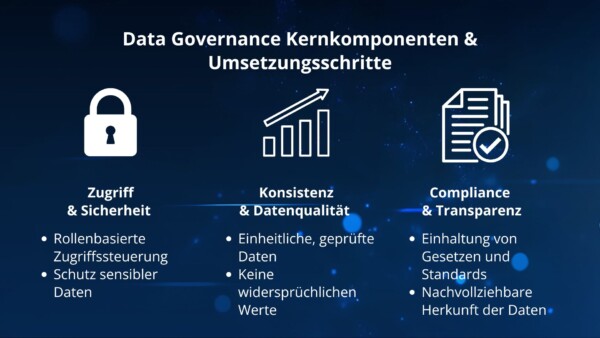
Data governance is a structured framework of policies, processes, roles, and technologies that ensures data is accurate, secure, consistent, and usable. It goes far beyond data protection or IT security. Governance encompasses:
-
Quality: Complete, error-free data
-
Access: The Right Data for the Right People
-
Compliance: Adherence to all regulatory and legal requirements
-
Transparency: Origin and use can be traced at any time
These principles are not merely theoretical requirements—in the age of AI, they determine the reliability of results, the speed of decision-making, and the scalability of new projects.
Why Data Governance Is Essential in the Age of AI
AI models are only as good as the data used to train them.
Without proper governance, the rule is: garbage in, garbage out.
The challenges are clear:
-
Reliable data for AI models: Without quality, there can be no reliable analyses
-
Increasing regulatory requirements: data protection, ESG, and industry-specific regulations
-
Exploding data volumes: Without governance, there is a risk of losing control
-
Speed as a competitive advantage: Streamlined processes reduce coordination loops and data conflicts
AI without governance accelerates mistakes—not progress. The risk: hasty decisions based on flawed premises.

Data Governance as the Foundation of the Modern Data Estate
A modern data estate without governance is like a skyscraper without a foundation—it stands, but every expansion costs a disproportionate amount of time and money.
Without governance means: inconsistent data, insecure access, and high integration costs for every new project.
With governance means:
-
Enterprise-wide, reliable database
-
Secure and scalable AI implementations
-
Faster, well-informed decisions
-
Efficient collaboration across all departments
Implementation in the Microsoft Cloud
The Microsoft Cloud offers a comprehensive set of tools for efficiently implementing data governance:
-
Microsoft Purview – a central tool for data cataloging, classification, and compliance
-
Azure Active Directory – Role-Based Access Control
-
Microsoft Fabric – Centralized integration and analytics
-
Power BI – Governance for dashboards, reports, and approvals
The key is to view governance not as a one-time project, but as an ongoing process—from defining responsibilities to automating policies.
4 Steps to a Data Governance Strategy
-
Define objectives: What data, what risks, what regulatory requirements?
-
Define roles: Data Owners, Data Stewards, Governance Board
-
Integrating technology: Purview, AAD, automation solutions
-
Continuous improvement: Governance is an ongoing process that evolves over time
Conclusion: Governance determines who leads—and who follows
Without governance, your data is a cost and risk factor. With governance, it becomes a competitive advantage. Your competitors are building the infrastructure today to work with AI—accurately, quickly, and in compliance—tomorrow. If you wait, you’ll be reacting—instead of leading.