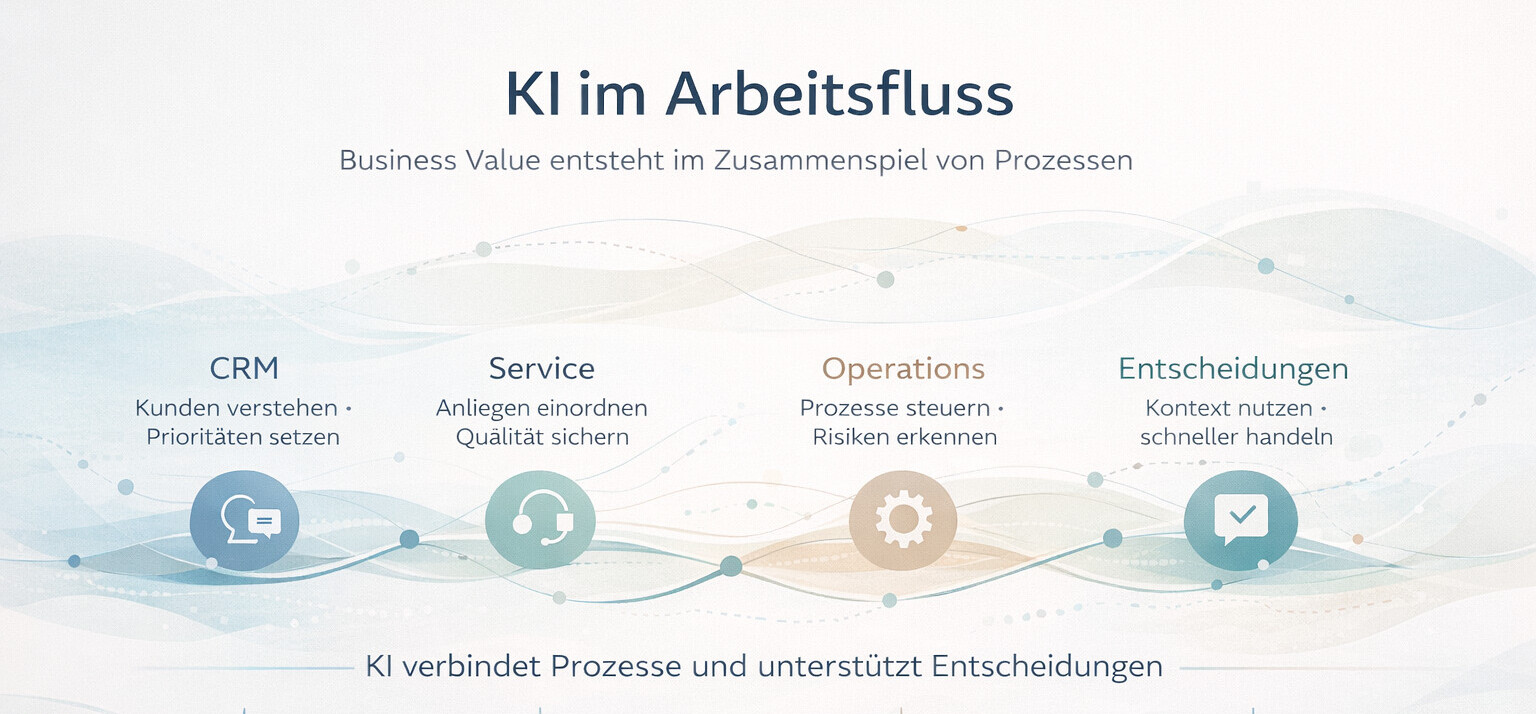
AI is no longer an add-on for individual tasks. It is becoming part of operational workflows, where decisions are prepared, processes are controlled, and customer relationships are shaped. This is precisely where the real business value lies.
What will change in 2026: The new demands on AI in companies
The focus is shifting. Away from the question of whether AI is used, toward the question of what impact it has.
In 2026, companies expect one thing above all else from AI: relief and better decisions in day-to-day operations. Not in isolated tools, but along real processes.
Specifically, this means:
-
Departments spend less time on manual tasks
-
Decisions are based more on context than on individual pieces of information.
-
Processes run more consistently, even with growing volumes
-
Scaling becomes possible without proportionally increasing staffing levels
AI in business in 2026 means thinking in terms of processes, not functions.
The greatest progress lies not in new features, but in a changed understanding of how the system is used.
In 2026, AI will be used in areas where many handovers, coordination tasks, and manual decisions still take place today. Instead of automating individual steps, AI will support entire process sections—across departments.
The result:
-
less coordination effort
-
clearer responsibilities
-
faster turnaround times
-
more stable processes
AI in CRM 2026: From data maintenance to decision support
CRM provides a particularly clear example of how the use of AI will have changed by 2026. Whereas it used to primarily assist with data collection, simple rules, or the automation of individual steps, today a different added value is coming to the fore: decision support in day-to-day business.
AI helps sales and service teams better assess situations. It evaluates leads, customers, and opportunities not in isolation, but in the context of previous interactions, current activities, and the overall course of the customer relationship. This provides a much clearer picture of where attention really has an impact.
Instead of working through lists or relying on rigid prioritization, teams receive context-related information: Which contacts are currently relevant, where is it worth taking the next step, and where does it make more sense to wait and see? This support works quietly in the background, but noticeably improves the quality of decisions.
The result is less operational hustle and bustle and more focus. Sales work becomes more targeted, handoffs between marketing, sales, and service become more consistent, and manual follow-up work is reduced. CRM is thus evolving from an administrative system into a genuine basis for decision-making in customer relations.
AI in customer service in 2026: support rather than replacement
In 2026, service will not be about replacing people.
It will be about noticeably reducing their workload.
AI supports service teams in areas where a lot of time is lost today:
-
Quick classification of concerns
-
Providing relevant information at the right moment
-
Support in finding solutions
-
Consistent communication across different channels
This allows employees to focus more on complex cases and personal customer interactions.
The result:
-
shorter processing times
-
Consistent quality with increasing volume
-
More satisfied customers and relieved teams
Service becomes scalable without losing its human touch.

AI in operations and controlling: real-time decisions
AI will also have a clear impact in operational areas in 2026.
Instead of reports focused on the past, AI supports ongoing decisions:
-
Project progress is continuously evaluated
-
Risks and deviations identified early on
-
Forecasts are becoming more dynamic and resilient
-
Operational bottlenecks become visible more quickly
Not as a monthly report, but as ongoing decision support.
For companies, this means:
-
greater transparency in day-to-day business
-
faster responses
-
better controllability of complex projects
AI is thus becoming an integral part of operational management.
AI agents in business: The next logical step
There is a pattern that runs through many successful AI applications:
AI independently performs clearly defined tasks within defined processes.
These so-called AI agents:
-
handle recurring tasks independently
-
work in a rule-based and context-sensitive manner
-
make preliminary decisions
-
escalate to people if necessary
They do not replace teams, but they relieve them of routine decisions and coordination tasks.
This is giving rise to new working models, particularly in CRM, service, and operations, where people can concentrate on what really creates value.
What successful companies will have in common in 2026
Companies that successfully use AI in 2026 will differ less in terms of individual technologies than in terms of how they work. The decisive factor is not how many AI functions are available, but how naturally they have been integrated into existing processes.
AI is effective when it supports specialist departments in their day-to-day work and simplifies decision-making rather than creating additional complexity. Employees no longer have to constantly switch between systems or gather information. Processes run more smoothly, handovers are clearer, and work feels more focused overall.
Nevertheless, certain patterns can be observed without overemphasizing them:
-
AI is directly embedded in operational processes
-
Departments benefit visibly in their day-to-day business
-
Decisions are made faster and more consistently
What these companies have in common is a pragmatic understanding of AI. It is not treated as an innovation project, but as a natural part of the operating model. This is precisely what creates a lasting impact – not spectacular, but permanent.
Conclusion
2026 is not a new beginning for AI in business. It is the moment when it will become clear where it delivers real added value.
Not through more tools or spectacular demos, but through targeted use where decisions are prepared, processes are controlled, and customer relationships are shaped.
Companies that understand AI in this way not only create efficiency, but also lay the foundation for sustainable scaling.