Many HR departments are currently under pressure, even if this isn’t always openly acknowledged. Budgets are being scrutinized more closely. Hiring decisions are being questioned. At the same time, expectations are rising for HR to deliver well-informed decisions. In this situation, a topic that has long been viewed primarily as a reporting discipline is coming more into focus: HR analytics. But more data alone does not solve any problems. Many organizations today have extensive people data. What is often missing is the ability to derive reliable decisions from it. This article explains why HR analytics is gaining importance right now, where typical weaknesses lie, and what HR specifically needs to clarify so that data actually becomes actionable.
Why HR Analytics Is Becoming Crucial Right Now
During times of economic uncertainty, the demands placed on HR change significantly. Decisions are scrutinized more closely, actions must be justified, and at the same time, the scope for action remains limited. As a result, HR bears a greater responsibility than ever before for setting priorities.
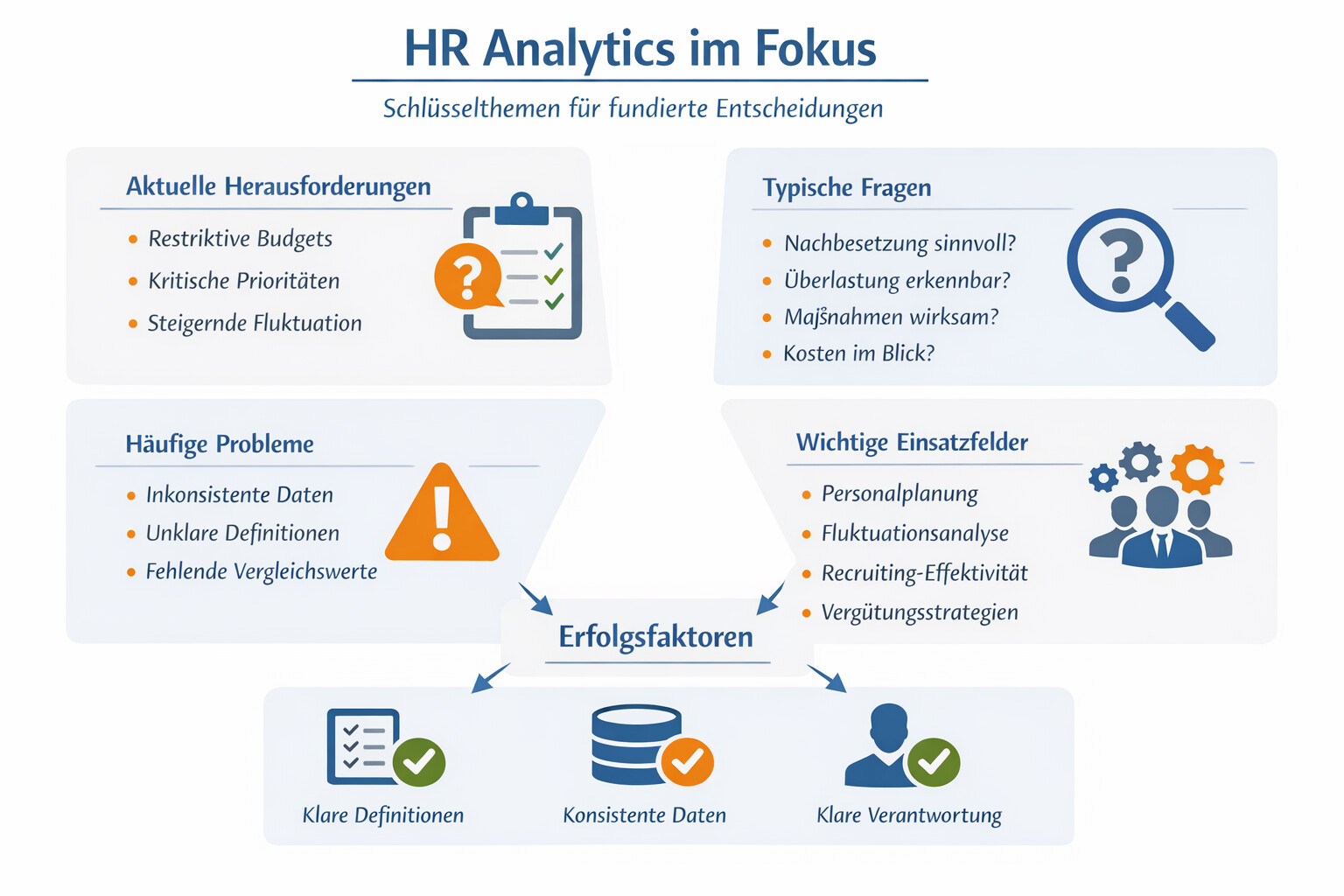
Typical questions that are currently gaining importance include, for example:
- Should the position really be filled, or can it be covered internally?
- Which areas are structurally overburdened, and where are there untapped capacity reserves?
- Which employee retention strategies actually work?
- How do cost structures evolve in relation to performance?
Questions like these can no longer be answered based on qualitative data alone. They require a reliable data foundation and, above all, a clear classification.

Where HR Analytics Often Falls Short in Practice
Many companies already have dashboards, reports, and key performance indicators. Yet uncertainty arises as soon as concrete decisions need to be made. This is rarely due to a lack of data, but rather to the fact that the data is not used consistently.
A common pattern is that key performance indicators are interpreted differently. What exactly constitutes employee turnover is often not clearly defined. Different departments operate according to their own logic, data sources are not properly integrated, and as a result, comparisons lose their significance.
Another problem is the lack of context for the numbers. An employee turnover rate of eight percent can be stable or critical, depending on the context. Without benchmarks, targets, or historical trends, each metric stands alone and is difficult to interpret.
In these cases, HR analytics fails not because of the volume of data, but because of a lack of structure.
What HR Analytics Must Deliver
HR analytics only serves its purpose when it supports decision-making. This means that data is not merely collected and visualized, but actually answers specific questions.
Typical decisions that should be supported by HR analytics include:
- Prioritizing Hiring and Replacements
- Identification of areas with a higher risk of employee turnover
- Assessment of the effectiveness of HR measures
- Capacity and Utilization Management
Answering these questions requires more than just a reporting setup. Clear definitions, consistent data, and a shared decision-making framework are essential.
The Strengths and Limitations of HR Analytics in Practice
| Dimension | Strengths | Borders |
|---|---|---|
| basis for decision-making | Supports transparent and data-driven decisions | Depending on data quality and definitions |
| Transparency | Highlights trends and patterns | Can lead to misinterpretations without context |
| Comparability | Enables benchmarks and internal comparisons | Comparative figures are often not standardized |
| Control | Supports the prioritization of actions | It only works if decisions are actually based on it |
| Acceptance | Can increase trust in HR decisions | Decreases when figures are not transparent |
Typical applications of HR analytics
HR analytics is not an isolated discipline, but is closely linked to operational decisions. In practice, this is particularly evident in the following areas:
- Workforce Planning and Capacity Management
- Analysis of Turnover and Retention
- Evaluation of Recruitment Processes
- Development of compensation structures
- Identifying training needs
These areas of application make it clear that HR analytics does not merely describe what has happened, but also helps determine what should happen next.
The Real Challenge: Definition and Responsibility
The biggest challenge rarely lies in the technology. It lies in how key performance indicators are defined and assigned responsibility for. Without clear definitions, differing interpretations arise that undermine the validity of any analysis.
Key questions that often remain unanswered are:
- What exactly is measured and what isn't
- Which data source is considered authoritative?
- Who is responsible for the quality of the data?
- Which definition applies company-wide?
If these questions are not clearly answered, conflicting narratives emerge. As a result, while HR analytics exists, it is not accepted as a basis for decision-making.
What HR Should Clarify Right Now
To make HR analytics actionable, organizations need to address a few fundamental issues. These are less technical and more organizational in nature, and they determine whether the data actually has an impact.
Key aspects include:
- Which decisions should be supported by HR data?
- Which key performance indicators are relevant for this and how they are defined
- Which data sources are used and how consistent they are
- Who is responsible for data quality and definitions
At first glance, these questions seem simple, but in practice they are often not clearly resolved. This is precisely where it is determined whether HR analytics remains merely a reporting tool or functions as a management tool.
Conclusion
HR analytics isn’t becoming more important simply because more data is available. It’s becoming more important because decisions must be made under pressure and need to be better justified. Organizations that clearly define their key performance indicators, consistently structure their data, and assign responsibility lay the groundwork for sound decisions. It’s not more data that makes the difference, but the ability to interpret it meaningfully. HR analytics is therefore less about tools and more about clarity.