Salesforce is the world’s best-known CRM system – but does that automatically mean that it is also the best solution for medium-sized companies? Not necessarily. Especially in terms of costs, complexity and integration, the question arises when compared to Microsoft Dynamics 365 Sales: Which solution actually brings measurable added value for SMEs?
Two enterprise solutions – two ways of thinking
Both systems offer extensive CRM functionalities, but the way to get there is fundamentally different. Salesforce relies heavily on standardization and expansion via its own clouds. As part of the Microsoft ecosystem, Dynamics 365 Sales is much more open and can be integrated more flexibly – for example in Outlook, Teams, SharePoint or Power BI. While Salesforce relies on its own platform universe, Microsoft focuses on modular extensibility and process proximity.
Features and flexibility
Salesforce is powerful, but often requires a lot of configuration—especially when processes deviate from standard logic. Dynamics 365 offers a wide range of customization options out of the box, from simple business rules to low-code customizations with Power Platform. This means that processes can not only be digitized, but also precisely tailored to the reality of the company.
Artificial Intelligence and Automation
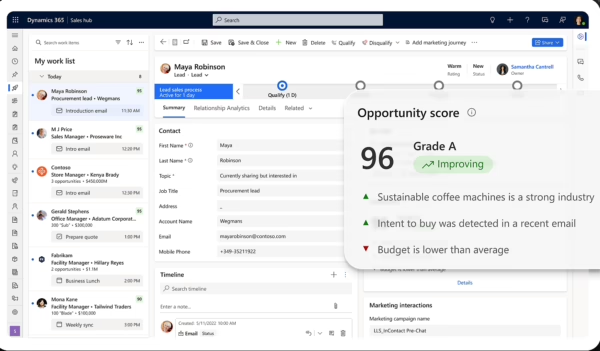
Both platforms offer AI-powered capabilities – Salesforce with Einstein AI, Microsoft with Copilot for Sales. In practice, however, medium-sized companies benefit faster from Microsoft: Copilot is embedded directly in familiar tools such as Outlook and Teams, making everyday sales easier without time-consuming training or system changes. Automation via Power Automate is also easier and more flexible to implement than comparable workflows in Salesforce.
Costs and total effort
Salesforce has a modular structure – what sounds good at first often leads to a sharp increase in licensing and consulting costs in practice. Many essential functions are only available via add-ons or paid add-ons. Dynamics 365 Sales offers a clearer licensing model that directly includes core sales functions. The project durations for introduction are also often shorter in medium-sized companies with Dynamics.
Reporting and data analysis
Salesforce offers powerful reports – but here, too, advanced evaluations (e.g. forecasting, custom dashboards) are often linked to additional costs. Dynamics 365 can be connected directly to Power BI. This results in powerful, interactive dashboards based on real-time data – without additional licensing models or external tools.
Data Protection, Hosting and IT Governance
Especially for German and European companies, the topic of data protection is crucial. Microsoft offers full GDPR compliance with European data centers. Salesforce hosts mainly in the USA, which can lead to legal questions under certain circumstances – especially in regulated industries or with sensitive customer data.
Conclusion
| Evaluation criterion | Salesforce | Dynamics 365 Sales |
|---|---|---|
| Customizability | High, but often expensive | High, with low-code & power apps |
| Automation & AI | Einstein, but limited | Copilot with Outlook, Teams, etc. |
| Reporting | Good, but partly fee-based | Power BI natively integrable |
| Cost structure | Modular, often non-transparent | Clear entry, scalable |
| Data Protection / Hosting | USA, limited configurability | EU data centers available |
Recommendation for medium-sized companies
Salesforce is a strong system – but its full potential unfolds above all in the large corporate environment. For medium-sized companies that already use Microsoft 365 and rely on short project durations and transparent costs, Dynamics 365 Sales is the more practical choice. It combines the necessary depth with scalability, automation and strong user adoption – without the overhead of a classic enterprise CRM.
Are you about to decide on a new CRM?
We help you make the right choice – with an honest assessment, concrete use cases and a CRM roadmap that fits your organization.