Many companies still use on-premises Dynamics 365 Customer Engagement systems that have been customized over the years. “On-premises” means that the CRM—such as Dynamics 365 Sales—is hosted on the company’s own servers rather than running in the Microsoft Cloud.
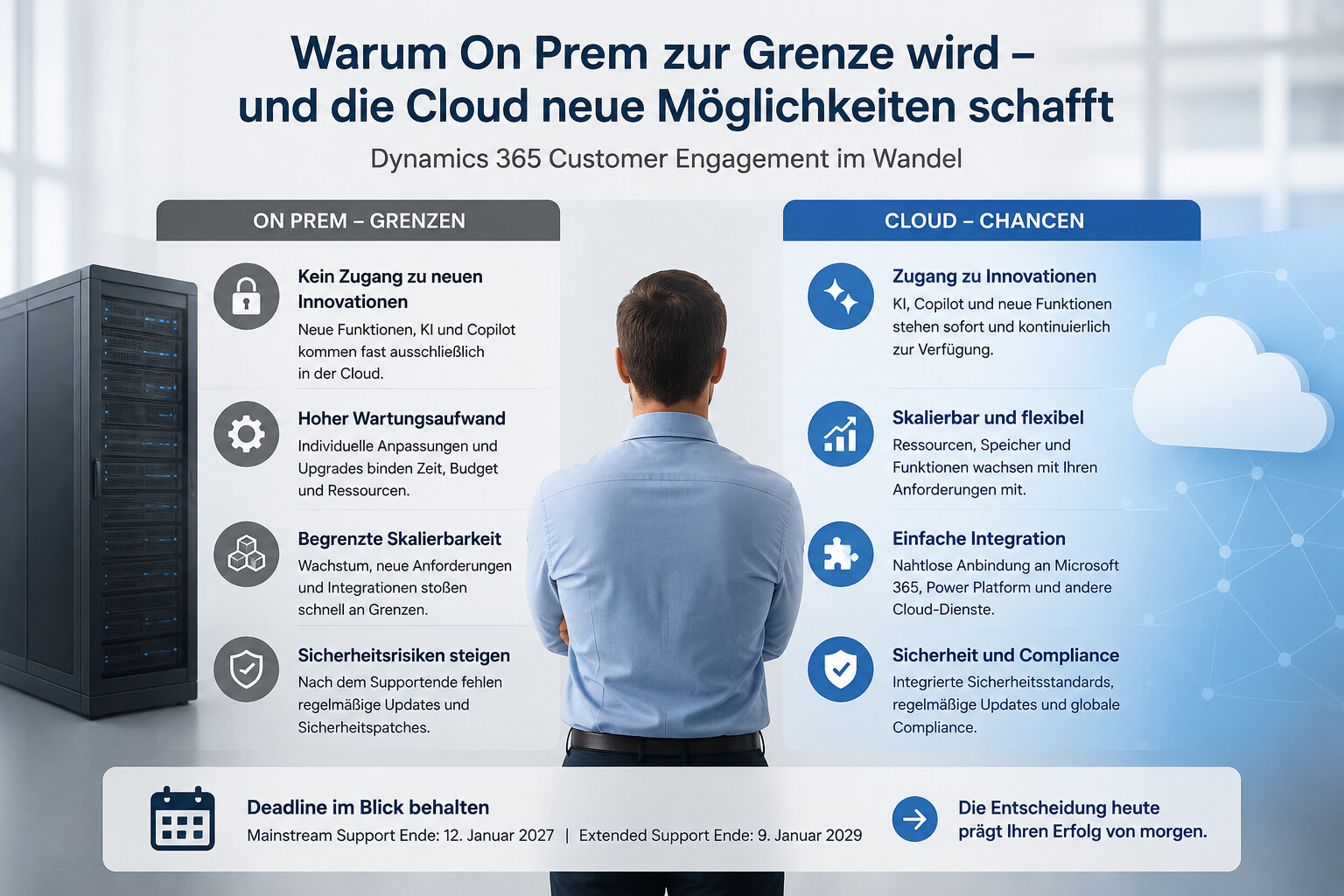
At the same time, an important deadline is approaching. Mainstream support for Dynamics 365 Customer Engagement On-Premises will end in January 2027*. While existing systems will continue to function after that, new features and innovations related to Copilot, AI, and modern automation are being developed almost exclusively in the cloud.
This shifts the focus of the question. It is no longer just a matter of whether migration is necessary, but rather how companies intend to structure their CRM systems going forward. In this article, you’ll learn why migration is becoming relevant now, which challenges are often underestimated, and what companies should keep in mind as they prepare.
What the January 2027 deadline actually means
Mainstream support for Dynamics 365 Customer Engagement On-Premises ends on January 12, 2027. After that date, Microsoft will no longer provide regular feature updates or active development for this version. Security updates will continue to be provided as part of Extended Support through January 2029.
To many companies, this may initially sound like plenty of time. In practice, however, it quickly becomes clear that CRM systems can rarely be modernized on short notice. Processes, data, integrations, and customizations have often evolved over many years.
This results in long lead times for planning, evaluation, and implementation.
| Area | Date | Meaning |
|---|---|---|
| End of Mainstream Support | January 12, 2027 | Regular updates, new features, and comprehensive Microsoft support will end |
| End of Extended Support | January 9, 2029 | Security updates will expire; after that, there will be no more official support |
| AI and Copilot Innovations | as early as today | New features are developed almost exclusively in Dynamics 365 cloud environments |
| Recommended start date for migration planning | now | Migrations often require a long lead time due to processes, data, and customization |
The real challenge, therefore, lies not only in the end of official support. Many companies are already realizing that their existing CRM infrastructure can only meet new requirements to a limited extent.
Why many companies are already feeling the pressure
This pressure stems primarily from technological advancements in modern CRM platforms. Today, new features are clearly being developed for cloud environments.
This applies in particular to:
- Microsoft Copilot
- AI-powered automation
- Modern integrations with the Power Platform
- Real-time analytics
- AI Agents and Intelligent Workflows
While Dynamics 365 cloud environments are constantly being expanded, many on-premises systems remain largely unchanged in terms of functionality. This is creating a growing gap between current requirements and the capabilities of existing systems.
This is particularly evident in the area of customer engagement. Customers expect faster responses, greater transparency, and consistent communication across various channels. At the same time, demands for data availability and automation are on the rise. As a result, many companies are finding that their existing CRM infrastructure is struggling to keep up with these demands on an operational level.
Why Many Dynamics Systems Are Becoming a Bottleneck Today
Many on-premises Dynamics 365 Customer Engagement systems have been individually expanded and customized over the years. Fields, processes, workflows, and integrations have often evolved over time. This is not unusual at first. However, it becomes problematic when these structures become difficult to understand or maintain.
Typical challenges include:
- high technical complexity
- different data sets
- inconsistent processes
- increasing maintenance costs
- lack of transparency regarding existing adjustments
Often, the real challenge lies not in the CRM system itself, but in the structure that has developed around it over the years. Migrations, in particular, highlight just how closely processes, data, and workflows are intertwined.

Why migration often turns out to be more complex than expected
Many companies initially assume that this is primarily a technical upgrade. In practice, however, it quickly becomes clear that many more areas are affected.
This is because the CRM system often supports core business processes. Sales, service, marketing, and operational teams all access the same data and structures directly.
Typical challenges include:
- processes that have developed over time
- customizations without clear documentation
- inconsistent data quality
- differences in how teams use the CRM
- Dependencies on other systems
As a result, migration becomes not just a technical task, but an organizational decision. Many companies underestimate the effort involved in data cleansing and process evaluation in particular. Older CRM systems, in particular, often contain fields, workflows, or custom logic that are no longer actively used today. Without a clear assessment, these structures are often simply carried over.
Why AI and Copilot Are Further Changing the Situation
The growing importance of AI is significantly changing the requirements for CRM systems.
Features such as Microsoft Copilot or AI agents require:
- consistent data
- modern integrations
- structured processes
- centralized data availability
These requirements are much easier to implement in modern cloud environments. At the same time, new opportunities are emerging in day-to-day work.
For example:
- automatic summaries of customer conversations
- AI-powered preparation for sales meetings
- Smart lead prioritization
- automated follow-ups
- Real-time support for service
Many of these features are closely tied to Microsoft's cloud architecture. As a result, for many companies, migration is not just an infrastructure issue, but the foundation for future ways of working.
Why many companies simply carry old problems over with them
A common mistake is to migrate existing processes to the cloud without making any changes.
This often applies to:
- unnecessary fields
- complex workflows
- inconsistent data structures
- duplicate processes
- custom solutions
This results in the same problems arising again, only in a new environment. Migrations therefore offer an opportunity to critically examine and simplify existing structures. It is precisely this step that is often overlooked because the focus is heavily on timelines and technical implementation. In the long run, however, this often leads to new systems remaining unnecessarily complex.
Why CRM migration is a strategic decision today
CRM systems are increasingly becoming the central platform for customer engagement, processes, and data.
At the same time, the demands on:
- Transparency
- Automation
- AI Support
- integrated processes
- consistent data
As a result, migration is no longer merely a matter of technical modernization, but a strategic decision regarding future work processes and structures. The real question, therefore, is no longer simply how to replace an existing system. What matters far more is what role CRM should play in the company going forward.
Conclusion
The January 2027 deadline is creating a real sense of urgency for companies using Dynamics 365 Customer Engagement on-premises systems. While existing solutions can technically continue to be operated, innovation and new features are increasingly shifting to the cloud.
The real challenge rarely lies solely in the technology. Processes, data structures, and accumulated customizations make many migrations more complex than expected.
Companies that plan ahead and critically evaluate their existing structure lay the groundwork for modern CRM processes, better integration, and future use of AI.
Let's take a moment to discuss how we can help you with this!
FAQ
When will support for Dynamics 365 Customer Engagement On-Premises end?
According to Microsoft, mainstream support for Dynamics 365 Customer Engagement Apps Version 9 On-Premises will end on January 12, 2027. Extended support will continue until January 9, 2029.
Will Dynamics 365 Customer Engagement On-Premise be discontinued in 2027?
No. Microsoft is not talking about a shutdown. Existing systems can continue to be used. However, mainstream support will end in January 2027. New features and regular updates will no longer be available to the same extent after that.
Why should companies migrate now anyway?
Because CRM migrations often require a long lead time. Processes, data, customizations, and integrations must be reviewed. Microsoft also provides official resources for migrating from Dynamics CRM On-Premises to Dynamics 365 Online.
Which versions can be migrated to Dynamics 365 Online?
Microsoft specifies that the source system must be running Dynamics CRM 9.0 or Dynamics 365 9.0 or 9.1 as a prerequisite for the on-premises-to-online migration process.
What is the difference between Mainstream Support and Extended Support?
According to Microsoft, during Mainstream Support, customers receive security updates, can request non-security updates, and can access incident support. After Mainstream Support ends, only Extended Support will remain, which is available until 2029.
What risks arise when companies get a late start?
Typical risks include tight deadlines, unclear data quality, poorly documented adjustments, and underestimated integration efforts. The situation becomes particularly critical when legacy processes are migrated to the cloud without modification.