The customer had service cases. There were project meetings. There are open offers. Marketing knows interests. Customer service knows problems. Project teams know risks. Finance knows contract and sales data. But when the next account appointment is being prepared, sales often has to gather this information manually.
This is where account intelligence comes in, meaning the ability to bring together relevant customer signals from different sources in such a way that sales teams can have better conversations, identify potential earlier and develop existing customer relationships in a more targeted manner.
No more data is the goal. Better context at the right moment is the goal.
Why existing customers are often used worse than new leads
New leads are visible. They come in via forms, campaigns, events or recommendations. They get attention because they are new. Existing customers, on the other hand, seem familiar. That’s exactly what is dangerous.
If you’ve been serving a customer for a long time, you often think you know the context. In reality, that context is constantly changing. Change contacts. New projects are emerging. Service cases are piling up. Budgets are shifting. Strategic priorities are changing. An account that seemed stable six months ago can be a risk today. An account that has been quiet for a long time can send a strong upsell signal today.
The problem isn’t that this information doesn’t exist. The problem is that it’s rarely in a form that an account manager can quickly use. Account intelligence therefore doesn’t just answer the question: What do we know about this customer?
It answers the more important question: What should sales know before the next meeting?
Account managers need context, not another dashboard
Many sales organizations already have dashboards. Pipeline, revenue, activities, open opportunities, forecast. This information is important, but it’s often not enough for real customer development.
A dashboard shows what happened. Account intelligence helps to understand what follows from this.
If a customer has had multiple support tickets, a project is nearing completion, and a new product campaign has been clicked at the same time, it will create a different conversation than an isolated opportunity list. If an existing customer repeatedly has similar requirements, this can create cross-sell potential. If a project team regularly documents manual workarounds, it can become a consulting or automation issue.
Sales does not need another surface for this. They need a condensed view of relevant signals.
Microsoft describes Copilot in Dynamics 365 Sales as a support for sellers to summarize leads, opportunities, accounts, track current changes, prepare meetings, and get account news, among other things.
What Account Intelligence Means in Customer Engagement
Account intelligence is more than a CRM note and more than a sales overview. It’s about a structured understanding of customers across sales, marketing, service and delivery.
This is crucial for customer engagement. Good customer relationships are not only created through campaigns or follow-ups. They are created when companies recognize relevant signals and derive the right next interaction from them.
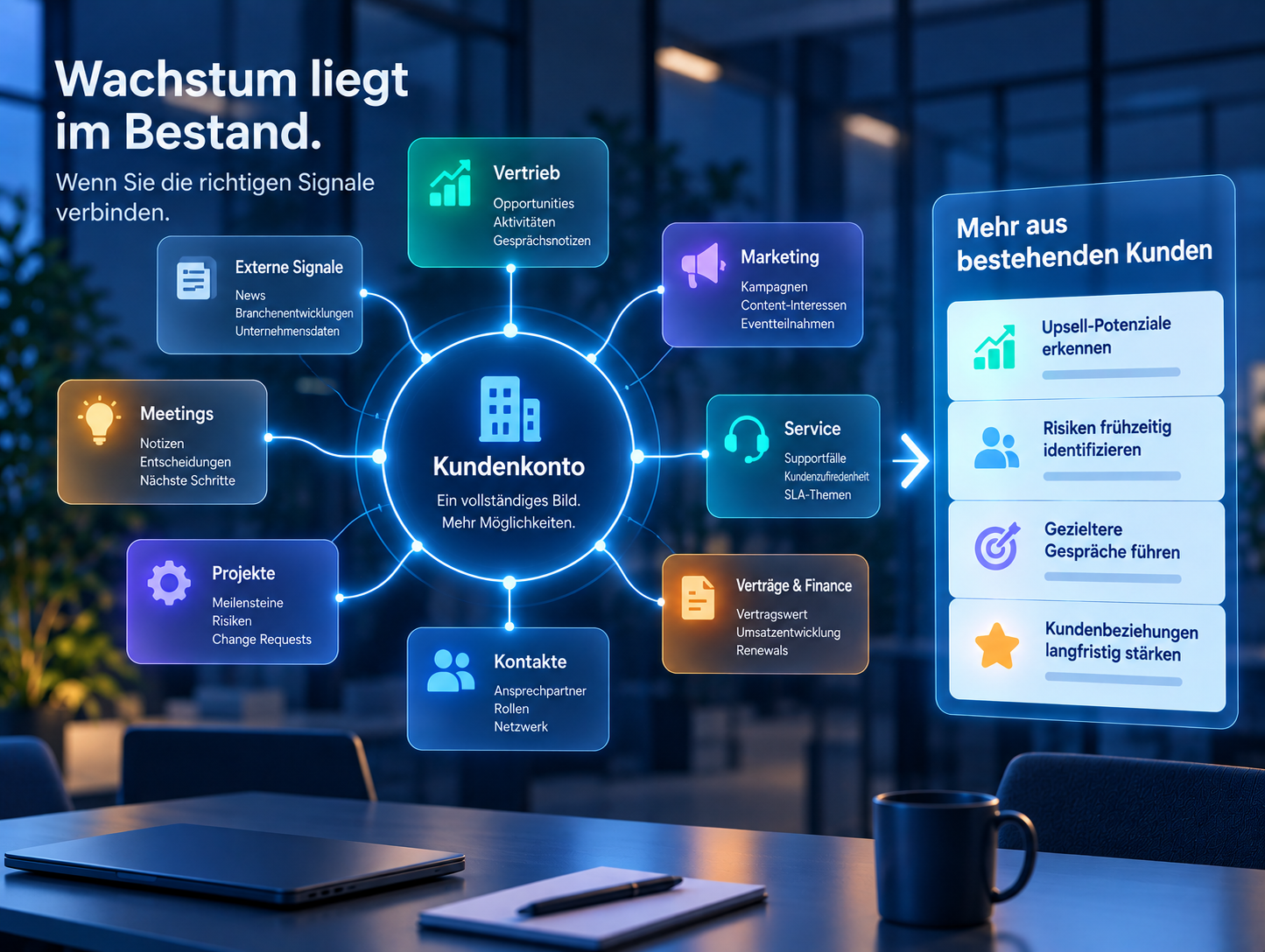
An account intelligence approach typically combines multiple perspectives: Sales knows opportunities, activities, and conversation notes. Marketing recognizes interests, campaign reactions, and event participation. Service sees support cases, complaints, and recurring issues. Project teams know ongoing projects, risks, change requests, and open decisions. Finance provides contract, revenue, and renewal information.
The value is not created by the fact that all the data is stored somewhere. The value is created when it becomes a clear basis for discussion.
Which signals indicate upsell or cross-sell potential
Upsell rarely comes out of nowhere. There are often signals beforehand. They are just not brought together consistently.
A customer asks for features in the service that are not included in the current setup. A project team documents recurring additional requirements. A contact person participates in a webinar on an adjacent topic. In the CRM, there are older opportunities that have never been properly tracked. New stakeholders emerge in meetings. New segments or interest patterns emerge in Customer Insights.
A single signal is often too weak. Several signals together can give a clear picture.
| Signal | Possible Meaning |
|---|---|
| Recurring service requests | Need for advice, training needs, or product gap |
| New stakeholders in the account | Change in the buying center |
| Interest in related topics | Cross-sell or expansion potential |
| Project delays | Risk to customer satisfaction or renewal |
| High level of manual coordination | Potential for automation |
| Positive project results | Starting point for expansion or reference |
This is where account intelligence comes in handy. The account manager doesn’t have to look for every signal himself. He needs a condensed view that shows what could be relevant for the next conversation.
Why CRM, projects, service and marketing belong together
Many companies still look too much at customer engagement from individual systems. Sales looks at CRM. Marketing looks at campaigns. Service looks at cases. Project teams look at delivery. Finance looks at invoices and contracts.
From the customer’s point of view, however, this is a relationship.
If this information remains separate, blind spots are created. Sales talks about new potential, even though the service is escalating. Marketing promotes a topic that has already been critically discussed in the project. Account management schedules an upsell conversation without knowing the latest support issues.
Dynamics 365 Customer Insights is Microsoft’s solution for unifying customer signals, building unified customer profiles, and using those profiles as the foundation for insights and actions.
This is particularly relevant for account intelligence. An account manager doesn’t just need CRM fields. He needs the connected context from the customer relationship.
Advanced insights from Customer Insights – Data can be linked to Dynamics 365 contacts, leads, and other customer tables. Examples include Customer Lifetime Value, Lead Scores, and other insights from the Unified Customer Profile.


How Dynamics 365 supports Sales, Customer Insights, and Copilot
In a Microsoft-based customer engagement architecture, the strength does not lie in a single tool. The strength lies in the interaction.
Dynamics 365 Sales structures accounts, contacts, opportunities, and activities. Customer Insights can unify customer data and enrich it with additional signals. Copilot features help summarize information, make changes visible, and speed up conversation preparation.
Microsoft mentions Record Summarization, Recent Changes, Meeting Preparation, Email Assistance, and News Updates as features for Copilot in Dynamics 365 Sales. These capabilities fit directly with Account Intelligence because they bring sales work closer to relevant account signals.
However, it is important to note that technology alone does not make a good account strategy.
Companies need to define which signals are really relevant. Not every data field helps. Not every activity is a buy signal. Not every service request is a risk. Account intelligence needs business logic: What patterns indicate growth? Which events require caution? Which customers deserve a proactive approach?
This logic decides whether AI only summarizes or really enables better customer development.
How an Account Intelligence Agent Can Help
An account intelligence agent can provide support at exactly this point. It not only passively bundles information, but also prepares it for concrete account work.
Before a customer meeting, such an agent can condense relevant information from CRM, service, projects, marketing and meetings. He can summarize open topics, make recent developments visible, highlight risks, prepare possible talking points and structure follow-ups.
The agent does not replace the account manager. It reduces the preparation work and makes relevant signals usable faster.
This is the crucial difference: Account intelligence is not intended to sell automatically. It is intended to help sales teams to be better prepared for customer meetings.
From Account Signal to Next Action
Account intelligence only becomes valuable when concrete next steps emerge from distributed information.
An account manager doesn’t just need a list of activities before a customer meeting. He needs a classification: Which topics are relevant? What risks should be addressed? Where are there indications of potential for expansion? What internal information should be checked before the meeting?
This is exactly where an account intelligence agent can help. It condenses signals from CRM, service, projects, marketing and meetings into a structured preparation. This creates a better basis for discussion from fragmented customer knowledge.
It is important to note that the agent does not automatically decide on the customer. He supports the sales department in understanding more quickly what information is important for the next conversation.
A sensible account intelligence process should do three things. First, relevant information from CRM, service, projects, marketing and meetings must be combined. Second, a professional assessment is needed to determine which topics, risks and potentials are really relevant for the account. Third, this must result in concrete next actions: talking points, follow-ups or internal coordination.
In this way, account intelligence does not become another reporting topic, but a concrete tool for better customer development.

How Businesses Should Get Started with Account Intelligence
A good start doesn’t start with the question of which AI function can be activated. It starts with a technical question:
Which customer relationship do we want to understand better?
According to this, companies should clarify which account situations are not visible enough today. For example: Which customers have potential for expansion? Where is there a risk of dissatisfaction? Which accounts have open topics from projects or service? Which opportunities have not been developed for a long time? Which customers show interest in related topics?
A pragmatic introduction can look like this:
- Select an account scenario: for example, upsell, renewal, risk, or meeting preparation
- Define relevant signals: CRM, service, projects, marketing, meetings
- Check data availability: Which sources are usable and trustworthy?
- Determine the technical logic: What is really a relevant signal?
- Test the agent or copilot scenario: Check specific support for account managers
- Evaluate the result: Does it save time, does it improve conversations, does it generate better follow-ups?
In this way, account intelligence remains close to everyday work and does not become another data project without operational impact.
Conclusion: Your customers have been sending signals for a long time
Existing customer development rarely fails because companies know nothing about their customers. It fails because this knowledge cannot be used at the right moment.
Account intelligence turns distributed customer signals into a better basis for conversation. It helps sales teams identify risks earlier, develop potential in a more targeted manner, and prepare account meetings with more context.
The crucial point is not to display as much data as possible. The crucial point is to translate relevant signals into concrete next steps.
If you manage to do this, you don’t just have to look for new leads. You can develop existing customer relationships more systematically.
FAQ
What is Account Intelligence?
Account intelligence describes the structured use of customer, sales, service, marketing and project data in order to better understand existing customer relationships and develop them in a more targeted manner.
Why is account intelligence important for customer engagement?
Customer engagement thrives on relevant interactions. Account intelligence helps sales and customer teams identify customer signals at the right moment and better prepare conversations.
What data is relevant for account intelligence?
Relevant include CRM data, opportunities, activities, meeting notes, service cases, project information, marketing interactions, contract data, and customer segments.
How does Microsoft Dynamics 365 support Account Intelligence?
Dynamics 365 Sales can structure account, lead, and opportunity information. Copilot in Dynamics 365 Sales provides support with summaries, recent changes, meeting preparation, account news, and more.
What is the role of Dynamics 365 Customer Insights?
Customer Insights – Data can unify customer signals and provide Unified Profiles as the basis for insights and actions.
What Does an Account Intelligence Agent Do?
An account intelligence agent can analyze information from CRM, service, projects, meetings, and other sources, condense relevant signals, and prepare conversation bases for account meetings.
When is Account Intelligence worthwhile?
Account intelligence is worthwhile when sales teams want to better develop existing customers, but still have to manually gather relevant signals from CRM, service, projects, marketing, and meetings today.
Sources
Microsoft Learn: Copilot in Dynamics 365 Sales overview
Microsoft Learn: Get started with Dynamics 365 Customer Insights – Data
Microsoft Learn: Automatically link Dynamics 365 apps to customer profiles