Many companies still measure AI adoption too simply. Who uses Copilot? How often is AI used? How many employees have completed training?
These are useful signals. But they don’t answer the most important question: Does it really make work better?
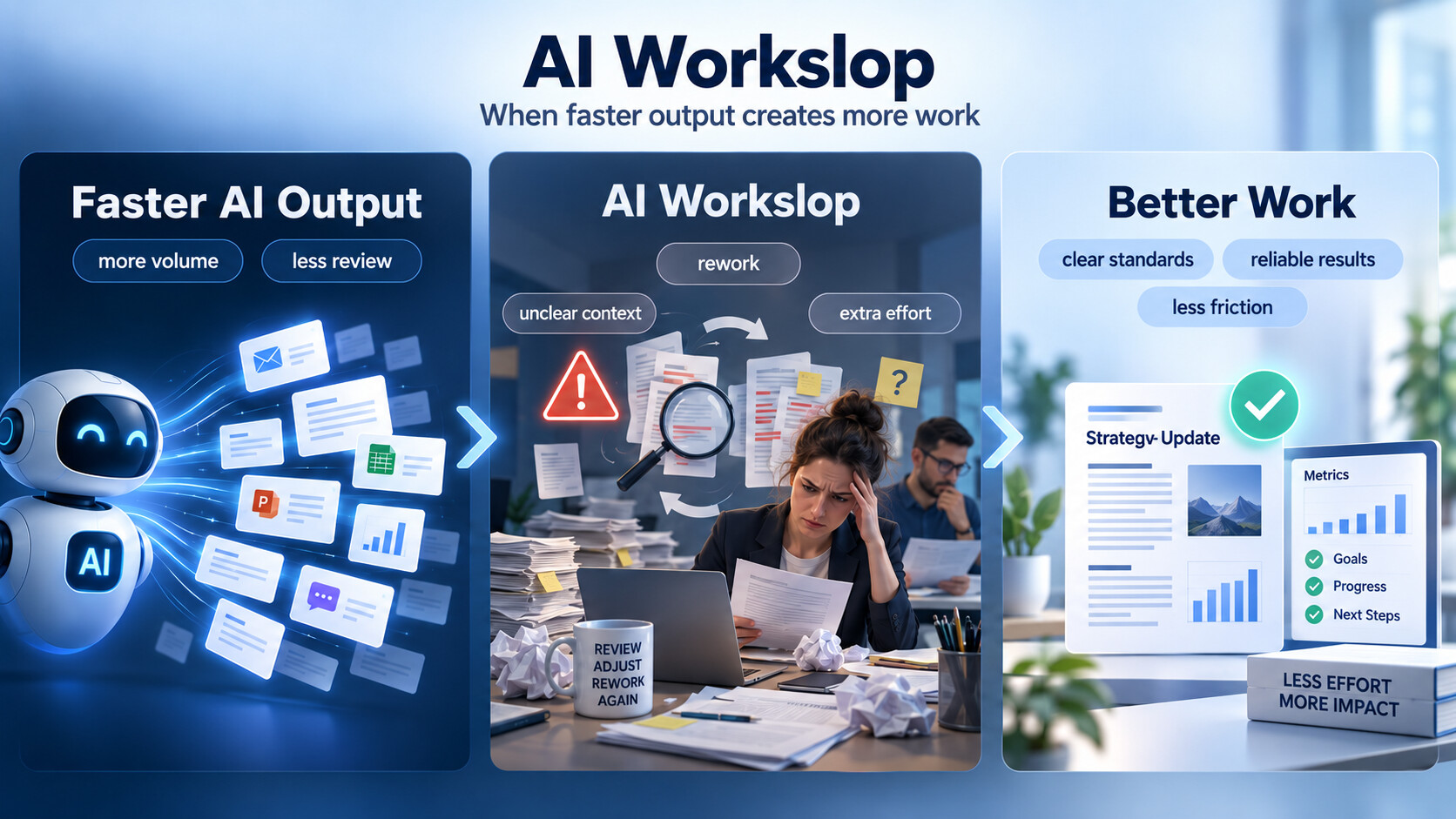
AI can increase productivity. But it can also make mediocre work faster. When employees generate content, forward summaries or take over analyses without properly checking quality, context and responsibility, a new risk arises: more output, but not automatically more value. Gartner calls this risk “AI Workslop”: fast but low-quality work that is created with or through AI. For HR, this becomes a central task because AI adoption must not only promote use. It must ensure quality*.
Why more AI usage doesn’t automatically mean more productivity
Many organizations are under pressure to quickly bring AI into everyday work. Teams should work less manually, make decisions faster and reduce repetitive tasks. This is understandable. But if AI is only understood as an accelerator, a blind spot is created. A faster report is not a better report. An automatically generated email is not better customer communication. An AI summary is not automatically a reliable basis for decision-making.
The problem does not arise from AI alone. It arises when companies do not define what good AI-supported work means.
| Old measurement logic | Better question |
|---|---|
| How many employees use AI? | For which work does AI generate real benefits? |
| How often is AI used? | Are results getting better or just faster? |
| How much content is created? | Is the content technically correct and relevant? |
| How much time is saved? | Is there less effort or just more rework? |
| How many processes will be automated? | Are quality and responsibility regulated? |
For HR, this is an important change of perspective. AI adoption must not stop at activation, training and usage figures.
AI Workslop: When fast output generates new work
AI Workslop sounds harmless, but it is dangerous in everyday work. It refers to work that is produced quickly, but generates additional effort for others. A project status sounds professional, but contains unclear assumptions. Finance must check. The project management must correct. Management does not get a better basis for decision-making, but another loop.
Or a sales team uses AI for customer communication. The email is written quickly, but generically. The customer does not recognize relevance. The lead was contacted faster, but not better cared for. Gartner warns that companies often roll out AI to as many use cases as possible without giving employees enough time and autonomy to check the quality of the results. This is exactly how AI can create new friction instead of relieving work*.

HR must translate AI quality
HR has a bigger role in AI than organizing training. HR must clarify together with managers how AI-supported work is evaluated. What is a good AI output? When is an AI summary sufficient? When is human examination needed? Which tasks can be prepared automatically? Which decisions must remain with humans?
These questions belong in competency models, leadership routines, onboarding, learning paths, and performance conversations. Otherwise, there will be a gap between technical use and actual work quality. Microsoft’s Work Trend Index 2026 shows that advanced AI users are placing greater emphasis on quality control and critical thinking. 50 percent of AI users surveyed cite quality control of AI output as a particularly important human skill, while 46 percent cite critical thinking**.
Managers become a quality filter
Many managers are not yet prepared for this role. They are supposed to promote AI, but control risks. They are supposed to increase productivity, but ensure quality. They are supposed to motivate teams, but not simply demand more output. This is challenging because AI can make work look more professional than it is. A text looks clean. An analysis seems plausible. A summary seems complete. Nevertheless, context, sources or assumptions may be missing.
Managers must therefore ask new questions:
| Working with AI | Quality question |
|---|---|
| Report prepared | What assumptions were checked? |
| Customer email formulated | Is it specific enough for this customer? |
| Meeting Summarized | Are tasks and decisions correct? |
| Analysis prepared | Is the data source and logic comprehensible? |
| Process Automated | Who checks exceptions and errors? |
HR should enable managers to do just that. Not with general AI presentations, but with concrete quality standards for real work situations.
AI competence is more than prompting
Many AI trainings focus on prompts. This is useful, but too narrow.
Good AI competence does not only mean writing better entries. Employees must evaluate results professionally, recognize limits, check sources, protect sensitive data and not outsource responsibility to a tool.
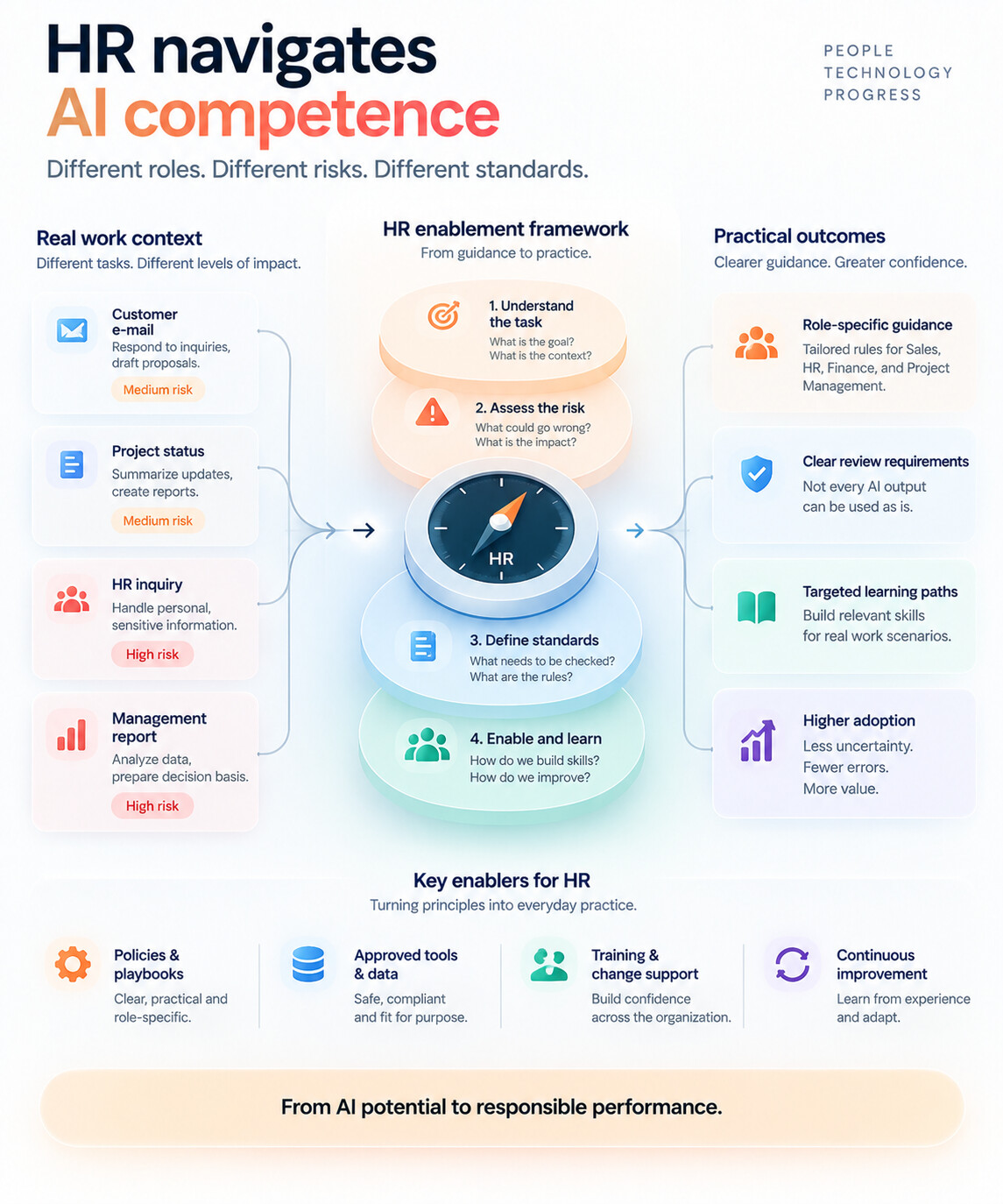
A consultant needs different quality criteria than HR. A project manager checks differently than sales. Finance needs different traceability than marketing. That’s why AI adoption should not be planned as a uniform training for everyone. The better approach is role-specific standards: What AI use makes sense in this role? What results need to be checked? Which tasks remain human responsibility?

How companies get off to a meaningful start
A good start doesn’t start with the question of how all employees use AI as often as possible. The better question is:
What work can and should be made faster by AI without sacrificing quality?
To do this, companies should select three to five specific work moments. For example, customer communication, project status reports, meeting summaries, HR self-service or management reports. Quality criteria are defined for each of these cases.
| Step | Objective |
|---|---|
| Select | Use AI where real value is generated |
| Define | Clarify what makes a good result |
| Define | Regulate responsibility and approval |
| Empowering | Making quality controllable in everyday team life |
| Capture | Detect bad patterns early on |
| training by role | Linking AI expertise directly to tasks |
In this way, AI adoption does not become a pure increase in usage. It becomes a work improvement.
Where Microsoft and HR systems can help
For companies in the Microsoft ecosystem, the practical start is often close to everyday work. Microsoft 365 Copilot, Teams, SharePoint, Copilot Studio, and HR systems like Hubdrive can help connect AI use more closely to knowledge, roles, processes, and learning paths.
However, it is not the technical activation that is decisive. The decisive factor is which tasks AI should support and which quality rules apply. An HR agent should only answer standard questions on the basis of approved sources of knowledge. A project status should make data sources and assumptions comprehensible. A customer email should not only be correctly formulated, but also relevant to the specific account.
AI only becomes productive when it is embedded in clear work and quality logic.
Conclusion: AI adoption needs quality, not just use
AI adoption in the company must not only be measured by whether employees use AI. The decisive factor is whether AI enables better work.
If companies only encourage use, they risk more output without more value. Poor summaries, generic content, unclear analyses and additional audit loops can even worsen productivity. HR plays a central role in this. Not as a tool administrator, but as a function that anchors skills, leadership, quality and responsibility in the AI-supported world of work.
The next maturity level of AI adoption is therefore not: more prompts. It is: better work with clear standards.
FAQ
What does AI adoption mean in business?
AI adoption describes how well employees use, accept and integrate AI into their everyday work. It’s not just tool access that is decisive, but whether AI improves real work.
What is AI Workslop?
AI Workslop describes fast, but low-quality work that is created with or through AI. It seems productive, but can create additional testing effort and new friction.
Why is AI Workslop an HR topic?
HR is responsible for competencies, roles, learning paths, leadership development, and work design. That’s why HR needs to help define what good AI-powered work looks like.
Is prompt training enough for AI adoption?
No. Prompt training is only one part. Employees must check AI results, classify subject context, evaluate data sources and know when human responsibility remains necessary.
What role do managers play?
Managers set quality standards in everyday team life. They decide which AI use is helpful, which results need to be checked and how employees can work safely with AI.
How should companies start?
The best way to start is with concrete work moments with high benefits, such as meeting summaries, project status reports or customer communication. To this end, quality standards, test rules and role-specific training should be defined.
Sources
*Source: Gartner – Top Future of Work Trends for CHROs in 2026