AI agents only become really useful when they work with the right context. To do this, they need data. But this is exactly where the risk begins: An agent does not get better just because he is allowed to access as much information as possible.
What matters is not maximum access. What matters is appropriate access. An agent should be able to use the data that is relevant, up-to-date, and shared for a specific task. Anything else creates uncertainty, false results, and new governance issues.
AI data access is thus becoming a central question for companies that want to use copilots, AI agents or automated workflows productively.
Why data access is the underestimated AI risk factor
When an AI agent provides inaccurate or incomplete answers, the first thing they often talk about is prompts, models, or technical configuration. In many cases, however, the problem lies deeper: the agent is working with the wrong data context. Maybe important information is missing. Maybe it’s using outdated documents. Maybe it’s finding multiple versions of the same file. Or it’s accessing information that shouldn’t be used for that task.
Data access is therefore not a technical detail. It determines whether AI results are reliable, secure and usable in everyday work.
More data doesn’t automatically mean better answers
The reflex is understandable: If AI is to provide better answers, we give it more data. In practice, this rarely works so easily. More data also means more noise, more old files, more duplicate documents, more contradictions and more permissions that have never been properly checked.
Especially in grown Microsoft environments, relevant information is often scattered: SharePoint, Teams, Dynamics 365, Dataverse, project storage, finance data, HR documents and personal files. This is difficult for employees to keep track of. For AI, it becomes critical if there are no clear rules as to which source applies to which context.
An agent who sees too much can be just as problematic as an agent who sees too little.
What data AI agents really need
An AI agent doesn’t need all the company data. They need the right information for a clearly defined task. A sales agent might need CRM data, call notes, and shared proposal documents. A project agent might need project plans, risks, tasks, times, and status information. An HR agent needs policies, process information, and only very controlled access to personal data.
Data access should therefore always be based on the use case. What task should the agent support? What information is required for this? Which data is sensitive? Which sources are binding? Which results may be used directly and where is human verification needed?
| Question | Why it’s important |
|---|---|
| What task should the agent solve? | The use case determines the necessary data context. |
| Which data sources are relevant? | Not every available source is helpful. |
| What information is sensitive? | HR, financial and customer data need clear boundaries. |
| What role does the agent use? | Access must fit the role and responsibility. |
| What data is up-to-date and reliable? | AI can only work as well as the sources. |
This creates a controlled framework instead of open data access according to the principle of “everything in”.
Permissions, roles, and context belong together
Permissions alone are not enough. A user can technically have access to a file, but the agent should still not use it in every context. An account manager is allowed to see certain customer data. This does not automatically mean that an agent should use this data for every request, summary, or email preparation.
The context is decisive: What is the task? What information is really needed? How sensitive is the result? Who sees the output? Good AI data access therefore combines role, task and risk. Only when these levels are considered together does it become clear whether an agent is allowed to use certain information.
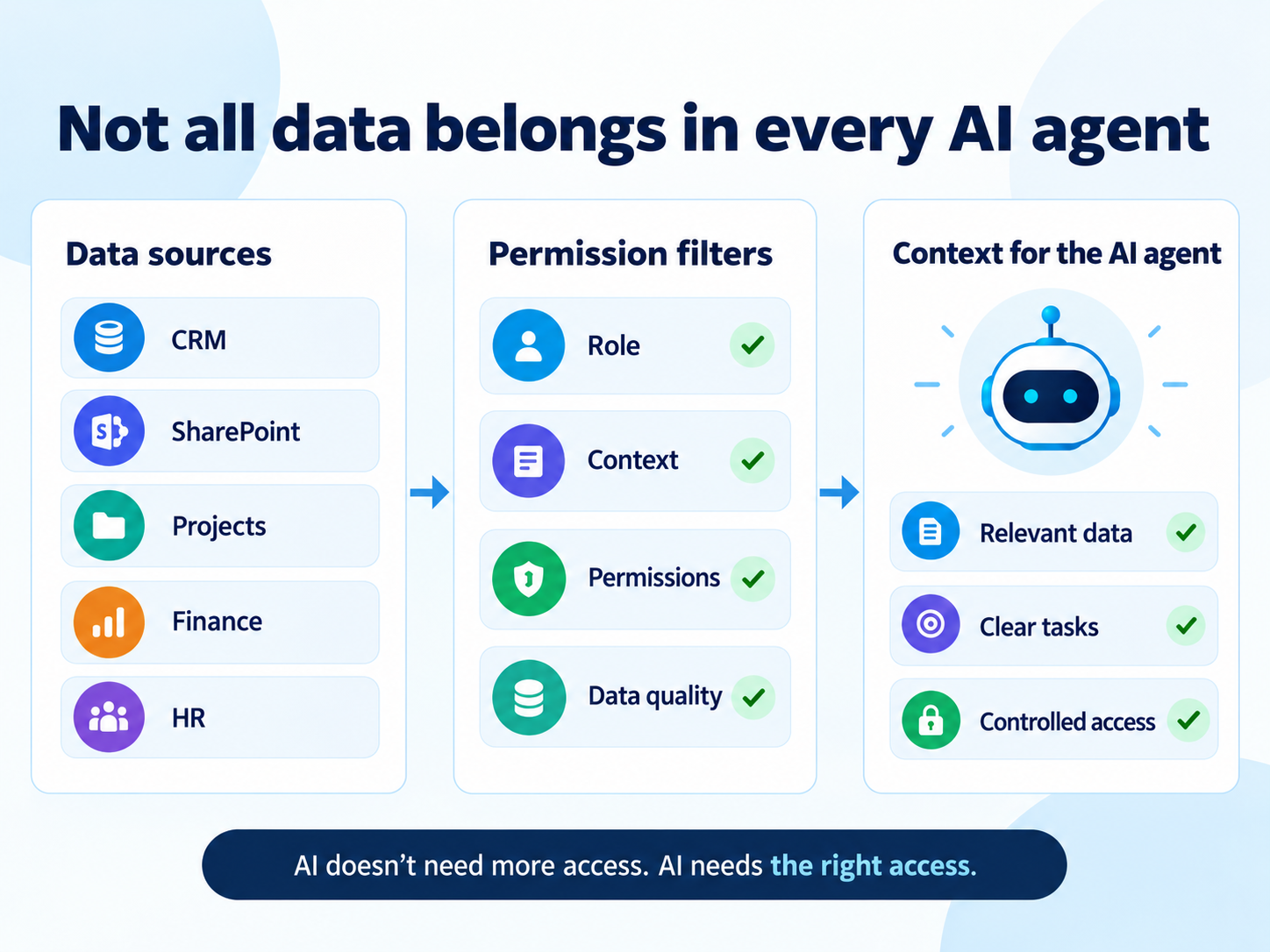

What Becomes Critical for SharePoint, CRM, Project Data, and HR Data
SharePoint is often the first place where AI scenarios make existing problems visible. Folder structures have grown historically, old files are left behind, permissions have been copied over years, and documents exist in multiple versions. When an agent accesses them, this clutter quickly becomes part of the result.
CRM data comes with a different problem. It’s very valuable, but it’s often poorly maintained. Activities, opportunities, contacts, and notes can be important for account intelligence, lead qualification, or sales preparation. At the same time, not all information should be used in every context.
Project data is about status, risks, budgets, resources and customer communication. AI can create a lot of value here if the data is cleanly structured. If not, incorrect assessments of effort, progress or risk quickly arise. HR and finance data need particularly clear boundaries. Technical authorizations are not sufficient here. It must be technically regulated which information an agent may use, which may only be used with approval and which remain completely excluded.
Data access is a business issue
AI Data access is often delegated to IT or security. This is understandable, but not sufficient. IT can technically implement authorizations. The technical decision must come from the business.
Only the specialist departments can answer which data is really relevant for a process. Sales knows which information is important for account discussions. Project Operations knows which project data is needed for control and forecasting. HR knows which information employees are allowed to see for themselves and which must remain sensitive.
Any AI initiative should treat data access as a shared decision-making process. Business, IT, security, and business must work together to determine what an agent is allowed to see, what they are allowed to do, and when a human must check.
Why data quality is just as important as authorization
Shared access is of little use if the data quality is poor. An agent that accesses outdated policies, duplicate project plans, or incomplete CRM data will not produce reliable results.
Data quality in this context does not mean perfection. It means that important sources are findable, up-to-date, clear and suitable for the respective purpose. Companies should therefore not only check authorizations, but also prioritize their most important knowledge and process sources.
Which documents are binding? Which systems are leading? What information is outdated? What content needs to be archived? What data should be deliberately excluded for AI? These questions determine whether AI really provides productive support or generates additional rework.

How companies should start
The best way to start is not to have a large governance program for all data. A concrete use case makes more sense. Choose an agent or co-pilot process that should bring real benefits. For example, account intelligence, project status, HR self-service, lead qualification or management reporting. Then it is checked what data is necessary for this and what risks arise.
A pragmatic start can look like this: select a use case, determine data sources, clarify roles, assess risks, limit access, check quality and monitor usage. This creates a controlled start that combines speed and security.
Conclusion: AI doesn’t need more access. AI needs the right access.
AI agents don’t unlock their value through unlimited data access. They unfold their value when data, permissions, roles, and context work together cleanly.
The right AI data access ensures that agents use relevant information, sensitive data remains protected, and results better fit into everyday work. This does not require endless fundamental discussions, but clear use cases, clean data sources and conscious decisions.
The central question is not: What data can AI access?
The better question is: What data should this agent be allowed to access for this task?
FAQ
What does AI data access mean?
AI data access describes which data sources an AI system or AI agent is allowed to access. This includes documents, CRM data, project data, HR information, finance data or other company sources.
Why is AI data access important?
Data access determines whether AI results are relevant, secure, and reliable. Too little access limits the benefits. Too much access increases risks and can generate false or undesirable outcomes.
Should AI agents have access to all data?
No. AI agents should only access data that is relevant, shared, and qualitatively appropriate for their use case. Unlimited access does not automatically improve results.
What role do permissions play?
Permissions determine what information an agent can see or use. They should be controlled by role, task, data source, risk, and context.
Why is data quality alone not enough?
Good data quality only helps if access is also properly controlled. An agent needs up-to-date and reliable data, but also clear boundaries as to what information he may use in which context.
How do companies start with AI data access?
The best way to get started is with a concrete use case. Relevant data sources, roles, risks, approvals and quality requirements are then examined. This creates a controlled framework for productive AI.