A project does not only lose its margin during implementation. Often, the damage occurs even before that: in the offer, in the estimate, in unclear assumptions and in expectations that have never been properly handed over to Delivery.
Sales sells a project to the best of its knowledge. Delivery takes over the implementation later. In between there is a critical moment that is underestimated in many project-based companies. The sales-to-delivery handover decides whether a project starts cleanly or whether the team starts directly with corrections, inquiries and silent compromises.
Especially in consultancies, IT services, agencies and professional services, this transition is not an administrative step. It is a margin moment.
Projects don’t just fail at the kick-off
The official start of the project often seems like the beginning of the actual work. In truth, a lot has already been decided at this point. The scope has been sold, expectations have been set, budgets have been agreed, the first timelines have been communicated and the customer has a picture of what he is getting.
If Delivery is only now fully integrated, the only thing left to do is to react. The team checks assumptions, detects missing information, discovers unrealistic efforts or notices that important skills are not available at all. Then the project does not start with control, but with damage limitation.
A good sales-to-delivery handover shifts this clarification forward. Delivery should not only understand what has been sold after the contract has been concluded. Delivery should see early enough what assumptions, risks and resource requirements arise in the sales process.
What already determines the later margin in sales
In the sales process, decisions are made that later have a direct impact on project margin, capacity utilization, and customer satisfaction. These include effort estimates, scope of services, project phases, dependencies, customer involvement, special requests, and implicit expectations.
An offer can be formally correct and still contain operational risks. Maybe a certain skill was assumed that is hardly available internally. Maybe a schedule was offered that only works if the customer delivers very quickly. Maybe risks were mentioned in the conversation, but not documented in a structured way. Maybe a workshop was calculated as a standard service, even though the customer actually expects a complex change project.
These details determine whether Delivery can work efficiently later. If they are not visible early on, they will be expensive in the project.
Why Delivery needs to be integrated earlier
Delivery doesn’t have to accompany every sales conversation. But Delivery must be involved in relevant projects early enough to check feasibility, effort, skills and risks.
This is not a brake on sales. It is a quality control for profitable projects.
Early exchange prevents sales from selling on assumptions that are not tenable later. At the same time, delivery helps to make offers more realistic, formulate risks more cleanly and define scope more clearly. The customer also benefits because expectations are clarified earlier and the start of the project creates less friction.
This is especially important for projects with a high degree of customization, scarce resources, complex integrations, multiple stakeholders or tight timelines. This is exactly where a bad handover costs the most time later on.
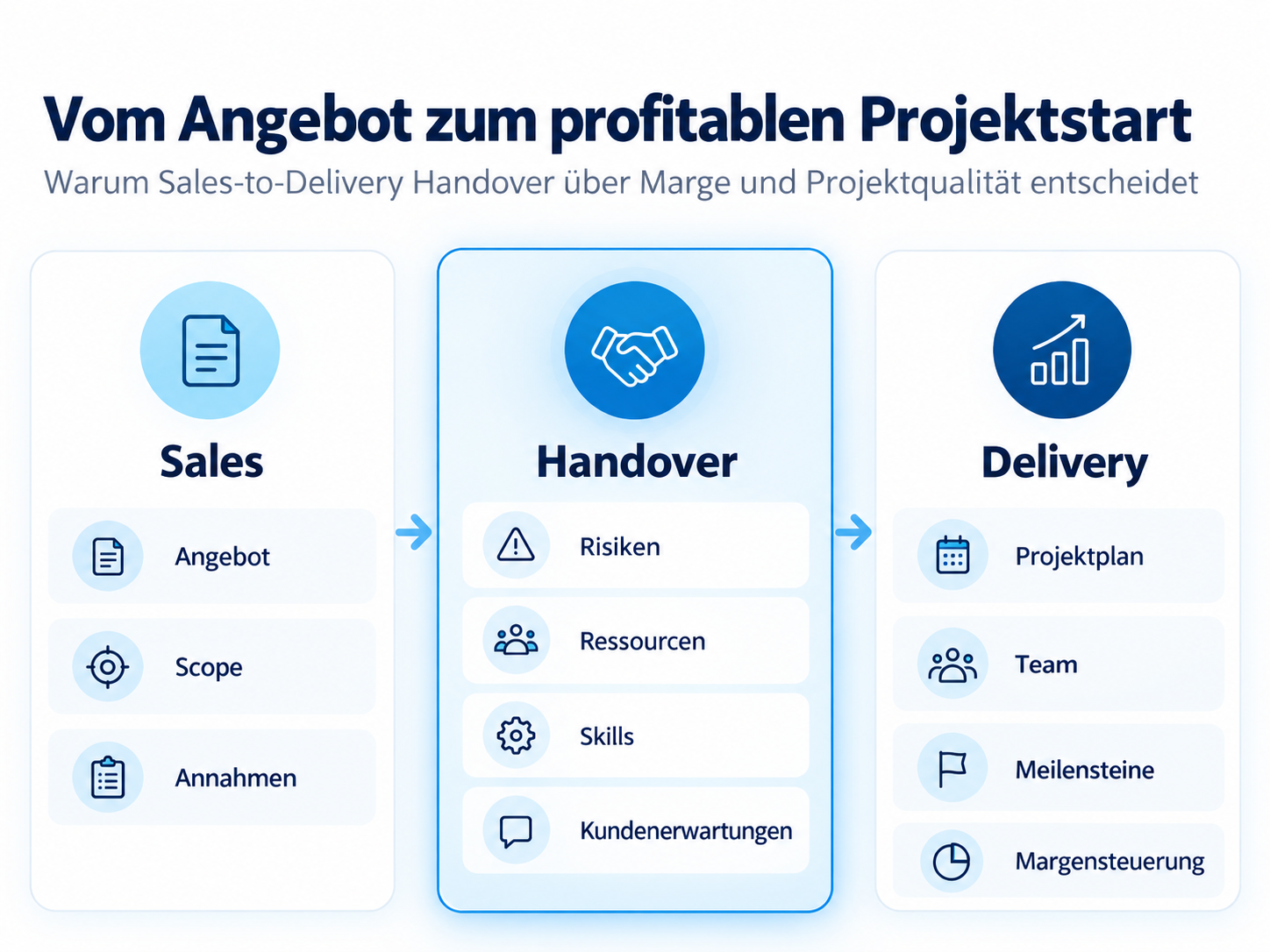

What information is often missing in handover
A sales-to-delivery handover is more than just handing over an offer. Delivery needs not only documents, but context.
Often, the very information that is crucial in everyday project life is missing: Why does the customer really want the project? What expectations were raised in the sales meeting? What risks were discussed internally? What assumptions are included in the calculation? Which stakeholders are critical? Which decisions are still open? Which services are expressly not included?
| Handover Information | Why It’s Important |
|---|---|
| Customer Goal | Delivery understands what success is really measured by. |
| Scope and exclusions | Misunderstandings are avoided early on. |
| Assumptions in the calculation | Effort and margin become comprehensible. |
| Risks | Escalations can be planned earlier. |
| Resource requirements | Skills and availability are checked in good time. |
| Open decisions | The project does not start with unclear dependencies. |
| Customer expectations | Delivery recognizes what is important professionally and communicatively. |
The better this information is transferred, the less the project team will have to reconstruct later.
Why resource planning begins even before the contract is signed
Resource planning doesn’t just start when the project is won. It starts as soon as a project is realistically in the pipeline.
If sales and delivery only talk about availability after completion, typical problems arise: the right people are already planned, important skills are missing, external support becomes expensive in the short term, or the project starts with a team that is not an optimal technical fit. This has a direct effect on quality, speed and margin.
A good handover therefore combines pipeline and resource planning. Delivery must recognize early on which projects are likely to come, which roles are needed and which capacities could become critical. Sales, on the other hand, needs a realistic picture of which services can be delivered in which period of time.
In Dynamics 365 Project Operations , this connection is important: project quotes, planning, resources, times, costs, and billing should not be considered separately. Value is created when sales and delivery work on the same operational basis.
What a good sales-to-delivery handover should look like
A good handover is short, authoritative, and repeatable. It shouldn’t depend on how well individuals communicate. The process must be designed in such a way that relevant information is systematically captured and handed over in a timely manner.
This requires clear handover points. Before submitting an offer, Delivery should check the effort, risks and resources for complex projects. Before the contract is signed, the scope, assumptions and customer expectations should be finally compared. After the contract has been signed, the project team should receive a structured handover that contains not only documents, but also technical context.
The most important point: The handover must not be a one-time meeting in which everything is explained afterwards. It should be part of the entire sales process.
Project Operations as a common basis for control
Project Operations becomes valuable when sales, project management, resource planning and finance no longer work in separate perspectives. A quotation is then not just a sales document. It is the beginning of a project logic that later continues in planning, effort, resources, budget and billing.
This changes the quality of the handover. Information does not have to be collected from e-mails, offer versions and meeting notes afterwards. It can be transferred from the sales process to implementation in a more structured way.
For project-based companies, this is crucial. Sales can see earlier which projects are realistically deliverable. Delivery recognizes earlier what work the team is facing. Finance can better understand margin risks. Management gets a clearer picture of whether pipeline, capacity, and profitability are a good fit.
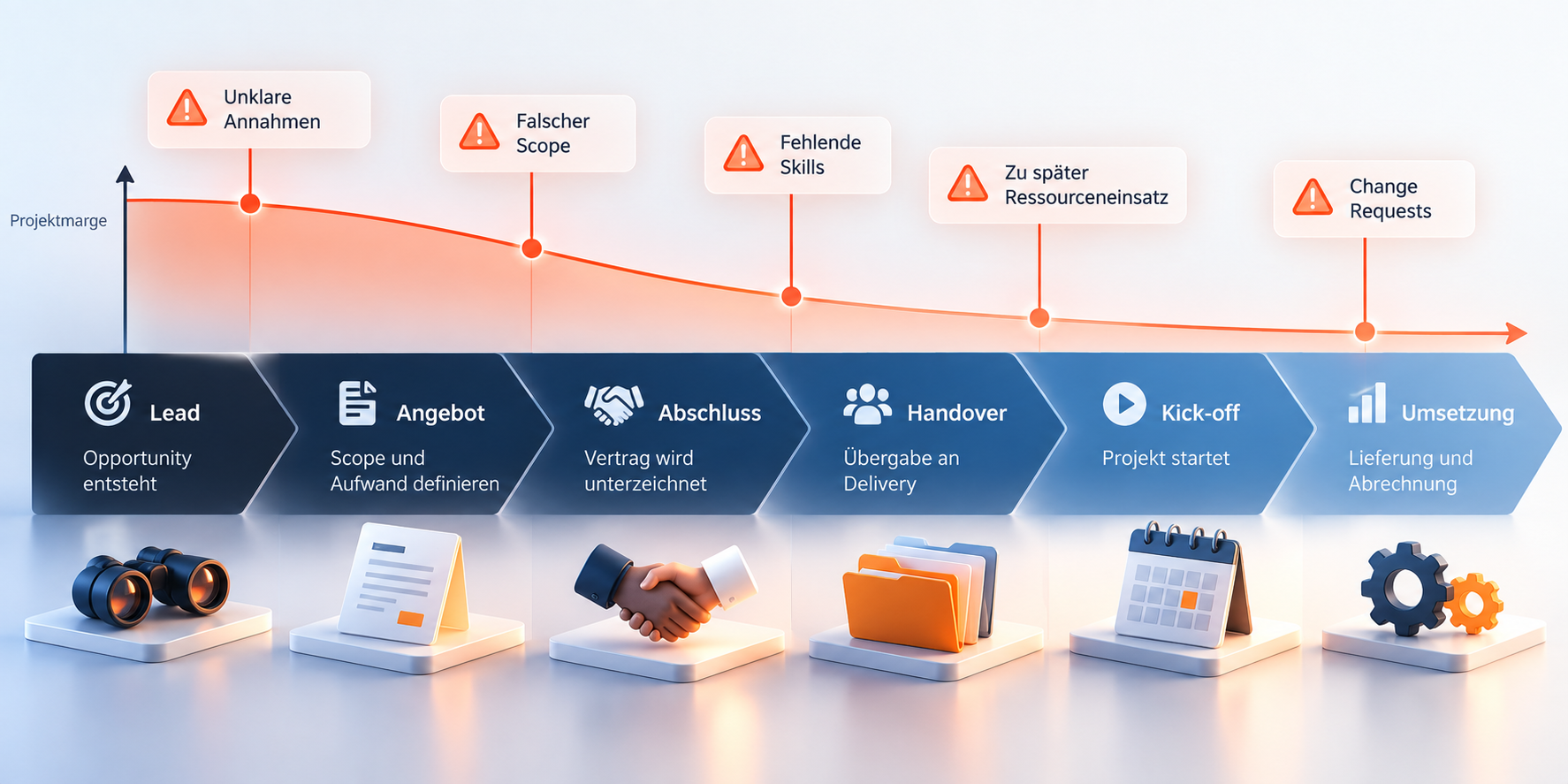

What needs to change organizationally
A good sales-to-delivery handover isn’t just a system issue. It’s also a leadership issue.
If sales are only measured in terms of deal volume and delivery later bears the consequences, a structural conflict arises. Then projects are won, but not necessarily started profitably. If, on the other hand, delivery is integrated too late or too defensively, sales loses speed and customer proximity.
A common understanding is better: A won project is only successful if it can be realistically delivered. To achieve this, sales and delivery need common criteria for good projects, clear escalation points and transparency about capacities, risks and margin expectations.
The goal is no longer coordination for the sake of voting. The goal is a profitable project start.
How companies should start
The easiest way to get started is to have a clear handover standard for all relevant projects. This standard should define when delivery is to be integrated, what information is mandatory and which risks must be clarified before submitting an offer.
A few questions are enough to get you started:
| Question | Purpose |
|---|---|
| What was promised to the customer? | Expectation and scope become visible. |
| What are the assumptions of effort and price? | The calculation becomes comprehensible. |
| What skills are needed? | Resource planning begins in good time. |
| What are the known risks? | Delivery can take countermeasures earlier. |
| What are the open points? | The start of the project is not burdened by ambiguity. |
If these questions are answered consistently, not only does the handover improve. The quality of the offers also increases.
Conclusion: The project starts in sales
A project doesn’t just start with the kick-off. It starts in the sales process.
This is where scope, expectations, effort, risks and initial margin assumptions are created. If Delivery receives this information too late, a won order quickly becomes a difficult project start.
A good sales-to-delivery handover ensures that sales and delivery look together at the same project context earlier. This makes offers more realistic, resource planning more reliable and margin risks visible earlier.
The decisive question is not: How do we hand over a project after completion?
The better question is: How do we ensure that sales and delivery see the same project before it closes?
FAQ
What does Sales-to-Delivery Handover mean?
Sales-to-Delivery Handover refers to the structured transition from the sales process to project implementation. Scope, assumptions, risks, resource requirements, customer expectations and open points are transferred to Delivery.
Why is a sales-to-delivery handover important?
A good handover prevents projects from starting with unclear expectations, incorrect assumptions or a lack of resources. This can reduce margin loss, delays and later escalations.
When should delivery be integrated into the sales process?
Delivery should be involved in complex, high-risk or resource-intensive projects before submitting a bid. At the latest before the contract is signed, effort, scope, risks and resource requirements should be examined together.
What information belongs in a good handover?
Important are customer goals, scope, exclusions, assumptions in the calculation, risks, required skills, open decisions, stakeholders and special customer expectations.
How does Dynamics 365 Project Operations support handover?
Dynamics 365 Project Operations can help bring sales, project planning, resources, effort, costs, and billing closer together. This creates a common foundation for sales, delivery, and finance.
Why does the handover affect the project margin?
The margin depends heavily on whether scope, effort, resources and risks have been realistically estimated. If these points are only clarified after the start of the project, follow-up work, delays and unplanned costs will occur.