Hybrid teams instead of human advisors? Professional services are currently experiencing the biggest shift in decades. Anyone who thinks that artificial intelligence is just a nice add-on for analytics or chatbots is underestimating the dynamics: Agentic AI is already taking on tasks on its own – faster, more precisely, and more scalable than ever before.
Whether in contract management, where AI checks hundreds of pages in minutes while lawyers assess strategic risks. Whether in tax consulting, where AI agents analyze transactions in real time while experts use the creative freedom. Or in project management, where hybrid teams simulate resources, budgets, and scenarios before human decision-makers set the final direction.
The question is not whether you will keep up with this development – but whether your business model will still be competitive in two years’ time, when hybrid teams have long been the industry standard.
Hybrid teams – what does that mean in concrete terms?
Hybrid teams are not a future scenario, but a new operating model that is already a reality today. The clear distribution of roles is crucial: Humans contribute strategic thinking, creativity and empathy – AI agents take over analysis, execution and orchestration.
This is what the interaction looks like in practice:
-
Tax and financial consulting: Experts develop design models, while AI agents simulate scenarios and continuously update data sources.
-
Project delivery: Consultants design the roadmap, AI monitors variances in real-time, adjusts resources, and automatically generates status reports.
-
Customer development: Consultants lead the negotiations, AI plays back opportunities from CRM, ERP and market sources in parallel and suggests next steps.
-
HR & Workforce Management: Managers decide on roles and priorities, while AI makes skills, utilization and availability transparent.
The result: projects run at a speed and precision that classic models cannot achieve.
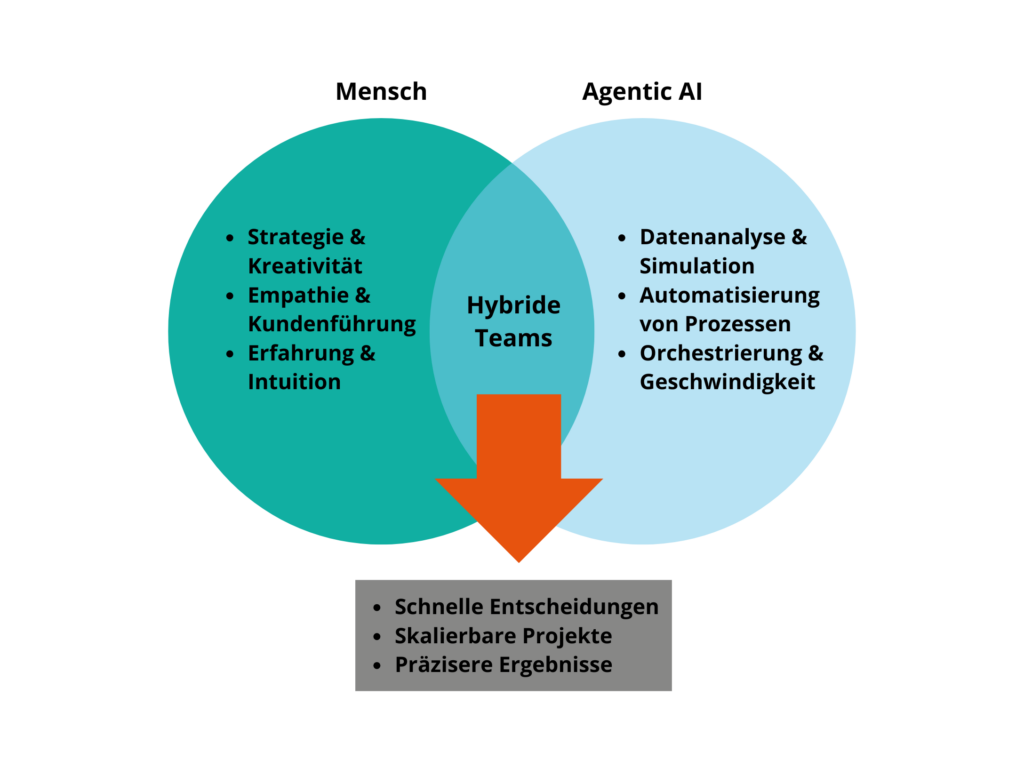

Agentic AI as a game changer
While many companies still work with classic Copilot scenarios – AI answers questions, writes texts or creates slides – Agentic AI goes much further. These systems act independently, access various data sources and orchestrate processes without having to initiate each step manually.
Practical examples:
-
M&A projects: AI agents comb through data spaces, compare information and automatically prepare decision-making dossiers for the partners.
-
Audit & Compliance: Instead of pure random sampling, Agentic AI continuously checks complete data sets and reports deviations in real time.
-
Marketing and sales operations: AI agents test hypotheses, adjust campaign parameters and provide recommendations for action before the consultant goes into a customer meeting.
The difference is fundamental: Agentic AI is no longer a tool, but an active part of the team.
Business Value for Professional Services
Hybrid teams don’t just deliver efficiency gains – they shift the value proposition of entire business models. Agentic AI makes possible what was previously unthinkable:
-
Scalability: Projects that used to require ten consultants can now be completed with five experts plus AI agents – without any loss of quality.
-
Speed: Analytics, reports, and simulations are available in minutes, not weeks. Customers expect this frequency – and they choose the provider that delivers it.
-
Quality: AI eliminates human error in routine tasks, while experts focus on strategy and creativity. This increases precision and trust.
-
Profitability: Fewer manual hours, higher margins, new service offerings – from “Research-as-a-Service” to “Automated Compliance Monitoring”.
The message is clear: Anyone who introduces hybrid teams today not only creates efficiency, but also builds competitive advantages that can no longer be caught up in traditional structures.

Challenges and success factors
The shift to hybrid teams sounds convincing – but it doesn’t happen automatically. Companies that want to make the leap must consider key success factors:
-
Data quality and security: AI is only as good as the data it processes. Clean data models and clear governance are mandatory.
-
Acceptance in the team: Employees must understand that AI is not competition, but creates relief. A lack of change management quickly leads to resistance.
-
New role profiles: Hybrid teams are creating new roles, from AI Orchestrator to AI Governance Officer, who ensures compliance.
-
Continuous learning: Hybrid teams are evolving. If you use Agentic AI today, you will have to integrate new skills, tools and processes tomorrow.
Crucially, hybrid teams only work if technology and organization go hand in hand. If you only buy tools without working on processes and roles, you will not leverage the potential.
Why waiting is not an option
Professional services are facing a paradigm shift. Hybrid teams of humans and AI are no longer an experiment, but the new operating model. Companies that use Agentic AI today are shifting the speed, scalability, and quality of their services—setting standards that others must measure themselves against.
One thing is certain: In two years, no one will be discussing whether hybrid teams make sense. The only question will be: Who established it in time – and who will follow suit?
👉 Get a head start now. Talk to us about how you can use hybrid teams and Agentic AI in your professional services at scale.