Many companies invest a lot of money in campaigns, events, webinars and website conversions. The goal is clear: more leads, more pipeline, more revenue opportunities.
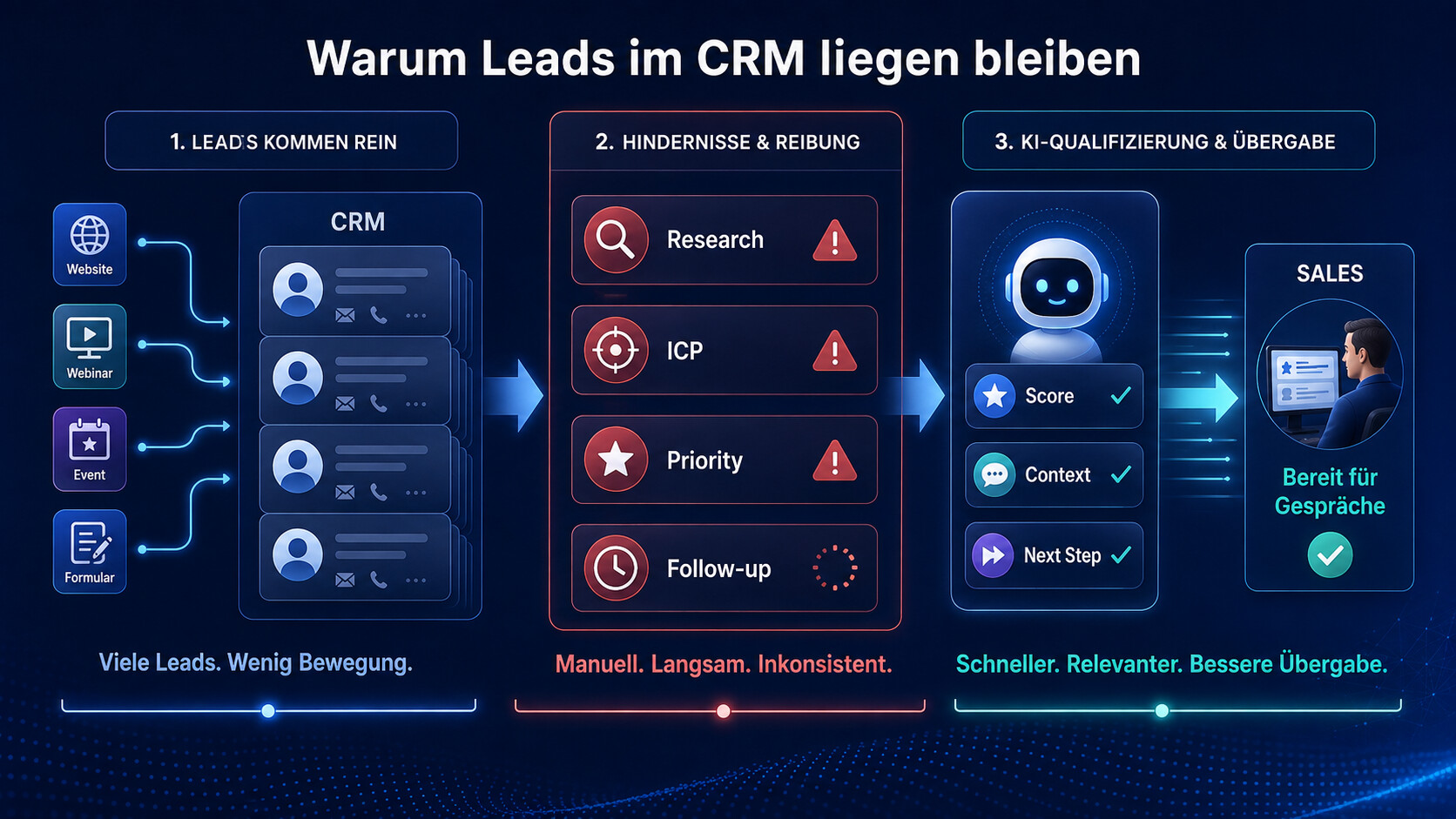
But after the conversion, the real break often begins. The lead is in the CRM, but no one knows right away if it’s really relevant. Sales has to research, add information, assess priority, formulate an initial message and decide whether the effort is worth it. This is exactly where many companies lose time.
Customer engagement doesn’t just start with the sales pitch. It starts the moment a potential customer shows interest.
Why leads in CRM often become too slow
A new lead is not yet a sales opportunity. It is a signal. This signal must be understood, evaluated and continued.
In practice, this is often done manually. A salesperson checks company information, searches for industry, size, location, current news, possible needs and suitable contacts. Then it is decided whether the lead is relevant and what the first approach should look like.
The problem: This process competes with ongoing deals, customer meetings, offers, forecasts and internal coordination. As a result, leads with high potential are sometimes processed too late. Leads with low potential, on the other hand, cost unnecessary time.
Microsoft describes exactly this challenge: Sales teams often struggle to keep up with the volume of incoming leads from websites, events, and webinars. This creates missed opportunities and untapped leads in the CRM. The Sales Qualification Agent in Dynamics 365 Sales is designed to automate lead research and qualification so that teams can focus more on the best leads. Source: Microsoft Learn.
The real bottleneck is not the lead. It is the first evaluation.
Many companies are trying to generate more leads. That’s understandable. But more leads won’t solve a problem if the score behind them doesn’t scale.
A Lead Qualification Agent changes this logic. It supports not only the management of a data set, but also the question: Is this lead relevant, why is it relevant and what should happen next?
in CRMmanuallyway
| Classic lead process | AI-powered lead qualification |
|---|---|
| Lead is created | Lead is researched automatically |
| Seller researches manually | Agent checks fit with the target customer profile |
| Priority is subjective | Lead is evaluated based on defined criteria |
| Outreach is formulated | Draft e-mail or address is being prepared |
| Handover often takes place in an unstructured | Lead is passed to Sales with context |
The benefit does not come from an agent “automating more”. The benefit arises because sales can work with better information earlier.
What the Sales Qualification Agent does in concrete terms
Microsoft describes two operating modes for the Sales Qualification Agent: Research-only mode and Research and engage mode.
In research-only mode, the agent researches leads, assesses the fit with the target customer profile, provides information such as company data, financial health, and breaking news, and creates a draft for an outreach email. In Research and engage mode, the agent can additionally qualify based on target customer profile and BANT criteria, send personalized outreach emails, respond to responses, send follow-ups, and hand over leads to sellers if they are interested in buying. Source: Microsoft Learn.
That’s an important difference. It’s not just about data enrichment. It is about a structured transition from signal to qualified sales action.

Why this is relevant for customer engagement
Customer engagement is often associated with marketing automation, campaigns, or service processes. But in B2B, the lead phase is a critical moment.
A potential customer has sent a signal. Maybe through a webinar, a form, a demo request or a content download. If the company reacts slowly, generically or inappropriately, the quality of the relationship will drop even before the first conversation.
A lead qualification agent can help here because it makes context available faster. Sales teams don’t start with a blank search. You can see more quickly why a lead might be interesting, what information is relevant and what next action makes sense.
In this context, good customer engagement does not mean more communication. It means better relevance at the right moment.
Why target customer profile and data quality remain crucial
A Lead Qualification Agent is only as good as the logic they work with. If the target customer profile is fuzzy, the ratings will also be fuzzy. When CRM data is out of date, context is missing. If industries, segments, regions, product interests or exclusion criteria are not clearly maintained, bad priorities arise.
Microsoft points out in the configuration that administrators must store company details, products, the target customer profile and other settings so that the agent can be adapted to sales strategy and goals. Source: Microsoft Learn.
This is not a technical subordinate clause. It is the strategic prerequisite. An agent can only qualify meaningfully if the company knows which customers are really a good fit.
Why 2026 is a good time for the topic
Dynamics 365 Sales is clearly moving in the direction of agentic sales processes in 2026. Microsoft describes Dynamics 365 Sales in Release Wave 1 2026 as a development from a “system of record” to a “system of action”. Copilot, AI and autonomous agents are to be embedded directly in the sales workflow, enrich data, analyze signals and prioritize important actions. Source: Microsoft Learn.
In the planned features for Dynamics 365 Sales 2026, Microsoft mentions, among other things, personalized outreach emails through the Sales Qualification Agent, Lead Research and Next Best Actions in Sales Home, prioritization of hot leads, multiple Sales Qualification Agents in one environment, and agent-based assessment across different data sources. Source: Microsoft Learn.
This clearly shows the direction: CRM will become less filing and more active workspace for sales.
What companies should prepare
Getting started should not start with the question of which agent feature can be activated. It is better to ask where leads are located today.
Which lead sources generate many but poorly qualified leads? Which leads are processed too late? Where do sellers research the same information over and over again? What criteria really determine quality? What handover from marketing to sales is unclear today?
Definelead sourcesqualification criteriaDefineClarifygovernance
| Preparation | Why it’s important |
| target customer profile | so that the agent can evaluate fit in a meaningful way |
| Analyze | so that not every lead is treated equally |
| Define | so that prioritization remains comprehensible |
| outreach rules | so that the approach remains relevant and controlled |
| the handover process | so sales knows when and why a lead is being taken on |
| Review | so that automation does not communicate uncontrollably |
Especially in B2B, automation should not mean that every lead is immediately contacted automatically. The decisive factors are which leads are qualified enough, what context exists and when a human should take over.

What this changes for sales and marketing
For marketing, there is more clarity about which campaigns really deliver suitable leads. Not every conversion is equally valuable. As qualification becomes more structured, marketing can better see which sources contribute to relevant pipeline.
For sales, there is less manual preparatory work. Sellers don’t have to research every lead from scratch, but can start with better context. This saves time and improves the quality of the first interaction.
There is more transparency for management. When lead scoring, handover, and follow-up are more structured, it becomes apparent where pipeline originates, where leads get stuck, and which criteria really work.
Conclusion: The first contact must not depend on chance
Many companies don’t lose out because they don’t have enough leads. They lose out because good leads are recognized too late, poorly prioritized, or addressed too generically.
A Lead Qualification Agent cannot solve this problem alone. But it makes visible what modern customer engagement processes need: clear target customer profiles, good CRM data, defined qualification criteria, relevant approach and clean handovers between marketing and sales.
CRM will not only become the place where leads are stored. It becomes a system that recognizes signals, provides context, and prepares sales for the next meaningful actions.
If you understand leads faster, you can address customers in a more relevant way sooner. This is exactly where modern customer engagement begins.
FAQ
What is a Lead Qualification Agent?
A lead qualification agent is an AI agent who researches, evaluates, and prepares leads for sales. In Dynamics 365 Sales, the Sales Qualification Agent can analyze leads, provide information, create email drafts, and hand off qualified leads to salespeople, among other things.
Why is lead qualification important for customer engagement?
Customer engagement starts with a potential customer’s first interest. If leads are processed too late or without context, the relevance of the approach decreases. Better qualification helps to react faster and more appropriately.
Does a Sales Qualification Agent replace the salesperson?
No. Microsoft explicitly states that the agent does not replace human evaluation and decision-making. It supports research, evaluation, and engagement so sellers can focus more on relevant leads. Source: Microsoft Learn.
What is the difference between Research-only mode and Research and engage mode?
In research-only mode, the agent researches leads, evaluates the fit, and creates email drafts. In Research and engage mode, the agent can also send outreach, respond to responses, perform follow-ups, and hand over leads to salespeople if they are interested. Source: Microsoft Learn.
What data does a Lead Qualification Agent need?
It is important to have a clear target customer profile, product information, lead sources, qualification criteria, CRM data and defined handover rules. Without these foundations, the valuation remains imprecise.
Why is the topic particularly relevant in 2026?
Microsoft is developing Dynamics 365 Sales 2026 more strongly in the direction of agentic sales processes. The 2026 Release Wave 1 mentions, among other things, Next Best Actions, Sales Qualification Agents, personalized outreach emails, and AI-powered lead prioritization. Source: Microsoft Learn.