Many sales and marketing teams experimented with AI in 2025. Texts were created faster, emails were automated, dashboards became smarter. And yet, everyday life often feels the same: lots of leads, little clarity, high pressure.
This situation will become more acute in 2026. Budgets will remain limited, decision-making processes will become longer, and expectations will rise. At the same time, there will be a growing demand for CRM and marketing systems to provide active support rather than creating additional work. This article shows how AI is being used effectively in sales today. Not as a feature, but as part of a clean lead and opportunity process.
Why AI in sales is now becoming a strategic issue
AI is not new. What is new is that it is now directly integrated into everyday work. It is found in CRM, email, and collaboration tools. This makes AI either productive or disruptive. The difference lies not in the technology, but in its application. In 2026, companies will be less concerned with what AI can do and more with where it can provide measurable help. In sales, the levers are clear: prioritization, qualification, and planning. In the professional services industry in particular, this has a direct impact on utilization and margins.
The real problem: data is available, but it is not decisive.
Many organizations have sufficient data. However, it is scattered, incomplete, or unreliable. AI exacerbates this problem because it can only work with what is available. Typical patterns:
- Leads are qualified too early or too late
- Activities are documented, but without context
- Pipeline status is maintained but not used
Before AI can deliver added value, it must be clear: What information drives decisions? And where does it arise in the process?
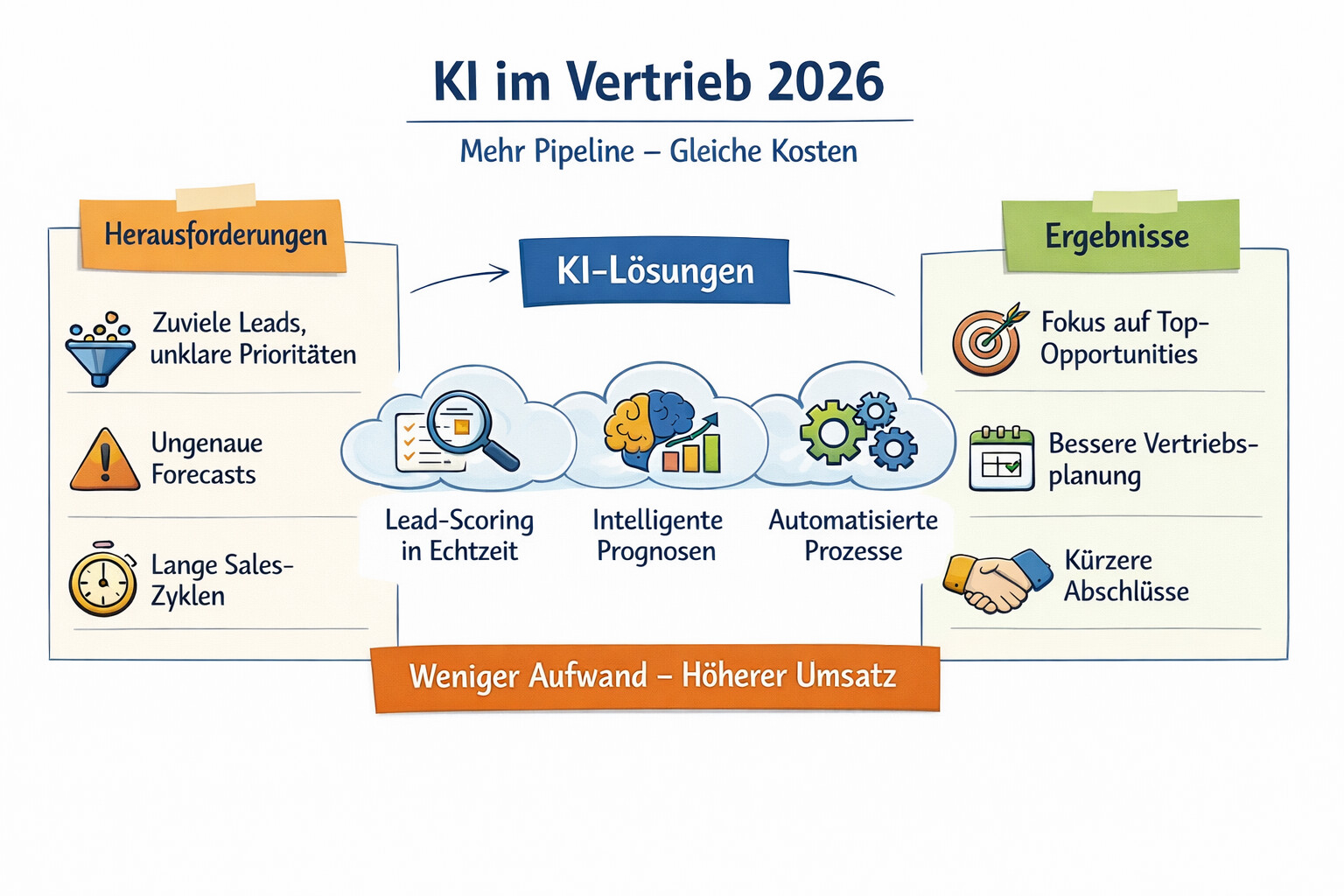

Four AI use cases that will really make an impact in 2026
Better lead prioritization
Instead of treating all leads equally, AI helps identify patterns from successful deals. This reveals which contacts are actually relevant. Transparency is important here. Only when the team understands why a lead is prioritized will there be acceptance.
Faster, cleaner qualification
AI can support qualification processes by bundling information and highlighting gaps. For example:
- Summaries from emails and appointments
- Notes on missing information
- Duplicate detection
This is particularly crucial for professional services, as incorrect qualification has a direct impact on win rates and forecasts.
Next logical step instead of task management
Instead of generic tasks, AI provides context-based recommendations. Not just what to do, but why. This provides guidance and saves time.
More stable pipeline and forecast quality
AI recognizes patterns that indicate risks at an early stage: standstills, missing information, or unusual deviations. The goal is not a perfect forecast, but rather better predictability.
Impact on marketing: Quality over volume
AI is also changing the role of marketing. Not through more content, but through better evaluation. Key questions are becoming measurable:
- Which channels generate sales?
- What content shortens sales cycles?
- Where does demand arise without conversion?
Compliance remains a prerequisite, not an obstacle
The closer AI gets to customer communication, the more important rules become. For regulated industries, this means:
- clear role and access models
- defined data classes
- documented AI usage
When implemented correctly, AI increases security because processes become more transparent.
A pragmatic introduction
Successful AI initiatives don't start with technology. They start with a clear use case. Three steps have proven effective:
- identify a bottleneck in the sales process
- define a clear minimum amount of data
- Regularly review usage and results
This turns a test into a reliable component of everyday sales work.
Conclusion
More pipeline is not created by more activity. It is created by better decisions throughout the entire lead-to-opportunity process.
Many companies will find themselves at this exact point in 2026.
They know that something has to change, but they don't know where to start.
A sensible next step is often to reflect on your own situation together:
Where are there frictions, ambiguities, or delays today?
And which approaches have proven successful in comparable organizations?
This is precisely why it is worthwhile to have a brief exchange in which we can share experiences from other companies and their best practices.
Not as a pitch, but to share experiences and classify what is realistically possible.