In the professional services sector in particular, project transparency is a stated goal for many companies. In practice, however, reporting in project management often boils down to one thing: regular status updates. Traffic-light colors, percentage figures, and summaries are intended to provide guidance. While this may be helpful for operational teams, this information rarely serves as a reliable basis for decision-making for management.
The problem is not a lack of reporting, but a lack of project transparency in the true sense of the word.
What Project Transparency Really Means
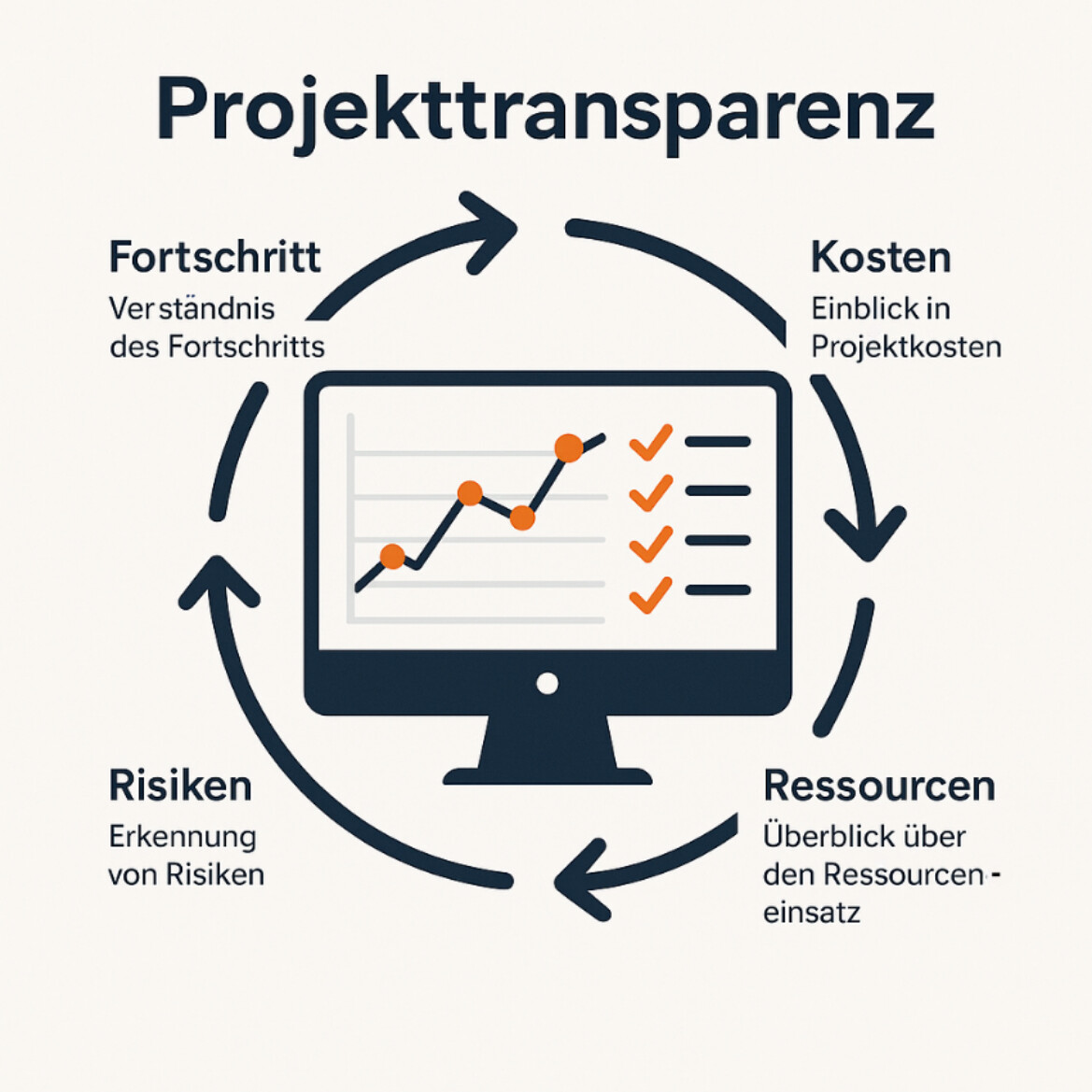
Project transparency refers to the ability to understand the actual status of a project in real time and within its context. This includes not only schedules and milestones, but above all the relationships between progress, costs, resources, and risks.
Many organizations confuse transparency with information. They generate data, reports, and presentations without deriving insights that can inform decision-making. However, transparency only emerges when information enables decisions.
Why Status Reports Are Reaching Their Limits
Traditional status reports are retrospective. They reflect a situation that is often already outdated by the time they are produced. As a result, decisions are based on past data—not on current developments.
Added to this is the subjective element. Assessments of project progress are often open to interpretation. Risks are downplayed, and deviations are put into perspective. As a result, problems often don’t become apparent until it’s almost too late to correct them.
This does not provide management with a clear picture, but rather a condensed overview lacking depth.
Common causes of a lack of project transparency
In practice, similar patterns emerge time and again:
-
Project data is spread across multiple tools and files
-
Costs, resources, and schedules are considered separately
-
Excel-based reports require a significant amount of manual work
-
Project knowledge resides in people's minds rather than in systems
The result is a fragmented picture. Connections remain hidden, dependencies are identified too late, and management becomes reactive.

What decision-makers need instead
From a management perspective, it’s not about the level of detail, but about reliability. Decision-makers need answers to key questions:
-
Where are discrepancies currently occurring?
-
Which projects are facing challenges?
-
What impact do delays have on costs and resources?
-
Where is immediate action needed?
Project transparency must answer precisely these questions—clearly, consistently, and without room for additional interpretation.
Project transparency as a management tool
True project transparency is achieved when project data is structurally linked. Progress, costs, and resources should not be viewed in isolation but must be considered within a shared context.
Only then can early warning signs be identified and informed decisions be made. This makes project management more predictable, allows risks to be identified earlier, and improves the quality of management decisions.
How companies implement this approach depends heavily on their project landscape, their processes, and their level of maturity. However, an integrated view of project data is always essential as the foundation for management and decision-making.
This is a good opportunity to gain further insights into digital project management within the company or into integrated project and controlling approaches.
Conclusion
Project transparency is not just a matter of reporting. It is a prerequisite for effective project management. Companies that rely on status reports react too late. Companies that systematically build transparency lay the groundwork for better decisions, both at the project and management levels.
Would you like to know how other companies use project transparency at the management level? A 15-minute conversation is all it takes to get started.