After years of experimentation, a central question will come to the fore in 2026:
Where does AI generate the greatest business value – measurable, scalable and sustainable?
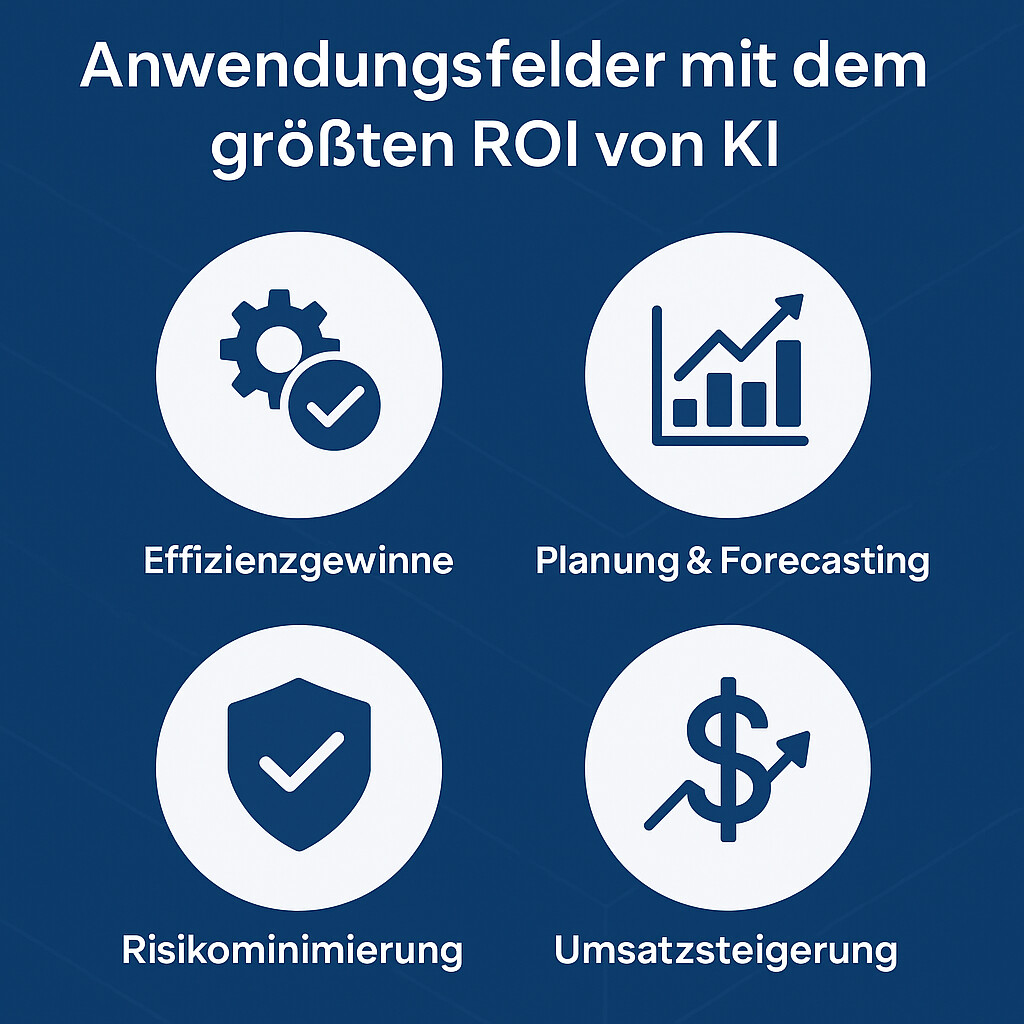
Companies have understood that AI is relevant not because of the technology, but because of its contribution to efficiency, planning security, risk reduction and increased sales.
The focus shifts from “What can AI do?” to “What does AI bring in concrete terms?”
According to PwC, more than 70% of executives now evaluate AI primarily on its financial impact, rather than on innovation potential.* The decisive factor is therefore not whether AI is used, but where.
The four areas where AI has been proven to deliver the greatest ROI in 2026
Efficiency gains in operations
This is where most of the “fast” effects occur.
AI reduces manual steps, automates routine decisions, and accelerates processes – especially in areas such as:
-
Reporting & Analysis
-
Document Processing
-
Classification & Summary
-
Service & Support
-
Process automation
ROI effect: less time, fewer errors, lower process costs.
Gartner rates this area as the “safest, broadly scalable” ROI lever of any AI use case.*
Planning & forecasting: more precise decisions
In 2026, the quality of forecasts will become a key success factor.
AI Enhances:
-
Sales forecasts
-
Budget adherence
-
Capacity planning
-
Project and Cost Histories
-
Demand forecasts
McKinsey shows that companies achieve 40-60% more accurate forecasts with AI-powered planning.*
ROI effect: stable margins, fewer surprises, better management.
Risk minimization through early pattern recognition
AI detects risks before humans perceive them:
-
Project delays
-
Quality issues
-
Supply chain risks
-
Churn Probabilities
-
Budget variances
Companies react earlier, reduce costs and stabilize their processes.
ROI effect: less unplanned costs, fewer operational disruptions, better resilience.
Increase revenue through data-driven go-to-market optimization
AI Enhances:
-
Lead scoring
-
Pricing Strategies
-
Cross-selling and upselling potential
-
Customer segmentation
-
Sales forecasts
According to Deloitte, companies report up to 10-20% increase in revenue when AI is used productively in sales.*
ROI effect: higher sales without rising costs.

Why Many AI Initiatives Don’t Deliver ROI and Why 2026 Will Be Different
The bottleneck is rarely technology.
They are:
-
Lack of data quality
-
Lack of integration
-
Unclear target definitions
-
Lack of scaling
In 2026, successful companies will rely on three principles:
-
Business goals first – not technology.
-
Data quality as a foundation – no AI model solves data problems.
-
Going live instead of PoC loops – value is created during operation.
Conclusion
The question “Is AI worth it?” is answered: Yes. And that is where business impact is created.
Efficiency, planning, risk and revenue: these are the levers that will decide in 2026.
Companies that consistently align their AI strategy with these four areas achieve the highest return on investment.
15-minute impulse discussion
Want to know which AI use cases generate the most ROI in your organization?
In 15 minutes, you will receive a clear assessment of your potential.
*Sources
-
PwC Global CEO Survey
-
Gartner AI Business Value Forecast
-
McKinsey Global AI Survey
-
Deloitte Future of AI in Sales