Marketing is at a turning point in 2026. Many mechanisms that have worked reliably for years are losing their effectiveness. Automation, AI-generated content, and data-based control have long been part of everyday operations. At the same time, customers are demanding the opposite. Communication should be understandable, relevant, and credible. Not perfect, but appropriate. Not loud, but helpful. The marketing trends of 2026 cannot therefore be understood as a continuation of existing tactics. They mark a structural paradigm shift that fundamentally affects marketing organizations.
Why marketing needs to be redefined in 2026
Marketing is under increasing pressure to deliver results. Budgets are becoming more restrictive, impact must be clearly demonstrated, and at the same time, the complexity of channels, technologies, and target groups is increasing. In many organizations, marketing has historically been structured around channels or campaigns. This logic will increasingly reach its limits in 2026. Relevance no longer comes from being present on as many channels as possible, but from consistent alignment with real customer needs. Marketing will be measured more strongly by its contribution to long-term customer value. This shifts the focus from activity to strategic impact.
Trend 1: AI-first marketing
Artificial intelligence is still considered a supplementary tool in the marketing departments of many companies. Another tool in the stack, a lever for efficiency in content production or analysis. By 2026, however, it will become clear that this view is too narrow. AI-first marketing describes the transition from selective AI applications to structural integration. AI will become an infrastructural foundation, comparable to CRM systems or marketing automation in previous years.
What this trend means for marketing organizations
AI-first does not mean maximum automation. The key is to make a conscious distinction between machine support, as in Dynamics 365 Customer Insights, and human evaluation. AI prepares decisions, prioritizes information, and recognizes patterns. The responsibility for classification, tone, and strategic relevance remains with humans. Organizations that do not clearly define these roles risk either blind automation or inefficient duplication of work. AI-first is therefore less a question of technology than a question of organization.
Trend 2: Zero-click marketing
A defining feature of marketing trends in 2026 is the continued decline of traditional click paths. Search engines, platforms, and AI interfaces are increasingly answering questions directly. Information is summarized, classified, and displayed without users necessarily visiting a website. Visibility is thus often achieved without direct interaction.
What this trend means for visibility and content
Success can no longer be measured solely by traffic. Content must be designed in such a way that it also works outside of your own channels. Comprehensibility, clarity, and quotability are becoming increasingly important. Relevance arises where guidance is offered. Not through reach, but through presence in the right places. For marketing organizations, this means viewing content more as a strategic asset and less as a campaign tool.
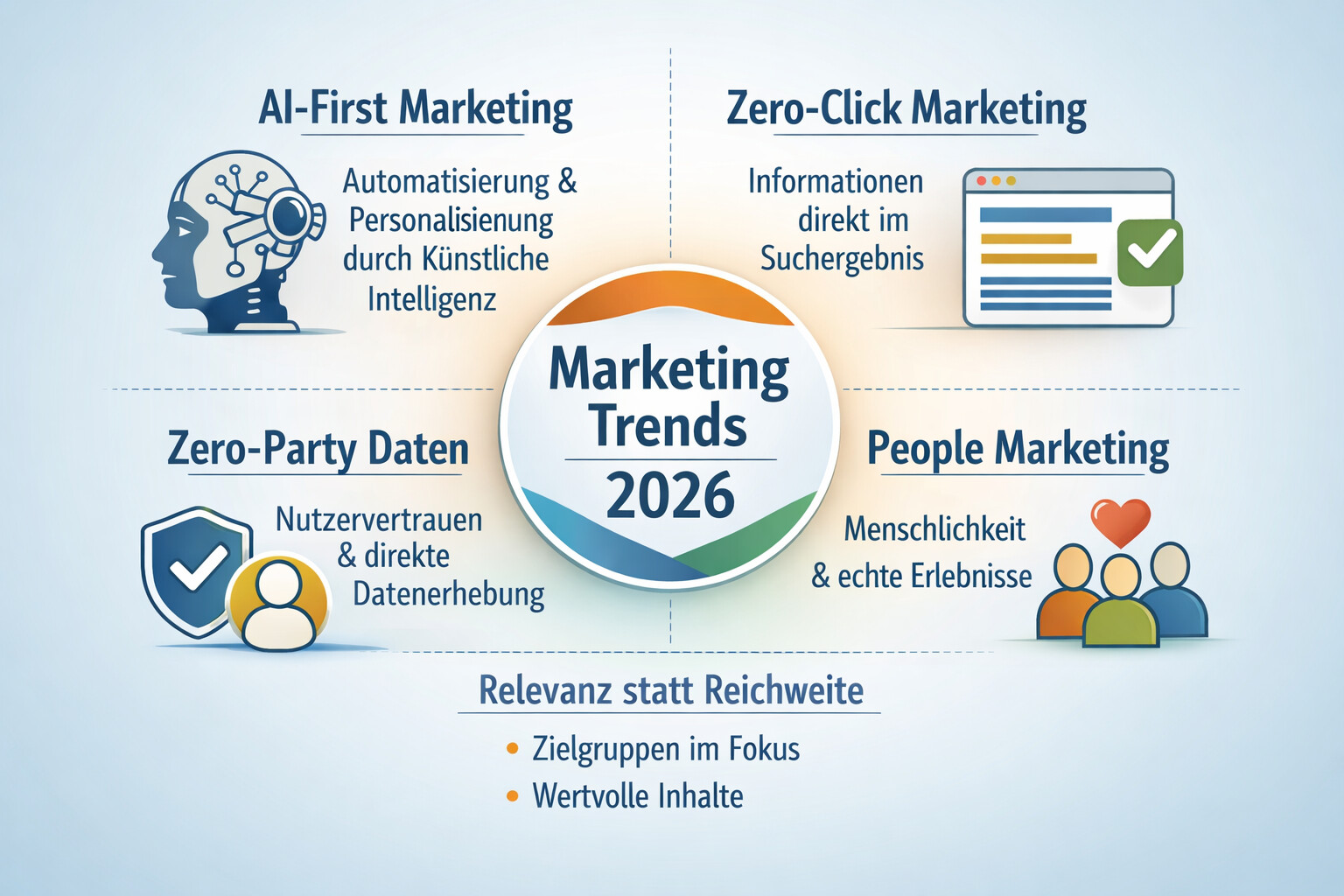

Trend 3: Zero-party data and trust
Parallel to the decline in the importance of third-party data, zero-party data is gaining relevance. This refers to information that users share consciously and voluntarily. This development is not a technical subtlety, but rather an expression of a fundamental shift in trust. Data protection regulations, increasing sensitivity, and declining acceptance of tracking are changing the rules of the game in the long term.
What this trend means for data strategies
Marketing can no longer simply collect data. It must provide reasons why people are willing to disclose information. Trust becomes a key resource. Content, services, and interactions must offer clear added value before data flows. This brings marketing closer to customer experience, service, and communication. Data strategy becomes relationship building.
Trend 4: People Marketing
The marketing trends for 2026 are also clearly evident in the context of employer attractiveness. Traditional employer branding often relies on generic promises and idealized images. These patterns are becoming increasingly less effective. Candidates and employees expect authenticity rather than staging.
What this trend means for organizations
People marketing focuses on real roles, actual expectations, and concrete development opportunities. Not as a campaign, but as continuous communication. Marketing plays a connecting role between internal reality and external perception. Credibility arises where communication is consistent with the organization as it is experienced.
Trend 5: Relevance instead of reach
One of the key marketing trends for 2026 is the shift away from a purely reach-based approach. Attention is fragmented, budgets are under pressure, and impact is becoming more difficult to measure. Reach alone is increasingly being decoupled from actual benefit.
What this trend means for control and KPIs
Successful marketing organizations prioritize relevance. They no longer ask how many people are being reached, but rather which people. This perspective changes target definitions, KPI models, and internal coordination. Marketing moves closer to business goals and is increasingly understood as a strategic function that makes value contributions visible.
Common misconceptions in marketing organizations
Many organizations respond to these developments with actionism. More tools, more content, more campaigns. However, the real problems often lie deeper. Marketing is still heavily structured in silos in terms of organization. These structures make it difficult to integrate AI-first approaches, zero-click logic, and relevance thinking in a meaningful way. Without clear priorities and decision-making processes, operational overload results instead of strategic impact.
What marketing organizations must do now
Marketing in 2026 does not require radical reinvention, but rather a clear realignment. Key areas of action include consciously clarifying the role of AI, adapting success criteria beyond clicks, building trust-based data relationships, strengthening the integration of marketing with HR, sales, and service, and consistently focusing on relevant target groups and topics. These steps are organizational in nature and require leadership and guidance.
Conclusion: Marketing is becoming quieter, but more effective
The marketing trends for 2026 do not show an easy path, but they do show a clear direction. Marketing is becoming both more technological and more human. Organizations that take this balancing act seriously will gain clarity. Not through volume, but through relevance. Marketing is thus evolving from a campaign function to continuous value creation for customers, employees, and the company as a whole.