At the start of 2026, many HR departments are under new, silent pressure. It is no longer just a matter of managing hiring, turnover, or short-term staffing needs. HR is expected to be able to realistically answer questions such as how well organizations will remain capable of acting in the future, how much capacity is actually available, what skills are lacking, and what risks arise when strategic decisions are based on assumptions that have little to do with operational reality. Workforce planning 2026 is thus moving to the center of strategic management.
Why workforce planning needs to be rethought for 2026
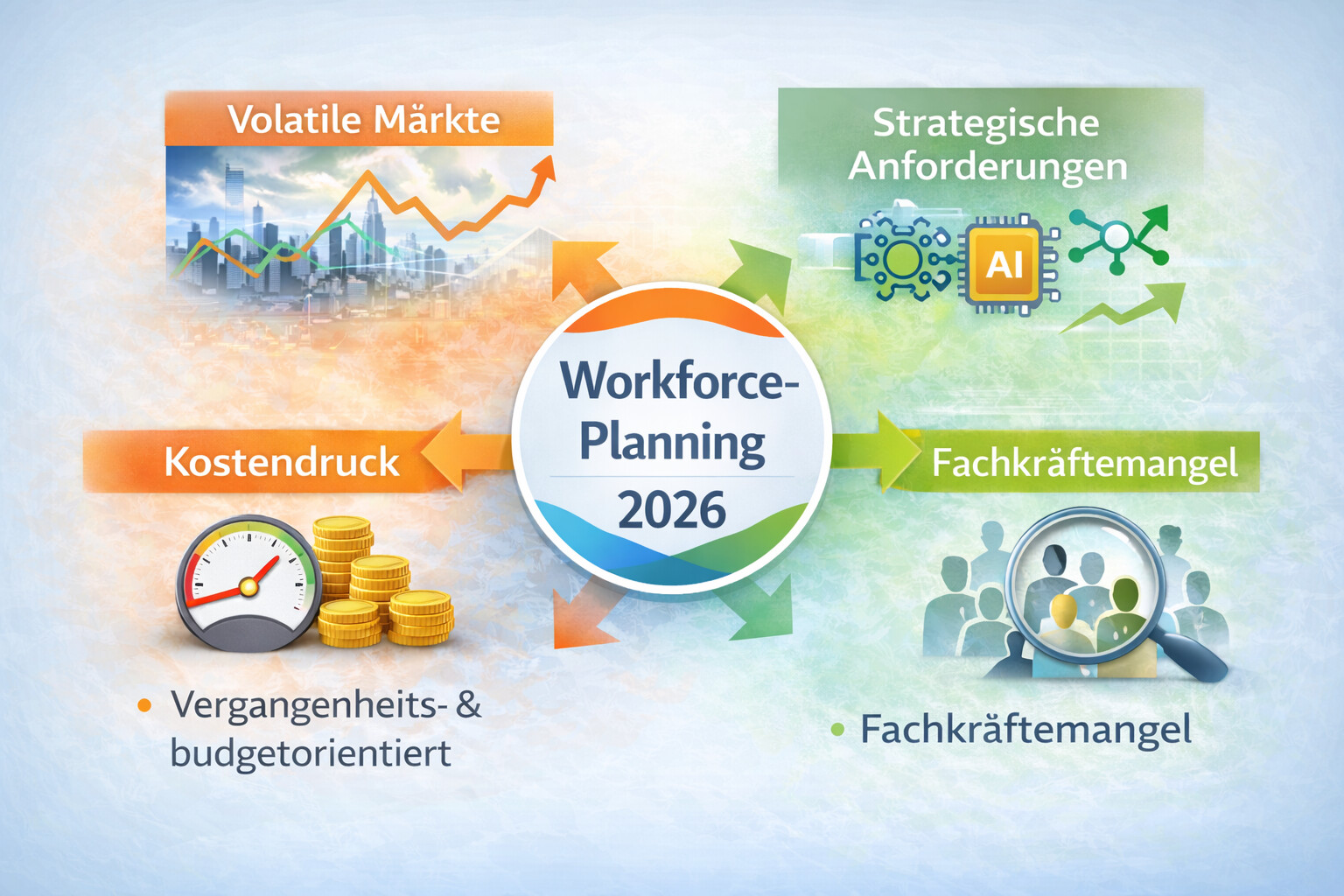
Several developments are converging simultaneously. Markets remain volatile, order situations are difficult to plan, and cost pressure continues to increase. At the same time, there is a continuing shortage of skilled workers in key roles, particularly in knowledge-intensive areas such as professional services and healthcare. Added to this are strategic initiatives relating to digitalization, AI, and new services that require different skills than before.
Many organizations have a structural problem in this regard. Workforce planning is often backward-looking, heavily budget-driven, or focused purely on headcount. It provides figures, but hardly any basis for decision-making. This is not always immediately apparent in day-to-day business. However, the gap becomes apparent at the latest when managers expect reliable statements on bottlenecks, scenarios, or risks.
Typical practical problems in HR planning
In 2026, many heads of HR recognize similar patterns in their organizations. Planning is based on positions and FTEs, not on actual utilization or available skills. Scenarios such as order fluctuations, waves of illness, or new projects are rarely systematically played out. HR planning and corporate strategy are out of sync, so decisions are made before HR can respond in an informed manner.
This is particularly critical in industries where capacity is directly linked to service delivery. In professional services, it affects revenue and project quality. In healthcare, it has a direct impact on the security of care and the workload of employees. A lack of transparency rarely has no consequences in these sectors.
Trend 1: From headcount to capacity and skill-based planning
A key change in workforce planning in 2026 concerns the focus of planning. Traditional headcount models only answer the question of how many people are available. They say little about what skills are available, how heavily these are utilized, or where bottlenecks arise.
What this change means for HR
Capacity and skill-based planning considers work, not just jobs. It asks what services need to be provided and what skills are actually required to do so. This gives HR a different role. Instead of providing retrospective figures, planning becomes forward-looking and relevant to decision-making. At the same time, complexity increases. Without a clear structure, this approach remains theoretical.

Trend 2: Workforce planning is no longer an Excel issue
In many organizations, workforce planning is still associated with spreadsheets and manual coordination. Excel is not really the problem here. The critical issue is that planning is often carried out in isolation, without a clean database and without any connection to operational realities.
Why workforce planning is not an IT project either
The countertrend is to view workforce planning as purely a system issue. That, too, falls short. Technology can provide support, but it cannot replace clarity about goals, roles, and decision-making logic. Workforce planning in 2026 is primarily a management and control task. HR must define which questions need to be answered and what consequences the results will have.
Trend 3: Scenarios become a core competency
A key shortcoming of today's HR planning is the lack of scenario capability. What happens when orders slump at short notice? What are the effects of delays in hiring? Where do risks arise when key roles remain vacant for longer periods of time?
Questions HR should be able to answer
Workforce planning for 2026 does not mean predicting the future. It means being prepared. HR should be able to make alternative developments transparent, disclose assumptions, and highlight decision-making options. Managers do not expect perfect forecasts, but rather guidance in times of uncertainty.
Trend 4: The hidden costs of inadequate planning
Inadequate workforce planning rarely becomes apparent immediately. Its effects are delayed. Workloads increase, projects are delayed, quality suffers, and managers make decisions based on incomplete information. The costs arise gradually but are considerable in the long term.
These effects can hardly be compensated for, especially in regulated or labor-intensive areas. Lacking capacity cannot be offset at will. Workforce planning thus becomes a key lever for stability and resilience.
What HR should clarify now before decisions are made under time pressure
Workforce planning for 2026 does not require perfect models, but rather clear fundamentals. HR should understand which skills are critical, where capacity could become scarce, and which assumptions underlie its own planning. Equally important is the timing of strategic decisions. Planning that comes too late loses its value.
Conclusion: Workforce planning is becoming a strategic HR skill
Workforce Planning 2026 marks a change in role for HR. Away from reactive delivery of figures, toward forward-looking decision support. Organizations that take this change seriously gain room for maneuver. Not because they know every development, but because they are better prepared when uncertainty becomes the norm.