Project management is poised for a fundamental transformation in 2026. Projects are becoming more complex, dependencies more intertwined, and operating conditions more volatile. At the same time, new opportunities are emerging through AI, data-driven planning, and more flexible delivery models. Traditional project management is reaching its limits, as are purely agile approaches. The project management trends for 2026 clearly show that organizations must find a new balance between flexibility and manageability, operational excellence and strategic control.
Why Project Management Needs to Be Reassessed in 2026
In many organizations, project management has historically been established as an operational discipline. The focus is on schedules, budgets, and deliverables. This approach falls short in 2026. Economic uncertainties, resource scarcity, and parallel transformation initiatives are increasing the pressure on project organizations. Projects are no longer isolated endeavors but part of larger change programs. Project management is thus increasingly measured by its ability to provide direction, transparency, and confidence in decision-making.
Trend 1: AI-powered planning and forecasting
By 2026, artificial intelligence will be widely adopted in project planning and management. Not as a replacement for project managers, but as a supporting infrastructure. AI-powered systems analyze historical project data, identify patterns, and provide forecasts regarding effort, risks, and dependencies. This makes planning more dynamic and less reliant on individual experience.
What this trend means for project organizations
AI alleviates operational burdens, particularly in terms of scheduling and resource planning. At the same time, the skill set required for project management is shifting. The ability to interpret forecasts, question assumptions, and draw conclusions is becoming more important than manually creating plans. Project managers must learn to work with uncertainty and probabilities rather than clinging to seemingly stable plans.
Trend 2: Hybrid delivery is becoming the norm
The distinction between agile and traditional approaches will continue to lose significance in 2026. In practice, hybrid delivery models that combine different approaches are gaining traction. Agile methods are used where uncertainty is high and learning is a priority. Traditional control mechanisms remain relevant when dependencies, regulation, or investment volumes require clear oversight.
What Hybrid Delivery Means for Management and Implementation
Hybrid delivery requires clarity regarding roles, decision-making processes, and expectations. Without a shared understanding, friction arises between teams, methodologies, and management levels. Successful organizations deliberately define where flexibility is necessary and where reliability is a priority. Hybridity thus becomes not a compromise, but a carefully designed delivery model.
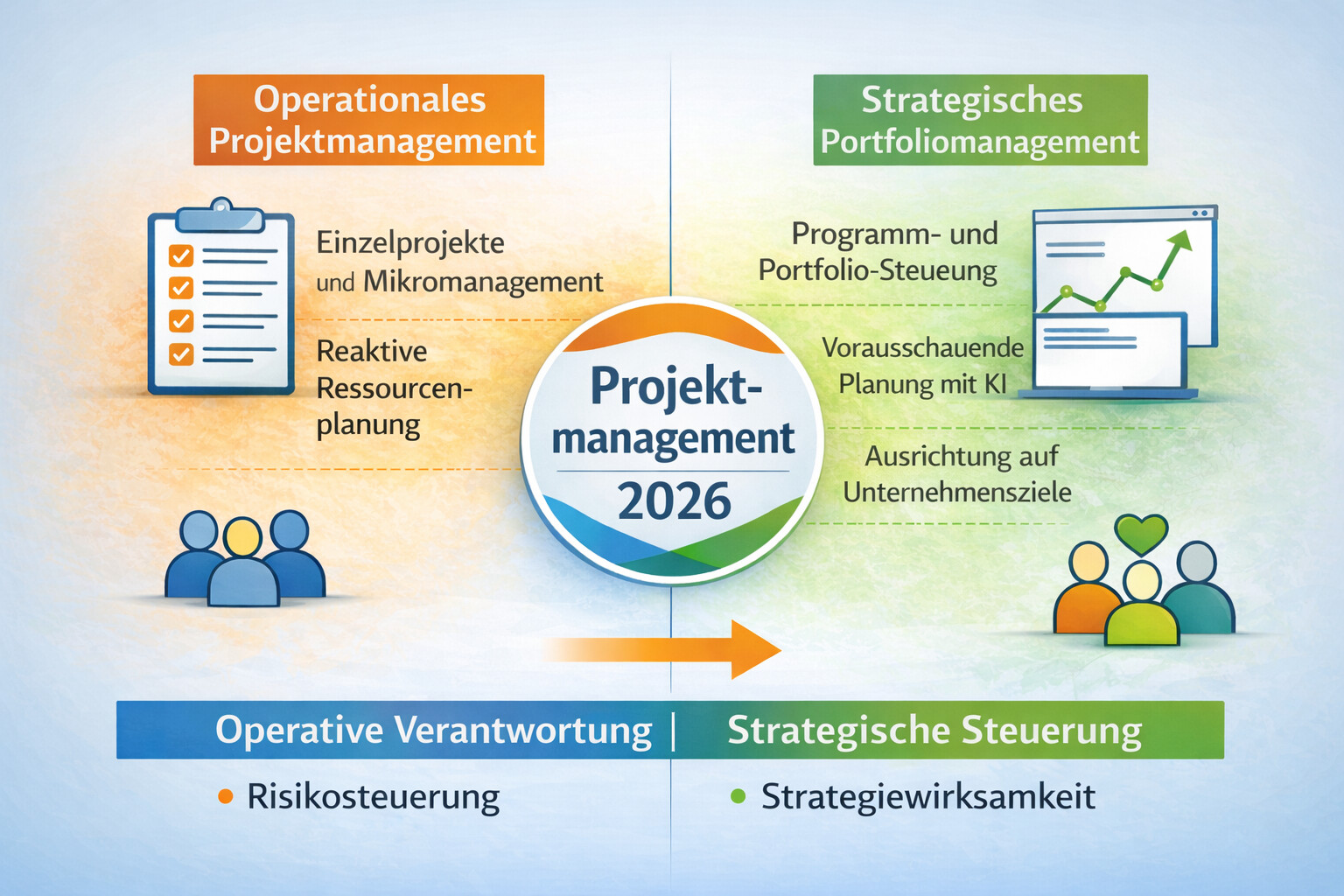

Trend 3: Portfolio and Program Management as a Core Discipline
As the number of projects increases, the importance of portfolio and program management grows. By 2026, it will be virtually impossible to manage individual projects effectively in isolation. Interdependencies, resource conflicts, and strategic priorities require a broader perspective. Portfolio management is evolving into the central coordinating body between strategy and implementation.
Why strategic management is becoming more important than optimizing individual projects
The success of individual projects says little about the organization’s overall success. What matters is whether the right initiatives are prioritized, synchronized, and, if necessary, discontinued. Portfolio management provides transparency regarding target contributions, risks, and resource utilization. As a result, project management becomes more strategically embedded and is viewed less as a purely operational function.
Trend 4: Soft skills and leadership are becoming increasingly important
As automation increases, the demands placed on project managers are also changing. Technical expertise remains important, but it is no longer sufficient. Communication, decision-making skills, and interim leadership are becoming key factors for success. Project managers are increasingly navigating the tensions between functional departments, management, and external partners.
How project managers' understanding of their roles is changing
By 2026, project managers will act more as facilitators, interpreters, and decision-making guides. They will bring clarity to uncertain situations, address conflicts early on, and reconcile differing interests. Leadership in a project context will mean less instruction and more guidance. These skills cannot be automated, but they will become increasingly important with the use of AI.
Common Misconceptions in Today's Project Organizations
Many organizations are responding to the trends described with isolated measures. New tools are introduced, methods are adapted, or roles are renamed. Without structural integration, however, these changes remain ineffective. Project management continues to be viewed as a support function rather than an integral part of strategic management. This misconception leads to overload, a lack of transparency, and inconsistent decisions.
How Project Organizations Should Structure Their Delivery Models
Project management in 2026 requires a deliberate alignment of structures, roles, and governance frameworks. Key issues include the integration of AI into planning and reporting, the clear definition of hybrid delivery models, and the strengthening of portfolio management. Equally important is the targeted development of leadership and communication skills in a project context. Organizations that integrate these elements successfully achieve both agile flexibility and strategic control.
Conclusion: Project management is becoming more strategic and more people-oriented
The project management trends for 2026 point in a clear direction. Operational excellence remains important, but it is no longer enough. Project management is evolving into a discipline that bridges the gap between strategy and execution. AI helps manage complexity, but it does not replace leadership. The real key lies in the ability to navigate uncertainty, set priorities, and guide people through change.