Many companies have more customer data than ever before. Yet this often does not translate into better customer experiences. Sales, marketing, and customer service teams work with different sets of information, campaigns are based on static target groups, and relevant signals are identified too late.
That's exactly where Dynamics 365 Customer Insights comes in. The Solution customer data, segments, real-time journeys, and AI-powered insights. This enables companies not only to better understand their customers but also to engage with them in a more targeted, faster, and more relevant way.
Why Customer Engagement Is a Data Problem Today
Customer engagement often sounds like campaigns, channels, and content. In practice, however, it starts earlier: with the data foundation. When customer data is scattered across CRM, ERP, the website, email marketing, events, and service systems, a clear picture doesn’t emerge. Marketing sees different information than Sales. Service picks up on different signals than Account Management. As a result, decisions become slower and less precise.
That is precisely one of the typical challenges facing growing companies. Processes scale, systems are added, data becomes more complex—and yet customer experiences are expected to become more personalized. Without a central database, personalization often remains superficial.
Microsoft positions Dynamics 365 Customer Insights as Solution for unifying customer data, personalizing customer journeys, and leveraging Copilot for real-time insights. This shifts customer engagement away from isolated campaigns toward data-driven interactions across the entire customer journey.
What Dynamics 365 Customer Insights Does
At its core, Dynamics 365 Customer Insights consists of two closely related components: Customer Insights Data and Customer Insights Journeys. Customer Insights Data helps unify customer data from various sources and build customer profiles. Customer Insights Journeys uses this data to design real-time journeys, segments, triggers, and personalized communications.
The goal isn't just better marketing automation. The greater benefit lies in systematically leveraging customer signals. When a customer fills out a form, visits a specific product page, attends an event, submits a service request, or falls into a target group, this can trigger an appropriate customer journey or interaction.
| Area | Business Benefits |
|---|---|
| Standardized Customer Profiles | Sales, marketing, and customer service all work with a more consistent view of the customer. |
| Segments | Target audiences can be defined more precisely and dynamically. |
| Real-Time Journeys | Communication responds more quickly to behavior and signals. |
| Trigger | Customer actions can directly trigger processes or journeys. |
| Copilot | Teams can create journeys, segments, and content more quickly. |
Microsoft describes in "Use Unified Profiles in Dynamics 365 Customer Insights"that companies can use unified customer profiles and segments in real-time journeys. This also includes dynamic content in emails, text messages, and push notifications based on data such as loyalty status, contract renewal, or other metrics.
Copilot in Customer Insights: Moving Faster from Idea to Journey
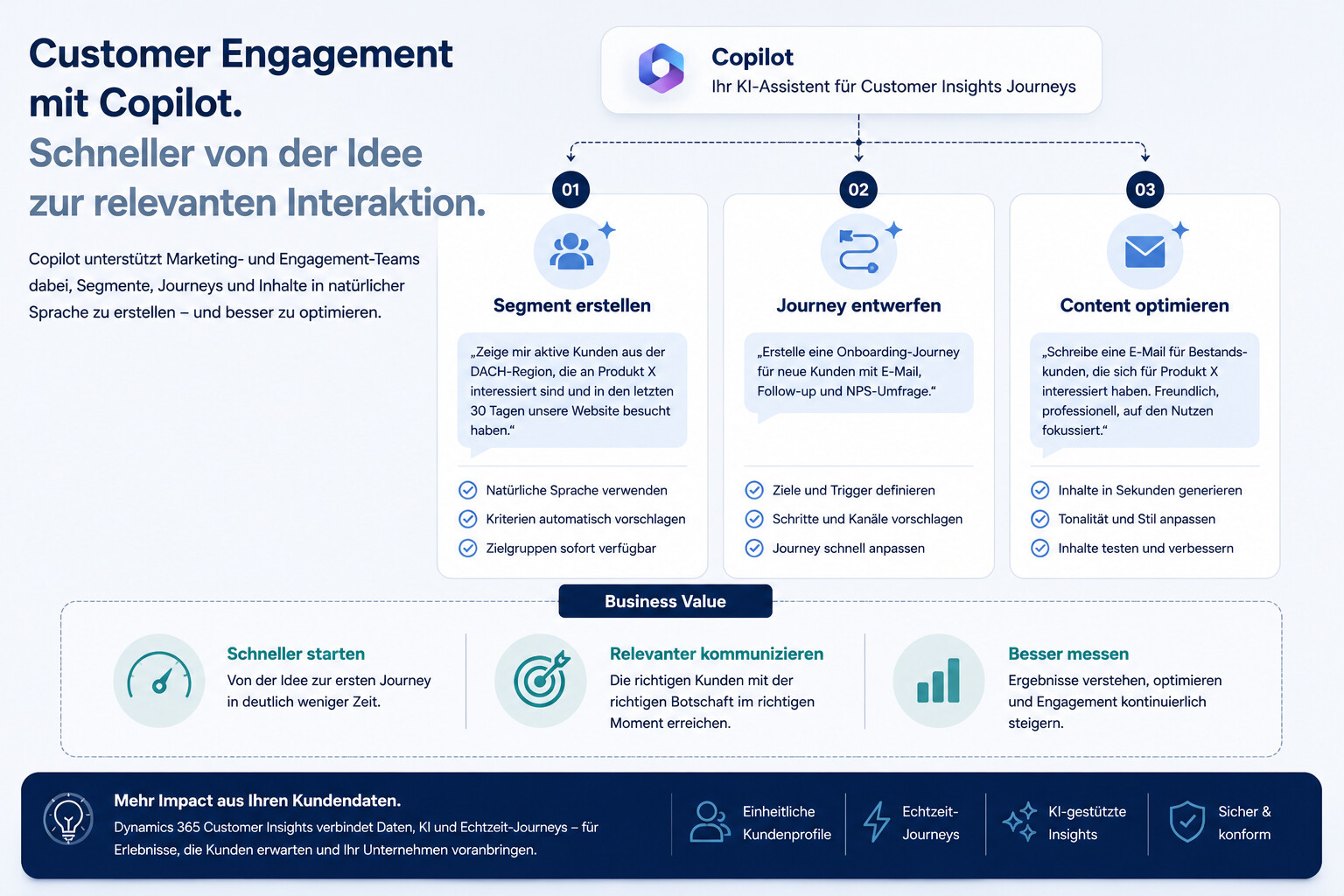
Copilot is a key tool. Many marketing and customer engagement teams waste time creating segments, emails, and journeys. They know which target audience they want to reach, but they have to translate that logic into a technically sound format. Copilot can speed up this process.
Microsoft describes in Copilot features in Customer Insights Journeysthat users can describe goals in natural language to create real-time journeys, define target audience criteria, and generate emails based on bullet points, tone, or topic. Copilot can also help with content editing and recommend images that Message the Message .
This changes the way we work. Teams don’t have to start with a blank canvas at every step. They can create designs faster, test variations, and structure user journeys. People remain responsible for strategy, tone, approval, and quality. But Copilot reduces the effort required between the initial idea and implementation.

Real-Time Journeys Instead of Static Campaigns
Many traditional campaigns follow a set plan. A target audience is defined, an email is sent, and further steps follow. This can work, but it’s often too rigid. Customers don’t respond based on a campaign schedule, but rather on their own circumstances, interests, and timing.
Real-Time Journeys solve this problem because they respond more effectively to signals and behavior. Microsoft describes in "Create custom triggers in Customer Insights Journeys" "Create custom triggers in Customer Insights Journeys," Microsoft describes custom triggers as a way to capture key moments and interactions and build customer journeys around them. A trigger can represent virtually any relevant customer action.
This is particularly valuable for companies when customer engagement is meant to be more than just newsletters. A customer downloads a white paper. An existing customer is nearing a contract renewal. A contact attends an event. An account shows repeated interest in a specific topic. Such signals can lead to targeted next steps.
Outbound Marketing Is Over: Why This Shift Matters
Another reason to explore Customer Insights Journeys is the change at Microsoft itself. The former outbound marketing module was removed in May 2026. Microsoft explains in Notes on the Removal of Outbound Marketingthat Dynamics 365 Customer Insights Journeys previously included an additional Outbound Marketing module, but that this module was removed in May 2026.
This is more than just a technical change. It shows the direction in which Microsoft is taking the product: away from traditional outbound marketing and toward real-time journeys, data activation, and AI-powered orchestration. Companies that still think heavily in terms of old campaign logic should therefore assess whether their customer engagement processes are still fit for the future.
The transition isn't simply a matter of transferring old emails to a new module. It's about rethinking journey logic, segments, triggers, data sources, and performance metrics. Anyone who views this transition solely from a technical perspective is missing out on potential.
How Companies Make Effective Use of Customer Insights
You shouldn't start with a broad discussion of the platform. It's better to ask a clear question: Which customer experience should be improved? Only then should you plan data sources, segments, and customer journeys.
A good starting point can be a specific customer journey that is currently still managed manually or imprecisely. For example, lead nurturing after an event, reactivating inactive contacts, onboarding new customers, renewal communications, or follow-ups after service interactions. The use case should be relevant enough to have an impact, but clear enough to be implemented quickly.
| Step | Goal |
|---|---|
| Define a Use Case | Select a specific customer engagement issue. |
| Check Data Sources | Determine which customer information is relevant to the journey. |
| Build Segment Logic | Define target groups based on real characteristics and indicators. |
| Set a trigger | Use relevant customer actions as starting points. |
| Design Your Journey | Clearly structure communication, channels, and handoffs. |
| Measuring Success | Analyze KPIs such as conversion, engagement, pipeline contribution, and retention. |
The most important point is the connection between data and action. A unified customer profile is valuable, but it’s only when it’s activated in journeys that it has an impact. Conversely, a journey without a solid data foundation is often just a fancier version of a campaign.
Why Customer Insights Is Especially Relevant for B2B
In B2B, customer engagement is often more complex than in B2C. Purchasing decisions take longer, multiple people are involved, and the relevant context is spread across many systems. A single point of contact says little about the account as a whole. A form submission is rarely enough to assess a customer’s intent to purchase.
Dynamics 365 Customer Insights can help here by consolidating data from various sources into a more comprehensive picture. Sales and marketing teams can better understand which accounts are active, which topics are becoming relevant, and which contacts should be engaged throughout a customer journey.
This is particularly interesting for project-based companies. When sales, service, project management, and finance teams work with different data sets, potential often remains untapped. Customer Insights can help consolidate signals from multiple areas and use them to develop better customer engagement processes.

The Role of AI: Support, Not Autopilot
AI can significantly accelerate customer engagement. Copilot helps create customer journeys, segments, and content. Data models support profiling and personalization. Triggers enable faster responses to customer behavior.
Nevertheless, AI should not be viewed as an autopilot. Especially in B2B, customer engagement requires expert oversight. Which target audience is truly relevant? What tone is appropriate for the account? Which communications are helpful, and which come across as too automated? What data can be used for personalization?
The best results are achieved when AI streamlines operational work, but strategy, accountability, and quality remain with the company. Dynamics 365 Customer Insights can support this work, but it does not replace the careful definition of target audiences, customer journeys, and business objectives.
Conclusion: Customer engagement requires more than just campaigns
Dynamics 365 Customer Insights is important because customer engagement today is no longer limited to individual campaigns. Companies need to understand customer data, recognize signals, and trigger the right interactions at the right moment.
The value doesn’t come from the product alone. It comes from the combination of data, segments, real-time journeys, Copilot, and clear business goals. Those who view customer insights solely as a marketing tool are only tapping into a fraction of its potential. Those who see it as the foundation for data-driven customer engagement can bring sales, marketing, and service closer together.
Customer engagement thus becomes less static and more event-driven. No longer: one campaign for many. Instead: relevant interactions based on genuine customer signals.
FAQ
What is Dynamics 365 Customer Insights?
Dynamics 365 Customer Insights is aSolution data-driven customer engagement. It helps companies consolidate customer data, create segments, build real-time customer journeys, and further personalize customer communications.
What is the difference between Customer Insights Data and Customer Insights Journeys?
Customer Insights Data focuses on standardizing customer data and building customer profiles. Customer Insights Journeys uses this data to design segments, triggers, communications, and real-time journeys.
What role does Copilot play in Dynamics 365 Customer Insights?
Copilot helps teams create segments, emails, and real-time journeys. Users can describe their goals in natural language and receive suggestions that they can review, customize, and publish.
Why Are Real-Time Journeys Important?
Real-time journeys respond more effectively to customer behavior and relevant signals. This enables companies to communicate more quickly and appropriately than with purely static campaigns.
Is Dynamics 365 Customer Insights relevant only for marketing?
No. While Customer Insights is strongly associated with marketing, its benefits extend beyond that. Consistent customer data and relevant signals can also support sales, service, and account management.
How Do Companies Get Started with Customer Insights?
A good place to start is with a specific use case, such as lead nurturing, event follow-up, customer onboarding, or reactivation. Next, define data sources, segments, triggers, journey logic, and KPIs.
Why is data quality crucial for customer insights?
Without clean and linked customer data, segments remain inaccurate and customer journeys are of little relevance. Data quality determines whether personalization is truly helpful or merely appears to be technically possible.