Artificial intelligence is currently becoming an important tool for finance departments. At the same time, many companies are finding that the success of AI depends less on the models used than on the quality of the underlying data.
This is precisely where the importance of modern ERP systems becomes apparent. After all, AI in finance can only deliver reliable analyses, forecasts, and recommendations if financial data is consistent, up-to-date, and centrally available. Microsoft Dynamics 365 Business Central provides the necessary foundation for this, making it a key component of many companies’ future finance strategies.
Why AI Is Currently Getting So Much Attention in Finance
The demands placed on finance departments have changed significantly in recent years. CFOs and finance teams are expected to respond more quickly to changes, continuously update forecasts, and make well-informed decisions. At the same time, there is growing pressure to control costs, identify risks early on, and streamline processes.
That is precisely why AI is becoming an increasingly important focus in finance. Modern systems can analyze large amounts of data, identify patterns, and process information much faster than would be possible manually. For many companies, this creates the opportunity to streamline financial processes and make better decisions.
However, it is often overlooked that AI is not a magic bullet. The quality of the results depends directly on the quality of the available data.
Why AI Is Only as Good as Its Data Set
Many companies begin their AI initiatives by asking which technology they want to use. However, the more important question is often: Is our data even ready for AI?
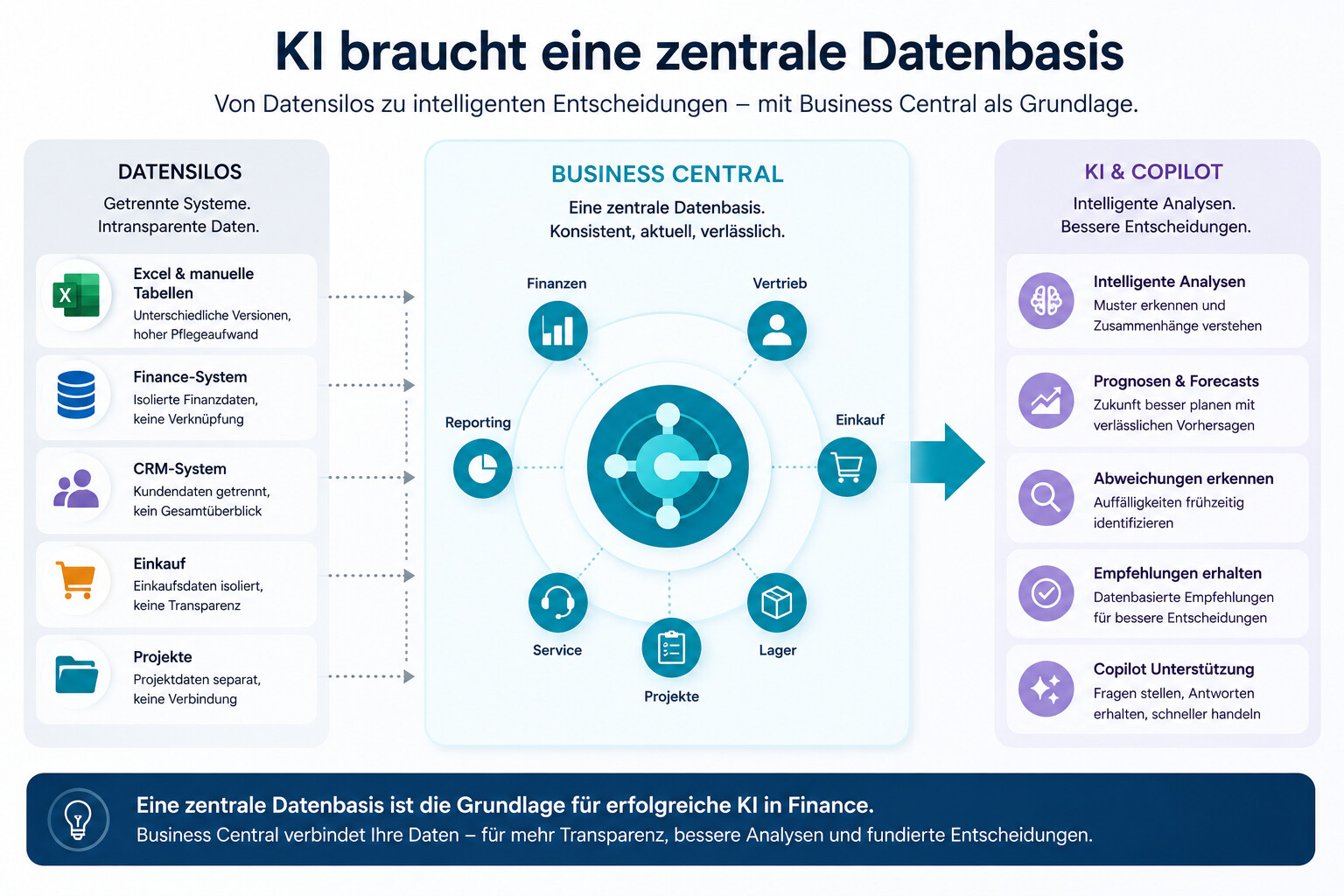
Today, financial data is generated in numerous systems. Information is stored in ERP, CRM, project management, and procurement systems, or in Excel files. Data is often maintained multiple times or manually consolidated. This leads to inconsistencies, data discontinuities, and discrepancies in data versions.
AI cannot automatically solve such problems. On the contrary, if incomplete or erroneous data is analyzed, the results will also be incomplete or erroneous.
This can have significant implications, particularly in the finance sector. Forecasts, cash flow analyses, and management reports lose their value if the underlying information is not consistent. That is precisely why AI in finance does not start with individual tools, but rather with the question of whether data is consistent, up-to-date, and centrally available.

The Problem with Isolated Financial Data
In many companies, data has accumulated over time. Sales works in its own systems, Finance uses separate applications, and project teams maintain additional information on other platforms.
These silos not only hinder reporting and transparency; they also limit the benefits of AI.
If financial data cannot be linked to project information, customer information, or operational metrics, the necessary context for intelligent analysis is missing. In that case, AI can only evaluate individual data points but cannot identify the full picture.
That is precisely why the need for a central platform is becoming increasingly important. Companies need an environment where information is consolidated and consistently available.
Why Business Central Lays the Foundation for AI in Finance
Business Central provides exactly this central foundation. Financial data, operational information, and business processes are consolidated into a single platform.
This results in several benefits. Data becomes more consistent, processes are standardized, and information is available more quickly. At the same time, the effort required for manual data maintenance and reconciliation between different systems is reduced.
For AI applications, this means a significantly better starting point. Instead of isolated pieces of information, up-to-date and reliable company data is available.
It is particularly important to note that Business Central not only stores data but also maps processes in a structured way. This creates a context that modern AI systems can use for analyses, forecasts, and recommendations.
Companies that want to successfully use AI in finance need precisely this combination of data quality, process standardization, and centralized access to information.
Microsoft Copilot and Business Central
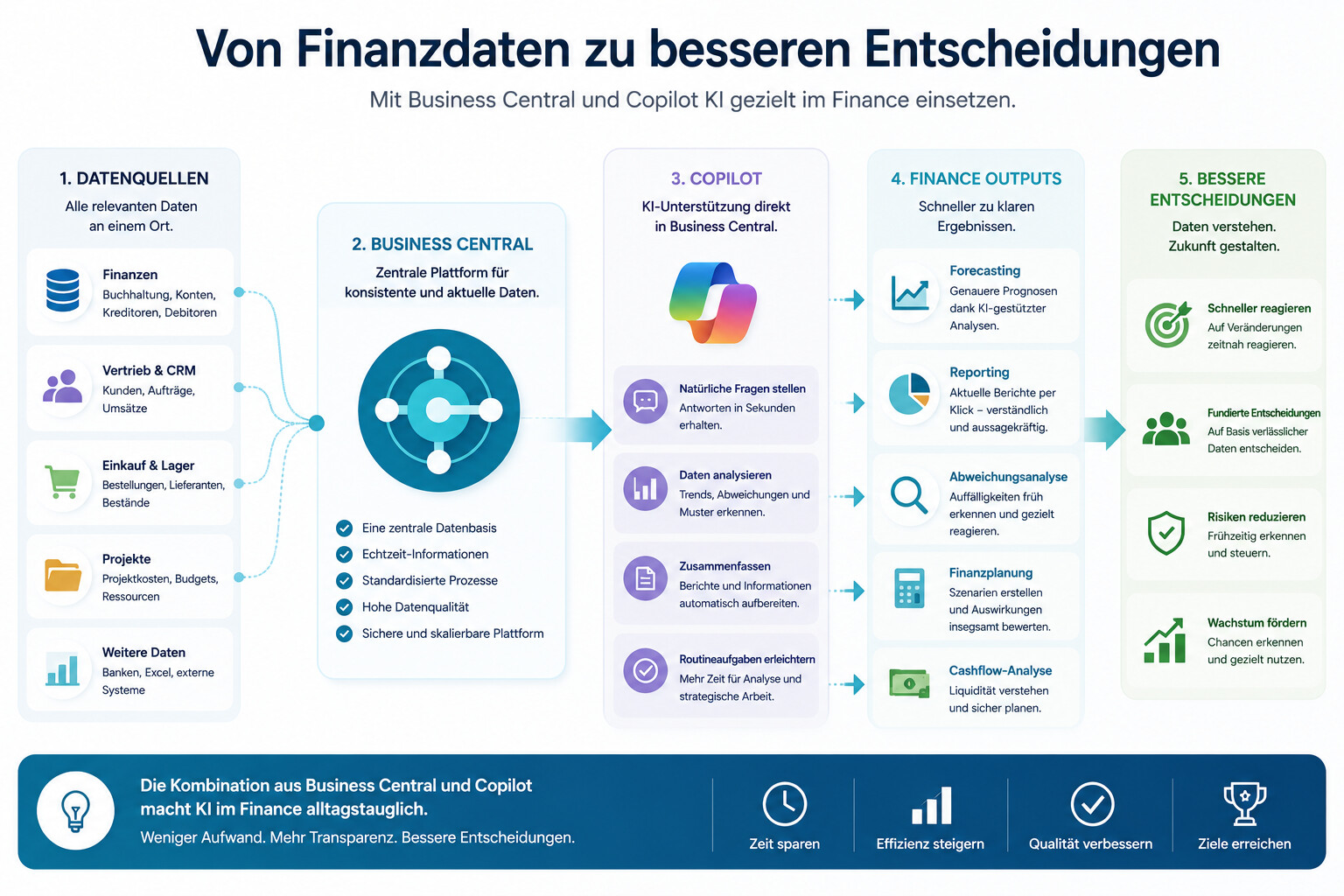
With Microsoft Copilot, AI is increasingly becoming part of the day-to-day work of finance teams. The goal is not to replace finance experts. Rather, Copilot helps them find information more quickly, perform analyses, and streamline routine tasks.
Users can ask questions in natural language and receive immediate answers based on the available data. Reports can be generated more quickly, correlations can be identified more easily, and information can be processed more efficiently.
This becomes particularly interesting when analyzing large volumes of data. Instead of manually searching for anomalies or trends, finance teams can identify relevant developments much more quickly.
This shifts the focus from data collection to interpretation and control.
How AI Can Specifically Support Finance Teams
Many companies initially associate AI with automation. In fact, however, its greatest value lies in supporting analysis and decision-making processes.
In forecasting, for example, AI can take into account historical trends, current financial figures, and trends to generate forecasts more quickly. In reporting, anomalies or deviations can be identified automatically. Cash flow analyses and budget planning also offer new opportunities to highlight correlations more quickly.
At the same time, finance teams benefit from the automatic processing of information. Instead of compiling reports manually, data can be analyzed and summarized in a clear and understandable way.
This frees up time for finance departments to focus on their core tasks: analysis, management, and strategic decision-making.
Why Modern ERP Systems Are Becoming a Necessity
Many companies today want to use AI without changing their existing system landscape. In the long run, however, this approach often reaches its limits.
AI requires up-to-date, structured, and reliable information. The more data is scattered across different systems, the more difficult it becomes to use intelligent features.
Modern ERP platforms therefore lay the foundation for future AI scenarios. They integrate processes, data, and applications, thereby enabling significantly more effective use of data.
Business Central thus becomes not only a finance platform, but also a central component for data-driven decision-making.

Why Companies Should Lay the Groundwork Now
The use of AI will continue to grow in the coming years. At the same time, it is already clear today that companies with a modern data and ERP strategy benefit from new technologies much more quickly.
The most important step in preparation, therefore, is not to implement as many AI tools as possible. It is far more important to build a clean and consistent database.
Therefore, anyone who wants to use AI effectively in finance must first modernize their ERP systems, data quality, and processes. Companies that modernize their ERP landscape and standardize their processes today are laying the groundwork for future AI applications. This allows them to adopt new features more quickly and derive significantly greater value from AI.
Conclusion
AI will bring about lasting changes to the work of finance teams in the coming years. However, the real key to success lies not in the technology itself, but in the quality of the underlying data.
Business Central provides the necessary foundation for this. A central database, standardized processes, and integration into the Microsoft ecosystem create a platform on which modern AI applications can be effectively deployed.
For CFOs and finance teams, this means one thing above all else: better data, faster analyses, and more informed decisions.
FAQ
What does AI in finance need to function effectively?
AI in finance requires consistent financial data, clear processes, and a centralized database. Without this foundation, analyses, forecasts, and recommendations remain unreliable.
What role does Business Central play in AI initiatives?
Business Central centrally provides financial and business data, thereby laying the foundation for analytics and AI applications.
How does Microsoft Copilot support finance teams?
Copilot helps with analysis, reporting, information retrieval, and data processing using natural language.
Can AI Improve Forecasts in Finance?
Yes. AI can analyze historical data, current trends, and patterns to generate forecasts more quickly and with greater accuracy.
Why aren't isolated data sources sufficient for AI?
Because important connections between finance, projects, customers, and operational processes are lost.
Is AI possible without a modern ERP system?
In principle, yes. However, the benefits are often limited if data is not centrally available and consistently structured.