Many companies invest a lot of money in campaigns, events, webinars, and website conversions. The goal is clear: more leads, a bigger pipeline, and more sales opportunities.
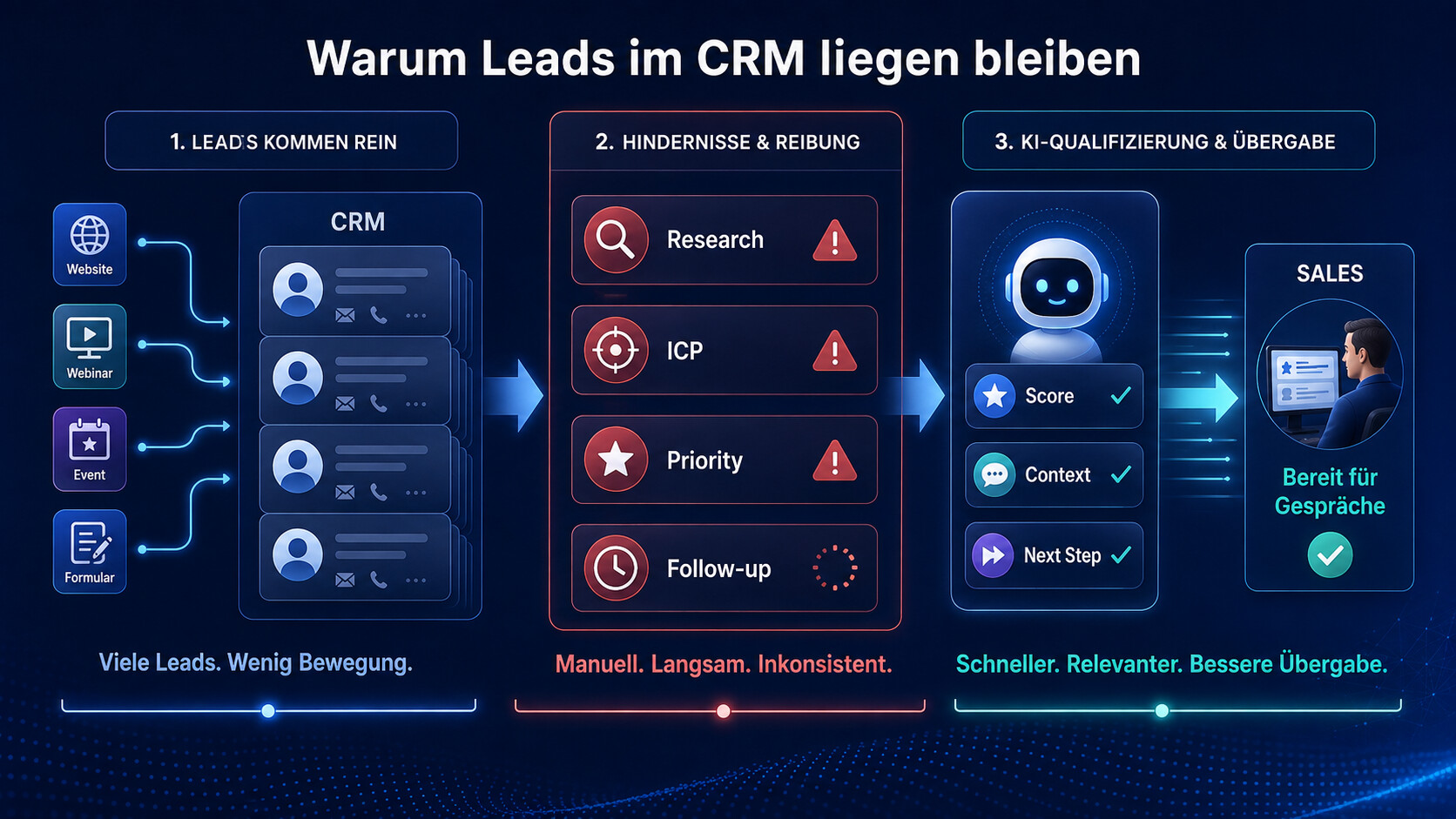
But the real challenge often begins after the conversion. The lead is in the CRM, but no one knows right away whether it’s truly relevant. Sales has to do research, gather additional information, assess the priority, draft an initial “ Message ,” and decide whether it’s worth the effort. That’s exactly where many companies waste time.
Customer engagement doesn't start with the sales pitch. It begins the moment a potential customer shows interest.
Why Leads Often Move Too Slowly in the CRM
A new lead isn't necessarily a sales opportunity. It's a signal. This signal must be understood, evaluated, and acted upon.
In practice, this is often done manually. A salesperson reviews company information, looking at industry, size, location, recent news, potential needs, and appropriate points of contact. Based on this, a decision is made as to whether the lead is relevant and how the initial outreach should be structured.
The problem: This process competes with ongoing deals, client meetings, proposals, forecasts, and internal coordination. As a result, high-potential leads are sometimes processed too late. Low-potential leads, on the other hand, take up unnecessary time.
Microsoft describes this very challenge: Sales teams often have trouble keeping up with the volume of incoming leads from websites, events, and webinars. This results in missed opportunities and unused leads in the CRM. The Sales Qualification Agent in Dynamics 365 Sales is designed to automate lead research and qualification so that teams can focus more on the best leads. Source: Microsoft Learn.
The real bottleneck isn't the lead. It's the initial evaluation.
Many companies try to generate more leads. That's understandable. But more leads don't solve the problem if the quality behind them doesn't scale.
A lead qualification agent changes this logic. It not only helps manage a data record but also addresses the questions: Is this lead relevant? Why is it relevant? And what should happen next?
| Traditional Lead Generation Process | AI-Powered Lead Qualification |
|---|---|
| A lead is created in the CRM | Leads are researched automatically |
| Salespeople conduct manual research | Agent checks for a match with the target customer profile |
| Priority is subjective | Leads are evaluated based on defined criteria |
| Outreach is drafted manually | An email draft or message is being prepared |
| The handover is often unstructured | Leads are passed on to Sales along with their context |
The benefit does not come from an agent “automating more.” The benefit comes from the fact that the sales team can start working with better information sooner.
What a Sales Qualification Agent Actually Does
Microsoft describes two operating modes for the Sales Qualification Agent: "Research-only mode" and "Research and engage mode."
In Research-only mode, the agent researches leads, assesses their fit with the target customer profile, provides information such as company data, financial health, and current news, and drafts an outreach email. In "Research and Engage" mode, the agent can also qualify leads based on the target customer profile and BANT criteria, send personalized outreach emails, respond to replies, send follow-ups, and hand off leads to sales representatives if there is a positive buying interest. Source: Microsoft Learn.
That's an important distinction. It's not just about data enrichment. It's about a structured transition from a lead to a qualified sales opportunity.

Why This Is Relevant to Customer Engagement
Customer engagement is often associated with marketing automation, campaigns, or service processes. But in B2B, the lead phase is a particularly critical moment.
A potential customer has shown interest—perhaps through a webinar, a form, a demo request, or a content download. If the company responds slowly, generically, or inappropriately, the quality of the relationship will suffer even before the first conversation takes place.
A lead qualification agent can help here because it makes context available more quickly. Sales teams don't have to start from scratch. They can see more quickly why a lead might be of interest, what information is relevant, and what the next logical step should be.
In this context, effective customer engagement doesn't mean more communication. It means greater relevance at the right moment.
Why Target Customer Profiles and Data Quality Remain Critical
A lead qualification agent is only as good as the logic they use. If the target customer profile is vague, the assessments will be vague as well. If CRM data is out of date, context is missing. If industries, segments, regions, product interests, or exclusion criteria aren’t clearly defined, priorities will be set incorrectly.
In the configuration, Microsoft notes that administrators must enter company details, products, the target customer profile, and other settings so that the agent can be tailored to the sales strategy and goals. Source: Microsoft Learn.
This isn't just a technical detail. It's a strategic prerequisite. An agent can only effectively screen candidates if the company knows which customers are truly a good fit.
Why 2026 Is a Good Time to Address This Issue
In 2026, Dynamics 365 Sales will evolve significantly toward agent-driven sales processes. Microsoft describes Dynamics 365 Sales in Release Wave 1 2026 as evolving from a “system of record” to a “system of action.” Copilot, AI, and autonomous agents will be embedded directly into the sales workflow to enrich data, analyze signals, and prioritize key actions. Source: Microsoft Learn.
Among the planned features for Dynamics 365 Sales 2026, Microsoft lists personalized outreach emails via the Sales Qualification Agent, Lead Research and Next Best Actions in Sales Home, prioritization of hot leads, multiple Sales Qualification Agents in a single environment, and agent-based scoring across various data sources. Source: Microsoft Learn.
This clearly points the way: CRM is becoming less of a filing system and more of an active workspace for sales.
What Companies Should Do to Prepare
The discussion shouldn't start with the question of which agent function can be activated. A better question is where leads are getting stuck today.
Which lead sources generate a large number of leads, but ones that are poorly qualified? Which leads are processed too late? Where do salespeople find themselves looking up the same information over and over again? Which criteria truly determine quality? Which aspects of the handoff from marketing to sales are unclear today?
| Preparation | Why It's Important |
| Define the Target Customer Profile | so that the agent can evaluate the fit appropriately |
| Analyze Lead Sources | so that not every lead is treated the same way |
| Define Qualification Criteria | so that prioritization remains transparent |
| Define Outreach Rules | so that communication remains relevant and controlled |
| Clarify the handover process | so that Sales knows when and why a lead is being handed off |
| Review Governance | so that automation does not communicate in an uncontrolled manner |
Especially in B2B, automation shouldn't mean that every lead is contacted automatically right away. What matters is which leads are qualified enough, what the context is, and when a human should take over.

How This Changes Things for Sales and Marketing
This provides marketing with greater clarity on which campaigns actually generate qualified leads. Not every conversion is equally valuable. When lead qualification becomes more structured, marketing can better identify which sources contribute to a relevant pipeline.
This reduces the amount of manual preparatory work for the sales team. Salespeople don't have to research every lead from scratch; instead, they can start with a better understanding of the context. This saves time and improves the quality of the initial interaction.
This creates greater transparency for management. When lead evaluation, handoffs, and follow-ups are conducted in a more structured manner, it becomes clear where the pipeline is generated, where leads get stuck, and which criteria are truly effective.
Conclusion: The first contact should not be left to chance
Many companies don't lose business because they have too few leads. They lose business because good leads are identified too late, poorly prioritized, or approached in a way that's too generic.
A lead qualification agent cannot solve this problem on their own. But they highlight what modern customer engagement processes require: clear target customer profiles, high-quality CRM data, defined qualification criteria, relevant messaging, and seamless handoffs between marketing and sales.
CRM thus becomes more than just a place to store leads. It becomes a system that recognizes signals, provides context, and prepares the sales team for the next logical steps.
Those who understand leads more quickly can engage customers earlier and in a more relevant way. That’s exactly where modern customer engagement begins.
FAQ
What is a lead qualification agent?
A Lead Qualification Agent is an AI agent that researches, evaluates, and prepares leads for the sales team. In Dynamics 365 Sales, the Lead Qualification Agent can, among other things, analyze leads, provide information, create email drafts, and hand off qualified leads to salespeople.
Why is lead qualification important for customer engagement?
Customer engagement begins as soon as a potential customer shows initial interest. If leads are followed up on too late or without context, the relevance of the outreach decreases. Better lead qualification helps you respond more quickly and appropriately.
Does a sales qualification agent replace the salesperson?
No. Microsoft explicitly states that the agent does not replace human judgment and decision-making. It supports research, evaluation, and engagement so that salespeople can focus more on relevant leads. Source: Microsoft Learn.
What is the difference between "Research-only mode" and "Research and engage mode"?
In "Research-only" mode, the agent researches leads, assesses their fit, and creates email drafts. In "Research and engage" mode, the agent can also send outreach messages, respond to replies, conduct follow-ups, and hand off leads to sales representatives if there is positive interest. Source: Microsoft Learn.
What information does a lead qualification agent need?
It is important to have a clear target customer profile, product information, lead sources, qualification criteria, CRM data, and defined handoff rules. Without these fundamentals, the evaluation remains imprecise.
Why is this topic particularly relevant in 2026?
Microsoft is developing Dynamics 365 Sales 2026 to focus more on agent-driven sales processes. Among the features mentioned for Release Wave 1 2026 are Next Best Actions, Sales Qualification Agents, personalized outreach emails, and AI-powered lead prioritization. Source: Microsoft Learn.