Many companies are looking for new talent, even though the right employees have been working there for quite some time. They just aren't visible enough.
That is precisely where one of the most costly HR problems lies: Open positions are advertised externally, recruiting processes begin, budgets are allocated, and teams wait for new hires. At the same time, there are employees within the company who possess the relevant skills, a willingness to learn, or potential for growth.
HR and managers often lack a clear picture of which skills employees possess, what certifications they hold, what training they have completed, what their career goals are, and who is ready for the next step.
Hiring from outside the company costs more than the recruiting budget
External recruitment often seems like the obvious Solution: post a job opening, search for candidates, conduct interviews, and hire. In reality, it is expensive, slow, and fraught with uncertainty.
In its benchmarking data for 2025, SHRM reports an average cost per hire of $5,475 for non-executive roles and $35,879 for executive roles. Additionally, according to SHRM, an average of 26 percent of the HR budget is allocated to recruiting. Source: SHRM
However, direct costs are only part of the equation. SHRM also points out that many employers estimate the actual total cost of a new hire to be three to four times the annual salary when interview time, lost productivity, onboarding, training, and other indirect costs are factored in. Source: SHRM
As a result, external recruitment quickly becomes the standard response—and a costly one at that. This is especially true when internal candidates aren't even considered in the first place.
Employee turnover makes the bill even more expensive
If external hiring does not drive growth but merely compensates for departures, costs continue to rise. Gallup estimates that the cost of replacing a single employee ranges from half to two years’ salary. For a company with 100 employees and an average salary of $50,000, this can result in annual turnover and replacement costs ranging from $660,000 to $2.6 million, according to Gallup. Source: Gallup
These figures aren't just a case for better employee retention. They're also a case for better internal mobility. After all, employees don't always leave a company because they're fundamentally dissatisfied. Often, they leave because they don't see any clear path for further growth within the company.
LinkedIn data shows that employees at companies with high rates of internal hiring stay 41 percent longer than at companies with low rates of internal hiring. Source: LinkedIn
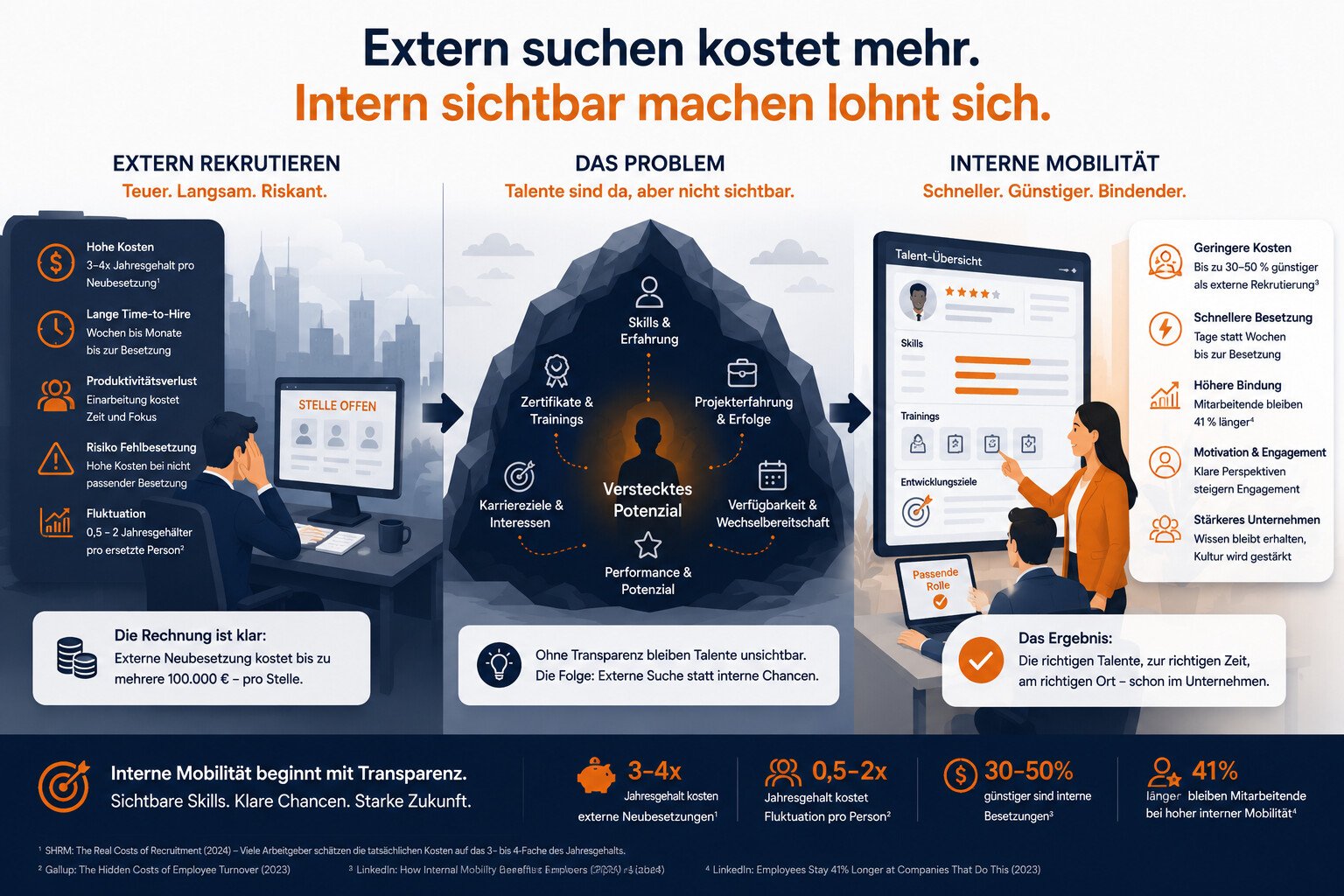

Many companies don't have a recruiting problem. They have a visibility problem.
External recruitment remains important. New perspectives, rare specialized skills, and growth all require external candidates. But many companies look to external sources too quickly because they don't see enough potential within their own ranks.
They know which position is open. But they don’t know which employees within the company have the relevant skills, who is ready for development, which training courses have already been completed, and which individuals could grow into a new role with a little further training.
If this information isn't organized, internal mobility becomes random. Then what matters is who a manager knows, who actively seeks opportunities for development, or who happens to be visible at the right moment. Talented employees who lack visibility within the organization remain untapped.
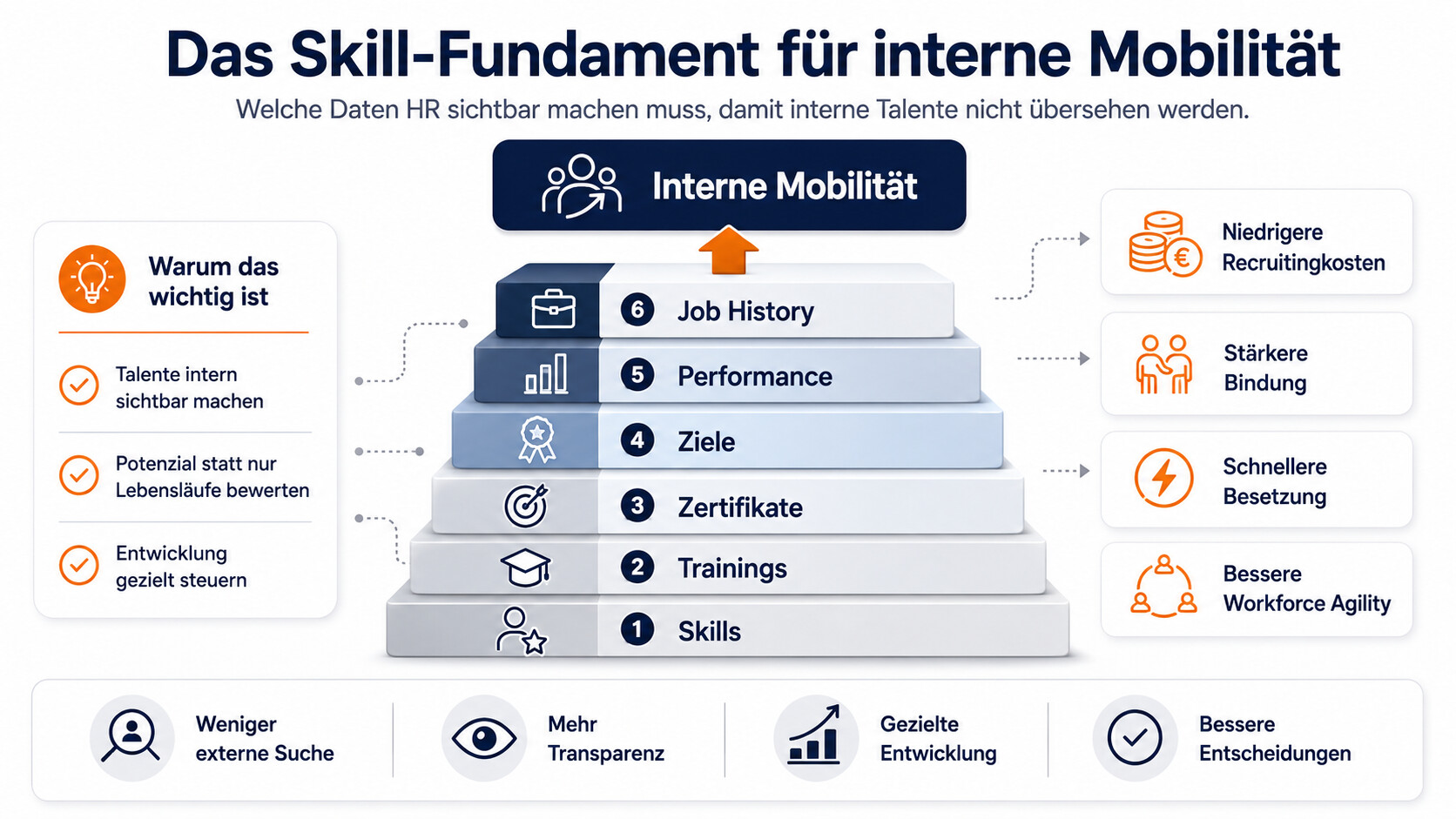
| What HR Needs to Make Visible | Why It Matters |
|---|---|
| Skills and Skill Levels | to identify suitable internal candidates more quickly |
| Training Courses and Certificates | so as not to overlook existing qualifications |
| Project Experience | to better assess actual skills |
| Career Goals | to link development to internal roles |
| Performance and Potential | in order to evaluate more than just current positions |
| Availability | to plan internal transfers realistically |
Without this transparency, an external search becomes a simple solution to an internal data problem.
Internal mobility is more than just an internal job board
An internal job board lists open positions. However, it doesn’t automatically show who would be a good fit, who wants to grow, or what qualifications are still missing. As a result, the responsibility often falls on the employee. Those who actively look may find an opportunity. Those who don’t look remain invisible.
LinkedIn describes this very problem: Internal mobility often operates too passively when companies wait for employees to notice open positions on their own. Source: LinkedIn
Modern internal mobility therefore requires more than just job postings. It requires skill data, career development paths, training information, manager involvement, and HR analytics. Only then can HR determine which roles need to be filled externally and which can be developed internally.
AI and digital transformation are driving up the demand for skills
AI makes this issue even more pressing. Roles are changing more rapidly, tasks are being automated, and new skills are needed. Companies cannot simply purchase every new skill from external sources. The market is often too limited, too expensive, or too slow for that.
Gartner reports that 48 percent of the HR executives surveyed say the demand for new skills is evolving faster than existing talent structures and processes can keep up with. At the same time, only 28 percent of employees say their company places importance on developing existing potential. Source: Gartner
This sends a clear message: HR isn't just about finding new talent. HR must better identify, develop, and mobilize existing skills.
Gartner also emphasizes that companies should focus more on development potential rather than solely on skills that are already fully developed. According to Gartner, employees who are placed in critical roles based on their potential are 1.9 times more likely to be effective than employees who are selected solely on the basis of their current, fully developed skills. Source: Gartner

Where Hubdrive Comes into Play in the Microsoft Environment
This is where the HR software Hubdrive comes into play—but not as an end in itself. Internal mobility requires a robust database of skills, development, training, and potential. It is precisely this foundation that HR must systematically build.
Hubdrive’s Talent & Performance Management solution for Microsoft Dynamics 365 offers features such as performance reviews, talent and skill management, goal setting, 360-degree feedback, training management, professional development, certifications, and job history tracking. These areas are crucial if HR wants to not only manage internal talent but also make it visible.
The focus on skills is particularly important. Hubdrive makes it possible to identify required and existing skills, as well as skill levels, for each employee; to detect skill gaps; and to directly enroll employees in appropriate training programs.
INKUBIT positions Hubdrive as an HR management solution for Microsoft Dynamics 365 designed to attract, retain, and develop talent based on data. Among the features highlighted are AI-powered automation, self-service tools, HR analytics, and data-driven development plans using Copilot. Source: INKUBIT
The point isn't to introduce yet another HR tool. The point is to bring skill transparency into the existing Microsoft ecosystem so that HR, managers, and employees can make better decisions.
How Companies Should Get Started
A good start isn't a major platform initiative. A good start is a simple question: Which roles are we filling externally, even though we might have internal talent available?
Companies should then analyze the past 12 to 24 months. Which positions were filled externally? Which of those could have been filled internally? Which employees left because of a lack of development opportunities? Which teams have recurring skill gaps?
This leads to a concrete starting point:
| Introduction | Goal |
| Skill Inventory for Critical Roles | Highlight existing skills |
| Talent Review for Key Areas | Recognizing Potential and Willingness to Grow |
| Training and Certification Overview | Making Better Use of Qualifications |
| Internal Candidate Matching | Review open positions internally first |
| Manager Dashboard | Involve managers more closely |
| HR Analytics on Turnover and Mobility | Making Costs, Risks, and Opportunities Measurable |
Internal mobility requires clear processes, reliable data, and leaders who facilitate development rather than hinder it.
Conclusion: If you don't recognize internal talent, you end up paying twice
The most expensive position is often not the one that's hard to fill. It's the position that's filled from outside the company, even though there was potential within the company.
Companies end up paying twice: for recruiting and for lost development opportunities. They pay with budget, time, lost productivity, and often with employees who leave because they see no prospects for growth within the company.
Internal mobility is therefore not just a “soft” HR initiative. It is an economic lever. Companies that make existing talent visible spend less time searching externally. Companies that make structured use of skills, training, goals, and potential turn HR into an active steering function for growth and transformation.
FAQ
What does internal mobility mean?
Internal mobility refers to the movement of employees within a company—for example, to new roles, teams, projects, or development programs. The goal is to make better use of existing talent and to offer employees internal career opportunities.
Why is internal mobility economically significant?
Filling a position externally incurs direct and indirect costs, including recruiting, interviews, onboarding, training, and lost productivity. At the same time, internal development and internal hiring can strengthen employee retention.
How much does it cost to hire a new employee?
SHRM estimates an average cost per hire of $5,475 for non-executive roles and $35,879 for executive roles in 2025. The total cost may be significantly higher due to indirect factors. Source: SHRM
Why Are Internal Talents Often Overlooked?
Internal talent is often overlooked because skills, certifications, project experience, career goals, and development potential are not clearly visible in a structured way. Without reliable data, internal mobility remains dependent on chance, networks, or individual initiative.
What role do skills play in internal mobility?
Skills form the basis for identifying employees for new roles or projects. What matters most are not only existing skills, but also skill level, willingness to learn, training needs, and development potential.
How can Hubdrive support internal mobility?
Within the Microsoft Dynamics environment, Hubdrive offers features for talent and performance management, skills, goal setting, 360-degree feedback, training management, certifications, and job history tracking. This enables companies to highlight existing talent in a more structured way.
What role does AI play in internal mobility?
AI can help better assess skills, roles, training, and development potential. However, it only works effectively if the underlying HR data is up-to-date, structured, and reliable.