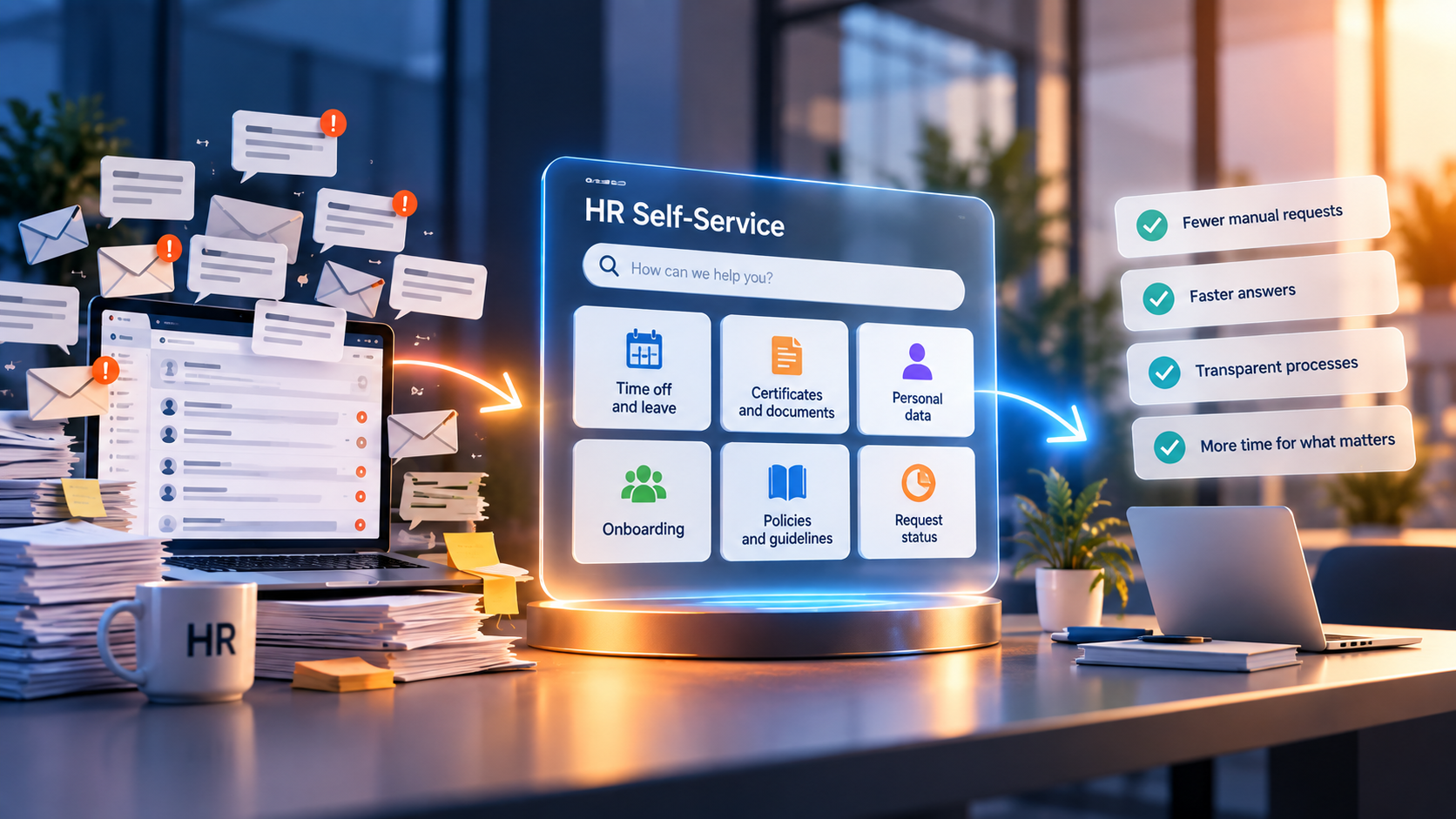
Vacation questions, certificates, master data changes, onboarding information, guidelines, documents and status questions still end up in many HR teams via email or Teams message. Every single request seems small. Together, they block time, attention and quality.
The problem is not that employees ask questions. The problem is that HR has to answer many of these questions manually, even though the answer should have been there long ago. This is exactly where HR self-service becomes relevant: Employees find information, start processes and track requests without HR having to process each query individually.
HR self-service is therefore not a comfort issue. It is an operational lever to relieve HR teams and make processes more reliable.
Why the inbox is not an HR process
An inbox is fast, flexible and familiar. This is exactly why it is used so often in HR and employee management . However, it is not a good process system. Inquiries disappear in individual email threads, responsibilities remain unclear and status information has to be requested manually. If employees ask the same question several times, HR answers them several times.
This creates a cycle of queries, forwarding and manual searches. HR then does not work on the most important topics, but on the management of information that should actually be available in a structured way.
This becomes particularly problematic when several people are involved. A request to change the contract concerns HR, managers and perhaps finance. An onboarding question concerns HR, IT and the department. A certificate must be created, checked and sent. Without a clear process, it quickly turns into an e-mail ping-pong.
Which inquiries HR answers manually again and again
Many HR requests are recurring. They differ in detail, but follow similar patterns. That’s exactly why they lend themselves to self-service, clear workflows, and better knowledge delivery.
| Inquiry | Typical problem without self-service |
|---|---|
| Vacation and absence questions | Employees manually query status, remaining days or rules. |
| Certificates | HR creates documents individually and has to clarify queries. |
| Master Data Changes | Changes arrive unstructured by e-mail. |
| Onboarding | New employees look for information in several places. |
| Guidelines | HR answers the same questions about processes and rules multiple times. |
| Documents | Contracts, proofs or forms are requested manually. |
| Status questions | Employees ask questions because the process is not visible. |
These requests are not unimportant. But they should not have to be processed from scratch every time.
Self-service doesn’t mean leaving employees alone
HR self-service is sometimes misunderstood. It’s not about fobbing off employees with a portal or removing HR from the process. Good self-service processes make the right path easier.
Employees should know where to find information, what data is needed, how a process starts and what happens next. HR remains responsible for quality, rules and sensitive cases. But HR does not have to answer every standard question personally.
The difference is important. Poor self-service simply shifts work to employees. Good self-service reduces uncertainty, accelerates processes and makes HR more transparent.

Why HR Data, Documents, and Workflows Belong Together
HR self-service only works if the underlying information is correct. A portal alone solves little if guidelines are outdated, master data is incomplete or documents are stored in different repositories.
HR therefore needs not only an interface, but a clear structure: What information is binding? Which documents belong to which process? Which data are employees allowed to change themselves? Which requests need approvals? Which cases need to escalate to HR?
Only when data, documents and workflows work together does self-service become reliable. Then a request can not only be made, but also processed and understood cleanly.
Where HR self-service makes an impact first
The best start is not the most complex process. HR should start where many recurring inquiries arise and the technical process is easy to describe.
Simple status queries, document requests, master data changes, onboarding information and frequently asked questions about guidelines are particularly suitable. These topics quickly relieve HR without having to automate highly complex special cases immediately.
Clear prioritization is important. HR self-service should not start with a large portal project that wants to solve everything at the same time. It is better to start pragmatically with a few processes that occur frequently and measurably tie up time.
Why AI only makes sense with clean self-service
AI can answer HR queries faster, summarize documents or guide employees through processes. But AI only becomes helpful if the basics are right.
If policies are contradictory, documents are outdated, or responsibilities are not clearly defined, AI exacerbates these problems. Then answers become faster, but not necessarily better.
Clean HR self-service creates the basis for meaningful AI support. Frequently asked questions are structured. Processes are defined. Data is not just in the inbox. Only then can AI really help: as an assistant for employees, as a support for HR and as a navigation aid through internal processes.

How companies should start
Getting started with HR self-service should deliberately remain simple. First, it is analyzed which inquiries reach HR most often. Then the recurring topics are grouped and prioritized. Clear answers are needed for each process: Who is allowed to request something? What information is needed? Who has to approve? When is HR involved? What is the status for employees?
This analysis does not result in an abstract HR digitization project, but a concrete relief plan. Which three processes immediately reduce manual work? What information needs to be updated? Which documents belong in a structured repository? Which workflows need clear responsibilities?
In this way, HR self-service is gradually becoming a real operating model for HR requests.
Conclusion: HR should not be the company’s search service
HR becomes more strategic when operational inquiries do not determine the mailbox every day. This does not mean that HR becomes less accessible. On the contrary, good self-service processes make HR more reliable for employees.
The crucial point is not to automate every request. The crucial point is to structure recurring questions, documents and processes in such a way that HR does not have to do the same work manually over and over again.
HR inquiries do not belong in the inbox. They belong in clear processes, reliable data and self-service that helps employees and relieves HR.
FAQ
What does HR self-service mean?
HR self-service means that employees can call up or start certain HR information, requests and processes independently. These include, for example, document requests, master data changes, guidelines, absences or onboarding information.
Why is HR self-service important?
HR self-service reduces repetitive manual requests and makes processes more transparent. Employees get orientation faster, while HR teams gain more time for more complex and strategic tasks.
Which HR processes are suitable for self-service?
Recurring and easily structurable processes are particularly suitable. These include master data changes, document requests, frequently asked questions, onboarding information, absences and status queries.
Does HR self-service replace personal HR support?
No. HR self-service does not replace personal support for sensitive or complex topics. It ensures that standard questions and simple processes are handled more efficiently.
Why is an HR mailbox not enough?
A mailbox makes inquiries difficult to trace. Status, responsibilities, approvals and documents often remain unstructured. This results in queries, delays and manual rework.
What role can AI play in HR self-service?
AI can support employees with questions, make information easier to find and accompany HR processes. However, this requires clean data, up-to-date documents and clearly defined workflows.