There is a paradoxical feeling in many companies at the moment: the order backlog is growing, sales appear solid - and yet nervousness increases when looking at the account balance. The reason: in times of high costs, rising interest rates and general economic uncertainty, cash flow becomes critical with every incoming and outgoing payment. Ten percent of companies are already experiencing liquidity problems - and 80%* fear that the situation will get worse.
In this environment, liquidity becomes an Achilles' heel: Projects that start today can stall tomorrow - because funds are lacking, payments arrive late or investments are not secured. Traditional tools and Excel models provide a snapshot at best in such situations. What is missing are scenarios, automatic adjustments and real security if the framework conditions change from one day to the next.
Why cash flow planning is essential
Liquidity is more than just a key figure - it determines the ability to act. Right now, it is becoming clear how quickly companies can stumble if they fail to look to the future:
-
Invisible bottlenecks
On paper, turnover is solid, but payments arrive late. Invoices pile up, while salaries and suppliers have to be paid on time. -
Missed opportunities
A planned investment or a strategically important order cannot be started because it is unclear whether the funds are really sufficient. -
Dependence on banks
If you have no transparency about future cash flows, you have to take out short-term loans - often at poor conditions. -
Error-prone Excel models
Manual forecasts are labor-intensive, rarely based on real-time data and at best provide a snapshot. -
Reactive action instead of control
Decisions are only made when the problem is already there - not before.
In this area of tension, it becomes clear that those who do not actively plan liquidity lose the overview and risk projects or growth strategies failing - not because there is no market, but because the money is not available at the wrong time.
Cash flow forecasts as a response to uncertainty
The key question is not whether liquidity problems will occur, but when. In an economic environment characterized by rising costs, geopolitical tensions and fluctuating demand, a snapshot is no longer enough. Companies need a tool that not only shows them where they stand today, but also what they can expect in the coming weeks and months.
This is exactly what cash flow forecasts do: they combine existing financial data with future cash flows and make it clear when bottlenecks arise or scope becomes available. Instead of making decisions blindly, managers are given a basis for securing investments, negotiating credit lines or strategically managing payments.
This transparency is particularly valuable when scenarios can be played out:
What happens if a major customer pays later?
How does a planned investment affect liquidity?
Is the inventory sufficient for additional project financing?
This creates an early warning system that provides planning security - even in an environment characterized by uncertainty.
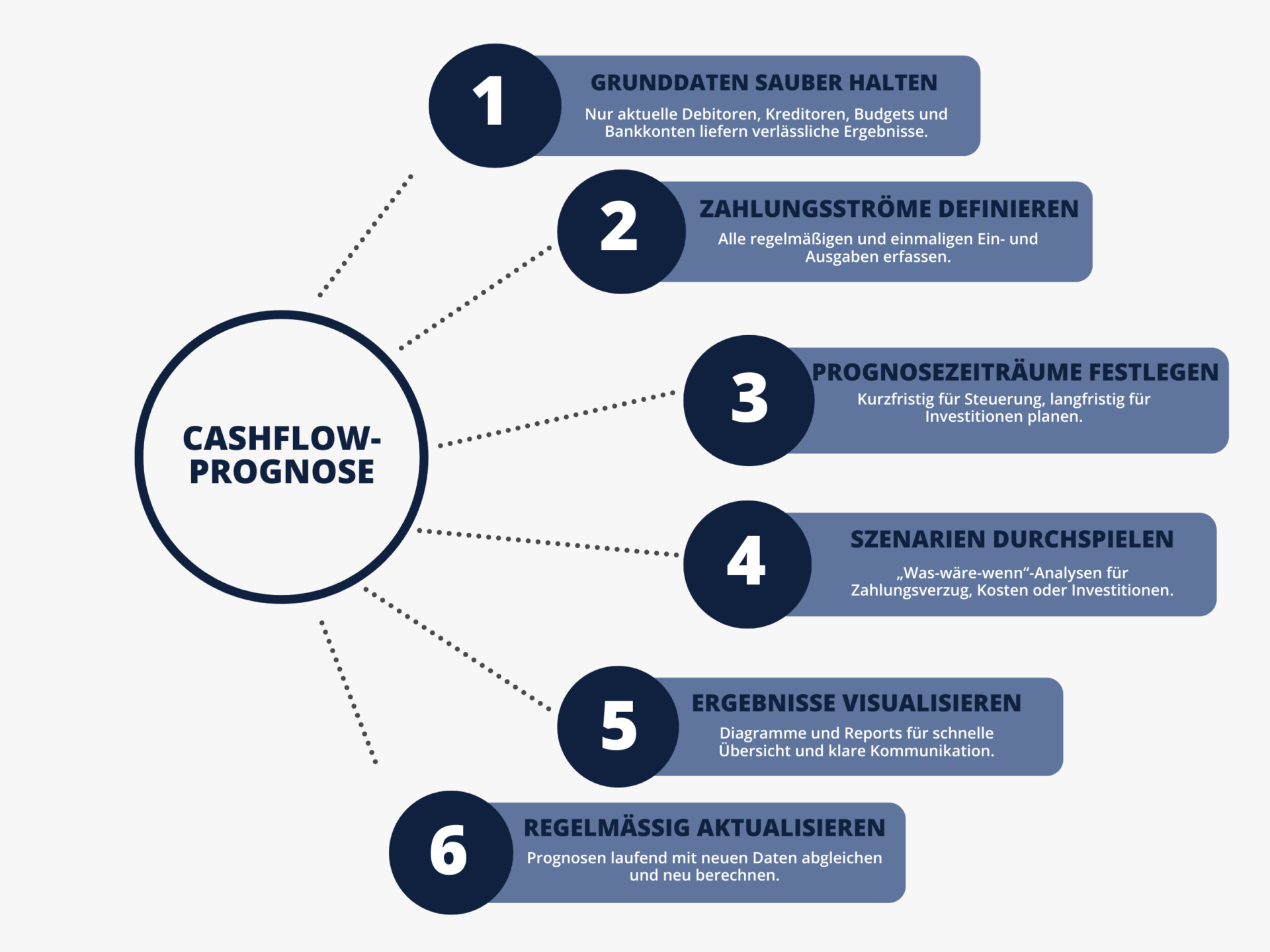

Step by step to the cash flow forecast
Keep basic data clean
A cash flow forecast is only as good as the database. Outstanding debtor and creditor items, current budgets and bank accounts must be maintained completely and correctly. Only then can reliable forecasts be made.
Define cash flows
Which income and expenses flow regularly, and which are one-off or project-related? This includes, for example, customer invoices, salaries, rents, supplier liabilities or planned investments. A clear structure prevents important items from being overlooked.
Define forecast periods
Not every forecast has to cover twelve months. A horizon of four to eight weeks is often sufficient for short-term management. For investment decisions, it is advisable to take a longer look ahead - including seasonal fluctuations.
Play through scenarios
Especially in uncertain times, it is crucial to simulate various "what-if" scenarios:
-
Late payment by important customers
-
Unexpected cost increases
-
New projects or investments
-
Financing through loans or leasing
Visualize results
A forecast only unfolds its full value when it is clearly understandable. Diagrams and reports help to identify trends immediately and present them to management or banks in a comprehensible way.
Regular updating
Liquidity planning is not a one-off project. Only if forecasts are continuously compared with current data and recalculated will the company remain manageable.
Strategic added value for companies
A well-prepared cash flow forecast delivers far more than just a bottom-line figure. It becomes a management tool for the entire company:
-
Planning security for management
Decisions on investments, new projects or staff expansion are based on reliable data rather than gut feeling. -
Early warning system for risks
Bottlenecks become visible before they become critical - allowing countermeasures to be taken in good time. -
Stronger negotiating position with banks and investors
Those who can present transparent forecasts at any time secure trust and better conditions. -
Optimized use of resources
Liquid funds can be used specifically where they will have the greatest strategic effect. -
Competitive advantage
Companies that actively integrate cash flow planning into their management are more resilient and can exploit opportunities faster than the competition.
In short, a reliable cash flow forecast provides clarity, certainty and speed - the three factors that make the difference in uncertain markets.
Conclusion: Liquidity determines growth
Uncertain markets, rising costs, changing payment terms - all this makes cash flow the most critical key figure in a company. Anyone who relies on Excel spreadsheets or late reports risks missing opportunities or running into bottlenecks.
A structured cash flow forecast provides the planning security that companies need: for investments, for negotiations with banks and for sustainable growth.
Want to know more about cash flow forecasts in Dynamics 365 Business Central? Read all about it in our article: Automated cash flow forecasts in Business Central.
👉 In 15 minutes, let's briefly discuss how cash flow forecasts can support your company.
*Source: Handelsblatt GmbH, 2025